Within Balloons
The Airspace Rules Behind Mystery Balloons
Balloon regulations reveal that unmanned free balloons are real airspace objects, not toys, and some must be tracked and reported.
On this page
- Which balloons are regulated as airspace hazards
- Why tracking and reporting matter after recovery
- How rules help test a balloon explanation
Page outline Jump by section
Introduction
Many UFO crash stories begin with a simple observation: something came down from the sky and left recoverable debris. What is often overlooked is that high-altitude balloons are not merely hobby objects. Under aviation law, many are treated as regulated airspace users whose launches, flight paths, equipment and recovery risks are subject to formal rules. Those rules exist because balloons can travel through controlled airspace, cross national borders and return to Earth carrying payloads. When investigators encounter unusual debris, flight records, notifications and tracking data associated with balloon operations can provide a practical way to test whether a reported “crash” was actually the end of a legitimate balloon flight.[ecfr.gov]ecfr.gov14 CFR Part 101 Subpart D – Unmanned Free Balloons(b) No person may operate an unmanned free balloon below 60,000 feet standard pres…
 Within the broader history of UFO crashes, balloon regulations matter because they create documentation trails. A genuine mystery object may leave little trace. A regulated balloon operation, by contrast, may generate launch notices, position reports, payload markings, tracking records and recovery expectations that can be checked against witness claims.[cornell.edu]law.cornell.eduLegal Information Institute14 CFR Part 101§ 101.33 Operating limitations. § 101.35 Equipment and marking requirements. § 101.37 Notice requirements. § 101.39 Balloon position…R…
Which Balloons Are Regulated as Airspace Hazards?
A common misconception is that all balloons are treated the same. Aviation authorities distinguish between small meteorological balloons and larger unmanned free balloons capable of presenting risks to aircraft or people on the ground. Internationally, the International Civil Aviation Organization (ICAO) classifies unmanned free balloons into categories such as light, medium and heavy, with different operational requirements attached to each class.[admin.ch]bazl.admin.chBazl Annex 2Annex 2 - BAZL28 Nov 2024 — — Unmanned free balloons are classified as heavy, medium or light in accordance with specifications conta…
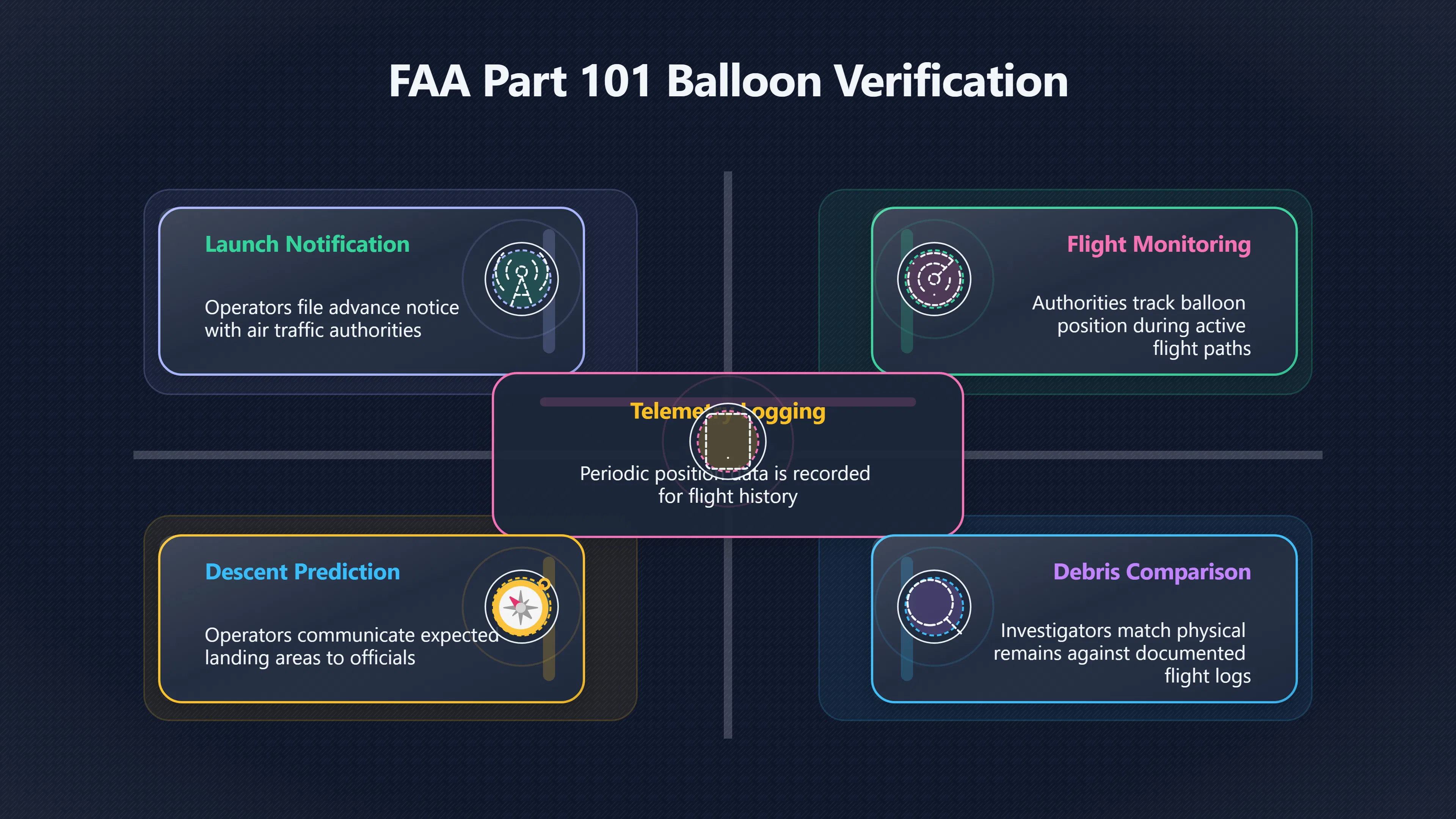
In the United States, Federal Aviation Administration (FAA) rules place certain high-altitude balloon systems under Part 101 regulations. Larger payloads trigger additional requirements involving flight notifications, equipment standards and operational limitations. Operators may be required to provide advance notice to air traffic authorities and comply with restrictions designed to reduce collision and impact hazards.[ecfr.gov]ecfr.gov14 CFR Part 101 Subpart D – Unmanned Free Balloons(b) No person may operate an unmanned free balloon below 60,000 feet standard pres…
Several regulatory themes recur across jurisdictions:
- Balloon operations must not create hazards to aircraft, people or property.
- Heavier balloon systems face stricter requirements than lightweight meteorological launches.
- Certain flights require prior authorisation or notification.
- Equipment standards may include visibility aids, markings, lighting or flight-termination systems.
- Operators are expected to manage the risk posed by the eventual descent of the balloon and its payload.[cornell.edu]law.cornell.eduLegal Information Institute14 CFR § 101.7No person may operate any moored balloon, kite, amateur rocket, or unmanned free balloon in a manner that creates a hazard to other perso…
This regulatory treatment reflects a basic reality: authorities regard some balloons as aviation objects capable of affecting other airspace users. That status alone makes them more relevant to crash investigations than many witnesses realise.
Why Tracking and Reporting Matter After Recovery
One reason balloon debris can become entangled in UFO crash narratives is that recovered material often appears disconnected from its flight history. Regulations attempt to reduce that problem by requiring operators to maintain awareness of where certain balloons are and where they are expected to come down.[Legal Information Institute]law.cornell.eduLegal Information Institute14 CFR Part 101§ 101.33 Operating limitations. § 101.35 Equipment and marking requirements. § 101.37 Notice requirements. § 101.39 Balloon position…R…
For regulated unmanned free balloons in the United States, operators may have to provide advance notification before launch and monitor the balloon during flight. Position information can be recorded periodically, and air traffic authorities may request updates. Some guidance also requires operators to report loss of tracking and to communicate projected descent areas.[cornell.edu]law.cornell.eduLegal Information Institute14 CFR Part 101§ 101.33 Operating limitations. § 101.35 Equipment and marking requirements. § 101.37 Notice requirements. § 101.39 Balloon position…R…
International rules follow a similar logic. ICAO standards include provisions covering flight notification, position recording and operational coordination for larger balloon classes. The goal is not merely air traffic safety; it is also accountability. If a balloon later lands unexpectedly or its debris is recovered, investigators have a documented flight to compare against the physical evidence.[studocu.com]studocu.comICAO Annex 2: Rules of the AirICAO Annex 2: Rules of the Air - Amendments Record…Classification of unmanned free balloons APP 5- · General operating rules AP…
This documentation can be valuable when witnesses describe:
- A falling object seen at high altitude.[wiki.kscucf.org]wiki.kscucf.orghigh altitude free balloonsKSC WikiHigh Altitude Free Balloons3 May 2026 — Every Unmanned Free Balloon must notify the nearest FAA ATC facility of the following wit…
- Debris spread across a field.
- Electronic equipment attached to unfamiliar materials.
- Recovery activity by officials or contractors.
- Reports that an object crossed long distances before landing.
Each of those features can occur in ordinary balloon operations. Tracking records help determine whether a known balloon was present in the area before more exotic explanations are considered.[kscucf.org]wiki.kscucf.orghigh altitude free balloonsKSC WikiHigh Altitude Free Balloons3 May 2026 — Every Unmanned Free Balloon must notify the nearest FAA ATC facility of the following wit…

Why Balloon Recoveries Sometimes Look Like Crash Sites
The public often associates aircraft crashes with large, recognisable wreckage. Balloon recoveries can be more confusing because the recovered material rarely resembles a complete vehicle.
A high-altitude balloon may burst tens of kilometres above the Earth. The envelope, suspension lines, parachute and payload can descend separately or become scattered over a wide area. By the time someone discovers the remains, the original configuration may be impossible to recognise. Lightweight materials, electronics, reflective surfaces and tangled cords can appear unusual when removed from their operational context.[Skybrary]skybrary.aeroSome States have developed further requirements and…Read more…
Regulators are aware of this descent problem. Rules addressing impact hazards, payload design and flight termination exist precisely because balloon systems are expected to return to Earth. The existence of such rules is a reminder that debris recovery is not evidence of a failed spacecraft; it is an anticipated phase of many balloon missions.[cornell.edu]law.cornell.eduLegal Information Institute14 CFR § 101.7No person may operate any moored balloon, kite, amateur rocket, or unmanned free balloon in a manner that creates a hazard to other perso…
Historically, confusion becomes more likely when the public encounters only fragments of information. Witnesses may see unusual debris without knowing that a launch occurred. Others may learn that authorities tracked an object, incorrectly assuming that tracking implies extraordinary significance. In reality, tracking is often a normal regulatory requirement for certain balloon operations.[faa.gov]faa.govSection 6. Unmanned Free BalloonsOperators of unmanned free balloons are required to monitor the course of the balloon and record its…
How Rules Help Test a Balloon Explanation
When evaluating a reported UFO crash, balloon regulations provide a practical investigative checklist rather than a speculative theory.
A balloon explanation becomes stronger when investigators can identify evidence such as:
- A documented launch within the relevant time window.
- Required notifications filed with aviation authorities.
- Recorded flight-path or telemetry data.
- Payload markings consistent with regulatory requirements.
- Predicted landing areas that match the recovery location.
- Recovery procedures expected for the type of balloon involved.[cornell.edu]law.cornell.eduLegal Information Institute14 CFR Part 101§ 101.33 Operating limitations. § 101.35 Equipment and marking requirements. § 101.37 Notice requirements. § 101.39 Balloon position…R…
Conversely, a balloon explanation becomes weaker if no documented operation can be identified despite extensive searching, or if the recovered material conflicts with known balloon construction and operational requirements.
The key point is methodological. Regulations transform balloons from anonymous objects into traceable airspace participants. Because some high-altitude balloons must be authorised, monitored, reported and recovered under formal rules, investigators often have more avenues for verification than they do in many other UFO crash claims. The existence of those regulatory records does not automatically solve every case, but it provides a structured way to distinguish a routine balloon recovery from a genuinely unexplained incident.[caa.co.uk]regulatorylibrary.caa.co.ukRegulatory Library2GENERAL OPERATING RULES - Aviation Regulation Library2.1. An unmanned free balloon shall not be operated without authorisation from the S…
Amazon book picks
Further Reading
Books and field guides related to The Airspace Rules Behind Mystery Balloons. Use these as the next step if you want deeper reading beyond the article.
eBay marketplace picks
Marketplace Samples
Live-tested eBay searches with available results related to this page.



Endnotes
1.
Source: ecfr.gov
Link:https://www.ecfr.gov/current/title-14/chapter-I/subchapter-F/part-101/subpart-D
Source snippet
14 CFR Part 101 Subpart D -- Unmanned Free Balloons(b) No person may operate an unmanned free balloon below 60,000 feet standard pres...
2.
Source: skybrary.aero
Link:https://skybrary.aero/articles/unmanned-free-balloons
Source snippet
Some States have developed further requirements and...Read more...
3.
Source: faa.gov
Link:https://www.faa.gov/air_traffic/publications/atpubs/atc_html/chap9_section_6.html
Source snippet
Section 6. Unmanned Free BalloonsOperators of unmanned free balloons are required to monitor the course of the balloon and record its...
4.
Source: scribd.com
Title: Unmanned Free Balloons Classification & Rules | PDF1
Link:https://www.scribd.com/document/684656870/Apendix5-annex2-1-Unmanned-Ballons
Source snippet
Classification of unmanned free balloons · 2. General operating rules · 3. Operating limitations and equipment requirements · 3.3 A heavy...
5.
Source: stratoflights.com
Link:https://www.stratoflights.com/en/tutorial/weather-balloon-registration-insurance/usa/
Source snippet
art 101 Subpart D applies. This introduces significantly more...
6.
Source: govinfo.gov
Link:https://www.govinfo.gov/content/pkg/CFR-2011-title14-vol2/pdf/CFR-2011-title14-vol2-sec101-35.pdf
Source snippet
900 Subpart D—Unmanned Free BalloonsJul 6, 2009 — (e) In such a manner that impact of the balloon, or part thereof including its payload...
7.
Source: studocu.com
Title: ICAO Annex 2: Rules of the Air
Link:https://www.studocu.com/row/document/king-ceasor-university/art-history/an02-10ed-amend-46-annex-4/57892765
Source snippet
ICAO Annex 2: Rules of the Air - Amendments Record...Classification of unmanned free balloons APP 5- · General operating rules AP...
8.
Source: faa.gov
Link:https://www.faa.gov/
9.
Source: faa.gov
Title: Section 5
Link:https://www.faa.gov/air_traffic/publications/atpubs/foa_html/chap19_section_5.html
Source snippet
Moored Balloons, Kites, Parasail, Unmanned...Apply the following guidelines to moored balloon, kite, parasail, unmanned rocket, or unman...
10.
Source: faa.gov
Link:https://www.faa.gov/media/108586
Source snippet
Part 101 Modernization Aviation Rulemaking Committee...Jan 12, 2026 — Guidelines for Processing Requests to 14 CFR part 101, Subpart D U...
11.
Source: ecfr.gov
Link:https://www.ecfr.gov/current/title-14/chapter-I/subchapter-F/part-101
Source snippet
e balloon in a manner that creates a hazard to other persons, or their...Read more...
12.
Source: studocu.vn
Title: ICA O Annex 2: Rules of the Air
Link:https://www.studocu.vn/vn/document/truong-dai-hoc-su-pham-thai-nguyen/sdsxv-fsdsd/icao-annex-2-rules-of-the-air-tenth-edition-july-2005/134207145
Source snippet
ICAO Annex 2: Rules of the Air - Tenth Edition (July 2005)This document outlines the International Standards and Recommended Practices fo...
Published: July 2005
13.
Source: scribd.com
Link:https://www.scribd.com/document/929778080/An02-Cons-9th
Source snippet
ICAO Annex 2: Rules of the Air | PDF4 Dropping or spraying. 3.1.9 Unmanned free balloons. Nothing shall be dropped or sprayed from an air...
14.
Source: icao.int
Link:https://www.icao.int/sites/default/files/APAC/Meetings/2025/2025%20UAS%20WS/02-Presentation/Day%201/Day%201%20-%209.ICAO%20Standard%20and%20Recommended%20Practices%20for%20Remotely%20Piloted%20Aircraft%20Systems%20%28SARPs%20-%20RPAS%29.pdf
Source snippet
RPASAnnex 2 – Rules of the Air. Sets the “general” rules for the aviation to fly, such as: ➢Flight Rules, VFR or IFR;. ➢Collision Avoidan...
15.
Source: ecfr.io
Link:https://ecfr.io/Title-14/Part-101
Source snippet
Part 101—Moored Balloons, Kites, Amateur Rockets, and...Browse 14 CFR Part 101, Moored Balloons, Kites, Amateur Rockets, and Unmanned Fr...
16.
Source: law.cornell.edu
Title: Legal Information Institute14 CFR Part 101
Link:https://www.law.cornell.edu/cfr/text/14/part-101/subpart-D
Source snippet
§ 101.33 Operating limitations. § 101.35 Equipment and marking requirements. § 101.37 Notice requirements. § 101.39 Balloon position...R...
17.
Source: regulatorylibrary.caa.co.uk
Title: Regulatory Library2
Link:https://regulatorylibrary.caa.co.uk/923-2012/Content/Regs/04260_2._GENERAL_OPERATING_RULES.htm
Source snippet
GENERAL OPERATING RULES - Aviation Regulation Library2.1. An unmanned free balloon shall not be operated without authorisation from the S...
18.
Source: bazl.admin.ch
Title: Bazl Annex 2
Link:https://www.bazl.admin.ch/dam/en/sd-web/g31otudiZUFM/icao_annex_2_rulesoftheair.pdf
Source snippet
Annex 2 - BAZL28 Nov 2024 — — Unmanned free balloons are classified as heavy, medium or light in accordance with specifications conta...
19.
Source: law.cornell.edu
Title: Legal Information Institute14 CFR § 101.7
Link:https://www.law.cornell.edu/cfr/text/14/101.7
Source snippet
No person may operate any moored balloon, kite, amateur rocket, or unmanned free balloon in a manner that creates a hazard to other perso...
20.
Source: law.cornell.edu
Title: Legal Information Institute14 CFR § 101.35
Link:https://www.law.cornell.edu/cfr/text/14/101.35
Source snippet
Equipment and marking requirements.No person may operate an unmanned free balloon below 60,000 feet standard pressure altitude between su...
21.
Source: wiki.kscucf.org
Title: high altitude free balloons
Link:https://wiki.kscucf.org/ballooning/high-altitude-free-balloons
Source snippet
KSC WikiHigh Altitude Free Balloons3 May 2026 — Every Unmanned Free Balloon must notify the nearest FAA ATC facility of the following wit...
Published: May 2026
22.
Source: standards.globalspec.com
Title: icao annex 2
Link:https://standards.globalspec.com/std/13152000/icao-annex-2
Source snippet
ANNEX 2 - Rules of the AirBalloons are classified as aircraft, but unmanned free balloons can be flown only under specified conditions de...
23.
Source: faraim.org
Title: Part 101
Link:https://faraim.org/faa/far/cfr/title-14/part-101/index-all.html
Source snippet
Complete Text | 14 CFR - Aeronautics and SpaceNo person may operate an unshielded moored balloon or kite more than 150 feet above the sur...
24.
Source: www2.anac.gov.br
Title: anac.gov.brunmanned free balloon
Link:https://www2.anac.gov.br/anacpedia/ing-esp/tr2274.htm
Source snippet
An unmanned free balloon shall not be operated without appropriate authorization from the State from which the launch is made. The me...
Additional References
25.
Source: pilot18.com
Link:https://www.pilot18.com/wp-content/uploads/2017/10/Pilot18.com-ICAO-Annex-2-Rules-of-air.pdf?srsltid=AfmBOoqxTRlg7vdNuQKYXzXPy6COJ6pUF8TpNlKm4UqK9pDUml01oKsu
26.
Source: overlookhorizon.com
Link:https://overlookhorizon.com/flight-safety/
Source snippet
Weather Balloon Safety & RegulationsNo person operating any unmanned free balloon may allow an object to be dropped therefrom, if such ac...
27.
Source: stratoballooning.org
Link:https://www.stratoballooning.org/part-101-rules
Source snippet
It is strongly recommended that groups looking to do a HAB flight read and understand these...Read more...
28.
Source: pilotinstitute.com
Title: This rule also applies to the act of dropping an object from
Link:https://pilotinstitute.com/part-101/
Source snippet
Part 101 Rules: FAA Laws for Kites, Balloons, and Rockets26 Aug 2022 — Part 101 forbids the operations of any moored balloons, or unmanne...
29.
Source: aviation.stackexchange.com
Link:https://aviation.stackexchange.com/questions/107443/14-cfr-part-101-moored-balloons-kites
Source snippet
stackexchange.com14 CFR Part 101 -- Moored Balloons, KitesDec 9, 2024 — I am hoping someone can hep me interpret the Regulations regardin...
30.
Source: launchwithus.com
Link:https://launchwithus.com/lwu-blog/2019/8/6/do-drone-and-uav-laws-apply-to-high-altitude-weather-balloons
Source snippet
Does FAA Part 107 (Drone and UAV Laws) Apply to High...Aug 6, 2019 — Exemption for Part 101 Weather Balloons under Part 107.1(2)...
31.
Source: tile.loc.gov
Title: cfr1976031 T14CIP101
Link:https://tile.loc.gov/storage-services/service/ll/cfr/cf/r1/97/60/31/-T/14/CI/P1/01/cfr1976031-T14CIP101/cfr1976031-T14CIP101.pdf
Source snippet
Balloons, Kites, Unmanned Rockets And...§ 101.7 Hazardous operations. (a) No person may operate any moored balloon, kite, unmanned rocke...
32.
Source: wyomingspacegrant.org
Link:https://wyomingspacegrant.org/balloonprogram/ballooning101/faa/
Source snippet
Wyoming NASA Space Grant ConsortiumFAA Rules and Regulations | High-Altitude Ballooning 101There are four main rules to consider for unma...
33.
Source: anac.pt
Link:https://www.anac.pt/VPT/GENERICO/DRONES/BALOESLIVRES/Paginas/Unmannedfreeballons.aspx
Source snippet
Unmanned free ballons (UFB)16 Mar 2026 — Their operation is subject to the Rules of the Air set out in Appendix 5 of ICAO Annex 2, curren...
34.
Source: launchwithus.com
Title: The blog post below has
Link:https://launchwithus.com/lwu-blog/2016/01/21/high-altitude-weather-balloon-laws-and-regulations
Source snippet
High Altitude Weather Balloon Laws and RegulationsJan 21, 2016 — Under 101.7(b)2, the FAA has clarified that weather balloons under Part...
Topic Tree