Within UFO Crashes
When Balloons Look Like Spaceships
Balloons are a recurring explanation because they can look strange, carry instruments, and leave unusual lightweight debris.
On this page
- Weather balloons and radar reflectors
- High altitude programs and secrecy
- How balloon debris becomes a mystery
Page outline Jump by section
Introduction
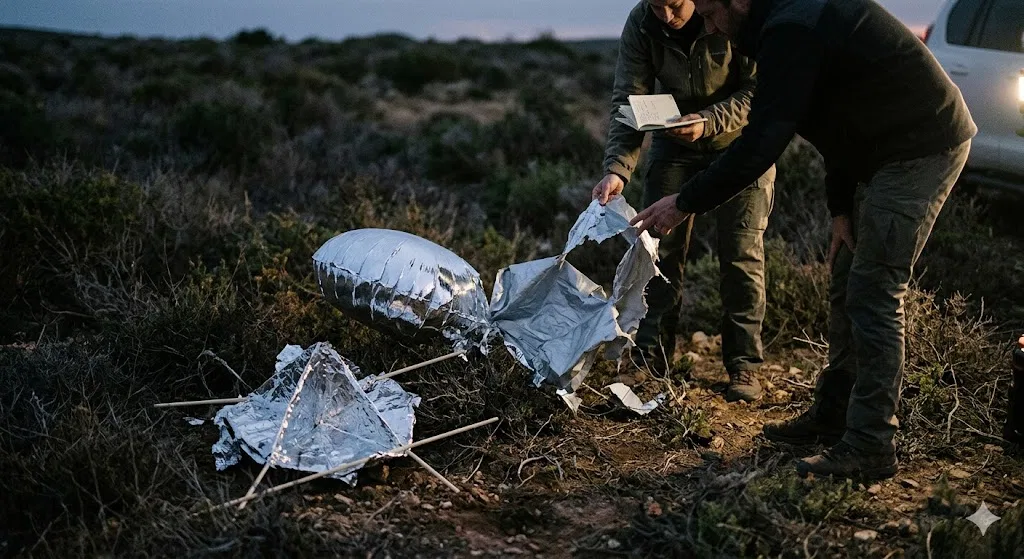
Balloons are one of the most persistent real-world explanations for UFO crash stories because they sit in an awkward middle ground: they are ordinary technology, but they can look and behave in ways that are not obvious to the people who find them. A burst weather balloon, a torn radar reflector, a parachute, foil, sticks, string and a small instrument package can spread into a debris field that looks stranger than household rubbish and less recognisable than aircraft wreckage. In the history of UFO crashes, this matters because the strongest “crash” stories usually promise recoverable material — and balloons are among the few mundane objects that really do fall from the sky and leave recoverable debris.
The balloon explanation is not a universal solvent for every UFO case. It is a mechanism: a way in which unusual aerial equipment can become a mystery after it descends, breaks apart, or is recovered under secrecy. Roswell made that mechanism famous, but modern UAP investigations still resolve some reports as balloons when the object’s shape and movement match lighter-than-air behaviour.[fas.org]sgp.fas.orgProject on Government Secrecy GAO Report on Roswell, NM UFO CrashProject on Government Secrecy GAO Report on Roswell, NM UFO Crash
Why balloon wreckage can look stranger than rubbish
A weather balloon is not just a balloon. In a typical upper-air observation, a large latex balloon carries a radiosonde, a small battery-powered instrument package that measures conditions such as pressure, temperature and humidity as it rises through the atmosphere. National Weather Service guidance notes that recovered radiosonde material may include cotton twine, an orange parachute and shredded balloon remains; people who find one are told to cut the string and dispose of the remaining items responsibly.[National Weather Service]weather.govNational Weather Service Weather Balloon Instrument/Radiosonde InformationNational Weather Service Weather Balloon Instrument/Radiosonde Information
That combination explains why a balloon recovery can feel “crash-like” to a witness. The balloon itself may have burst at high altitude, the parachute may be tangled, the instrument box may be partly smashed, and older systems could include radar-reflective structures that look unlike familiar consumer objects. A person encountering the remains in a field, on a ranch, in woodland or on a beach may see torn rubber, foil-like surfaces, string, sticks, tape, electronics and a parachute without seeing the intact system they once formed.
The effect becomes stronger when the debris is scattered. A balloon that bursts and descends under a parachute may still be dragged by wind, break apart on landing, or be partly collected before anyone documents the site. What later becomes a “debris field” may not require a hard impact, a crater, a propulsion system or a piloted vehicle. It may simply be a lightweight flight train stretched across the ground after a long fall.
This is why balloon cases are important inside the broader UFO crash subject. They show that a “thing fell from the sky” can be true, and still not imply a spacecraft. The central question is not whether there was debris, but whether the debris has features that require an exotic vehicle rather than a known balloon system.
Weather balloons and radar reflectors
Weather balloons are launched because the atmosphere cannot be measured adequately from the ground alone. NOAA describes radiosondes as instruments carried aloft that measure atmospheric conditions and transmit the data back as they rise. In the United States, the National Weather Service says balloons are launched twice daily at 92 sites, including 13 in Alaska, with data transmitters attached.[NOAA]noaa.govOpen source on noaa.gov.
For UFO crash reports, the most relevant parts are not the scientific measurements but the physical leftovers:
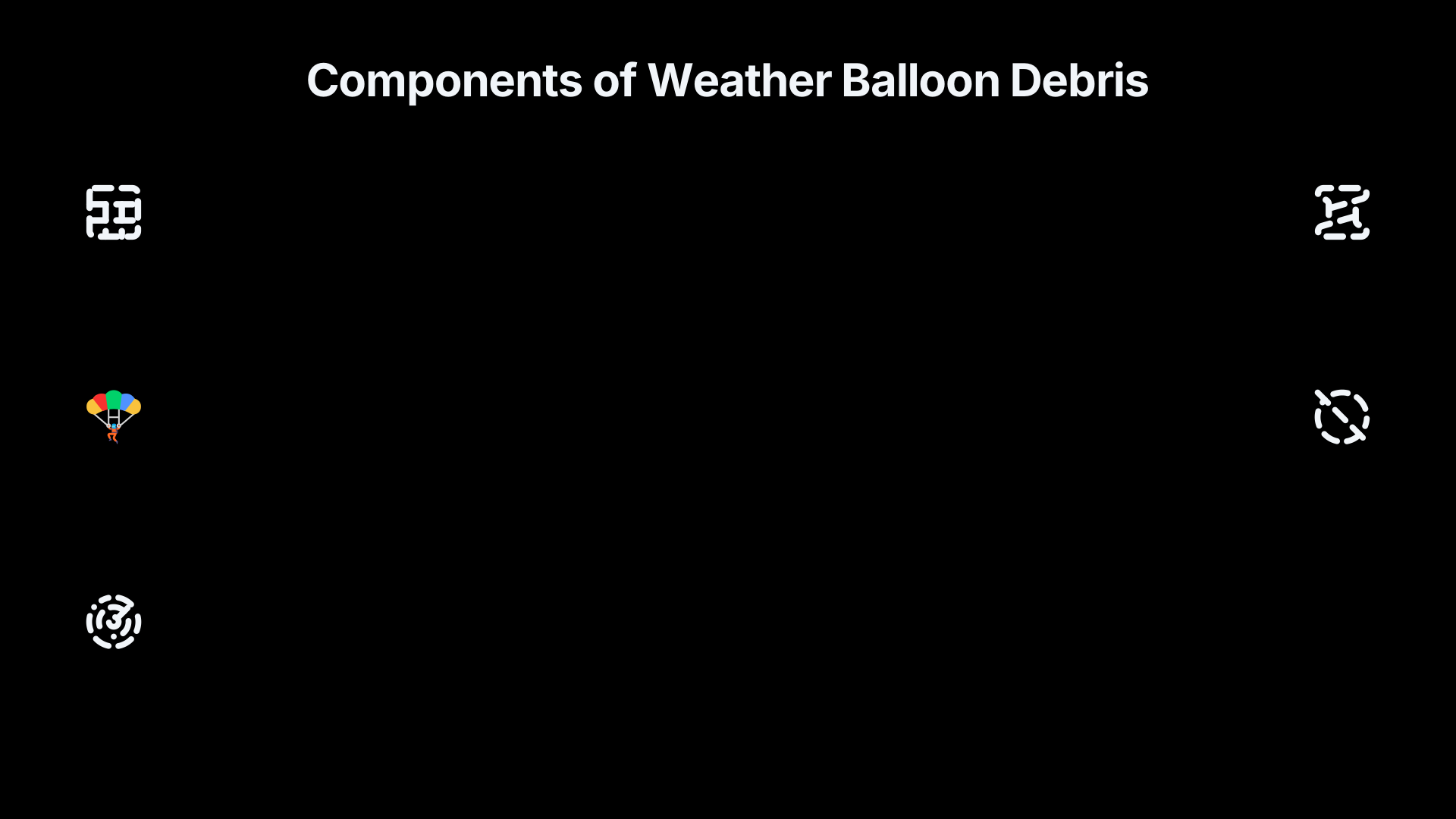
- Balloon skin can become shredded, rubbery or weathered.
- Twine and suspension lines can be mistaken for rigging from an unknown craft.
- Parachutes can look like emergency recovery equipment rather than meteorological hardware.
- Radiosondes may resemble small electronic payloads or unfamiliar boxes.
- Radar reflectors, especially older ones, could use foil-covered surfaces and lightweight frames to make the balloon easier to track by radar.
This last point is especially important. A radar reflector is designed to be conspicuous to radar, not to look familiar to a rancher or passer-by. In older accounts, the combination of thin reflective material and light structural supports often sounds more dramatic in retelling than it is in engineering terms. Foil, paper, tape, balsa-like sticks and angular reflector shapes can be remembered as “metallic” or “manufactured” without being spacecraft material.
The ordinary operation of these balloons also explains why they can appear in remote places. They are launched, rise with the wind, burst or descend, and may land many miles from their launch point. When the label or return instructions are missing, weathered or ignored, the finder may have no obvious context for what has landed.
Roswell shows why secrecy made balloons suspicious
Roswell remains the defining balloon-crash controversy because the official story was both mundane and incomplete. The best documentary trail does not support a recovered alien craft, but it does show why the balloon explanation became distrusted. In 1947, Roswell Army Air Field first announced that it had recovered a “flying disc”, then the explanation quickly shifted to a weather balloon. Decades later, the U.S. Government Accountability Office reviewed records connected with the event and identified a July 1947 FBI teletype discussing the recovery near Roswell of a high-altitude weather balloon with a radar reflector.[FAS Project on Government Secrecy]sgp.fas.orgProject on Government Secrecy GAO Report on Roswell, NM UFO CrashProject on Government Secrecy GAO Report on Roswell, NM UFO Crash
The key complication is Project Mogul. The Air Force’s later position, summarised in the GAO review, was that the recovered wreckage was most likely from one of the Project Mogul balloon trains. Mogul was a classified U.S. effort to use balloons carrying radar reflectors and acoustic sensors to help determine the state of Soviet nuclear weapons research.[FAS Project on Government Secrecy]sgp.fas.orgProject on Government Secrecy GAO Report on Roswell, NM UFO CrashProject on Government Secrecy GAO Report on Roswell, NM UFO Crash
That distinction matters. Saying “weather balloon” in 1947 sounded like a simple public explanation, but the suspected system was not merely an everyday weather observation balloon. It was part of a secret high-altitude programme. That secrecy helps explain why the first explanation could appear evasive even if the debris was not extraterrestrial. It also explains why some witnesses may have found the material odd: a classified balloon train with radar reflectors and sensors would not necessarily resemble equipment a civilian expected to find in the desert.
Roswell therefore teaches two lessons at once. First, balloon debris can be real, unusual and officially recovered without being alien. Second, secrecy around balloon programmes can create the very distrust that later turns a prosaic recovery into a crash legend. A cover story does not automatically prove a spacecraft; sometimes it conceals a classified terrestrial project.
High-altitude programmes and the problem of “not just a weather balloon”
The phrase “weather balloon” has become shorthand for official dismissal, but that shorthand can be misleading. There are ordinary meteorological balloons, research balloons, military balloons, surveillance balloons and experimental long-duration systems. Some are small and routine; others carry specialised payloads, fly high, drift for long distances or operate under rules unfamiliar to the public.
Civil aviation rules recognise that unmanned free balloons are real airspace objects, not toys. U.S. federal regulations in 14 CFR Part 101 cover moored balloons, kites, rockets and unmanned free balloons; they prohibit hazardous operation and require notice and reporting for certain balloon operations. FAA air traffic guidance also says operators of unmanned free balloons may be required to monitor course and record position at least every two hours.[ecfr.gov]ecfr.govOpen source on ecfr.gov.
For crash narratives, this creates a useful distinction:
- Routine weather balloons usually leave recognisable radiosonde debris, parachute material and balloon fragments.
- Older radar-tracked systems may leave foil-and-frame reflectors that can look more exotic.
- Research or military balloon trains may involve multiple payloads, unusual materials or secrecy.
- Modern long-duration balloons may be tracked and regulated, but still become puzzling to witnesses if seen briefly or found after damage.
That range is why “balloon” should not be treated as a lazy explanation by default. A good balloon explanation should specify what kind of balloon, what it carried, where it launched from if known, how winds could have moved it, what debris should be present, and whether the physical evidence matches. The explanation becomes stronger when it accounts for the strange details rather than waving them away.
How balloon debris becomes a mystery
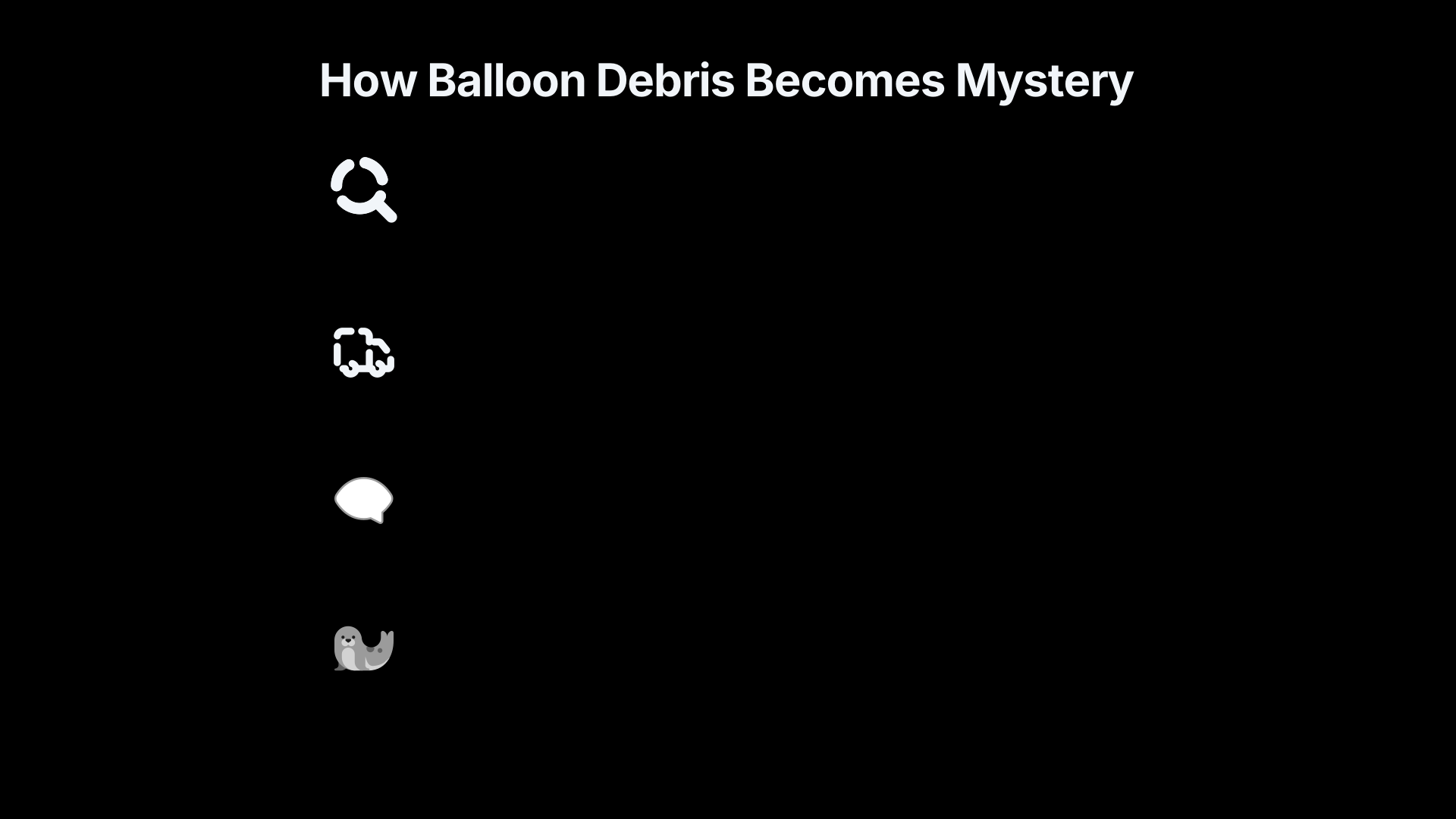
Balloons become UFO crash stories through a sequence of small interpretive failures rather than one big mistake. A person sees or finds something unfamiliar; local authorities or the military respond; parts are removed; witnesses remember different details; secrecy or poor communication fills the gap; later retellings compress uncertainty into a single dramatic claim.
Several recurring features make balloon debris especially vulnerable to this process.
The object can be unfamiliar but not advanced. Lightweight foil, sticks, string and instrument packages may look deliberately engineered, but they do not require exotic materials. In Roswell, the GAO-cited record of a high-altitude balloon with a radar reflector fits this pattern: the debris was unusual enough to attract attention, but still compatible with known balloon equipment.[FAS Project on Government Secrecy]sgp.fas.orgProject on Government Secrecy GAO Report on Roswell, NM UFO CrashProject on Government Secrecy GAO Report on Roswell, NM UFO Crash
The fall can be real without being a crash. A burst balloon descends; it does not “crash” in the aircraft sense. Yet witnesses may still use crash language because the object came down, broke apart and left debris.
The recovery can look secretive for ordinary reasons. Military or scientific payloads may be collected because they are government property, because they contain instruments, or because the programme is classified. In a UFO crash setting, that retrieval can be reinterpreted as evidence of a cover-up.
The debris is easy to over-read. A torn radar reflector can become “metallic wreckage”; a radiosonde can become an unknown device; a parachute can become part of a landing system; tape, symbols or manufacturer markings can become mysterious writing if remembered decades later.
The absence of aircraft parts can be misunderstood. A true aircraft crash normally leaves engines, structural metal, fuel evidence, serialised components, impact damage and a formal accident trail. Balloon debris may leave none of those things, but if the story is already framed as a UFO crash, the missing aircraft evidence can be reinterpreted as proof that the object was something beyond ordinary aviation.
What modern UAP reviews add to the balloon question
Modern UAP reporting has not made balloons irrelevant; it has made the distinction between data-rich and data-poor cases more visible. NASA’s 2023 independent study report defined the problem partly around observations that cannot be identified as balloons, aircraft or known natural phenomena, while stressing that limited high-quality observations prevent definitive scientific conclusions in many cases.[NASA Science]science.nasa.govOpen source on nasa.gov.
The Pentagon’s All-domain Anomaly Resolution Office, or AARO, likewise continues to resolve some cases as balloons. Its official imagery page lists several 2022 Europe cases assessed with high confidence as almost certainly balloons, citing shape consistency with other resolved balloon imagery and performance characteristics aligned with lighter-than-air objects, such as drifting at wind speed and direction.[AARO]aaro.milOfficial UAP ImageryAARO UAP Imagery…
AARO’s fiscal year 2024 report also shows the broader pattern: it received 757 UAP reports in the covered period, resolved cases to prosaic objects including balloons, birds and unmanned aerial systems, and stated that it had found no evidence of extraterrestrial beings, activity or technology. It also noted that many unresolved cases lacked sufficient data for analysis, a crucial point for crash-related claims: “unresolved” does not mean “extraordinary”; often it means there is not enough information to decide.[U.S. Department of War]media.defense.govFY24 CONSOLIDATED ANNUAL REPORT ON UAP 508FY24 CONSOLIDATED ANNUAL REPORT ON UAP 508
The modern lesson is methodological. A balloon explanation is strongest when investigators can compare the object’s apparent motion with wind, check launch or tracking data, inspect sensor artefacts, identify payload components, and document recovered material. It is weakest when it is offered as a reflexive answer without matching the evidence.
How to tell a balloon recovery from a stronger crash claim
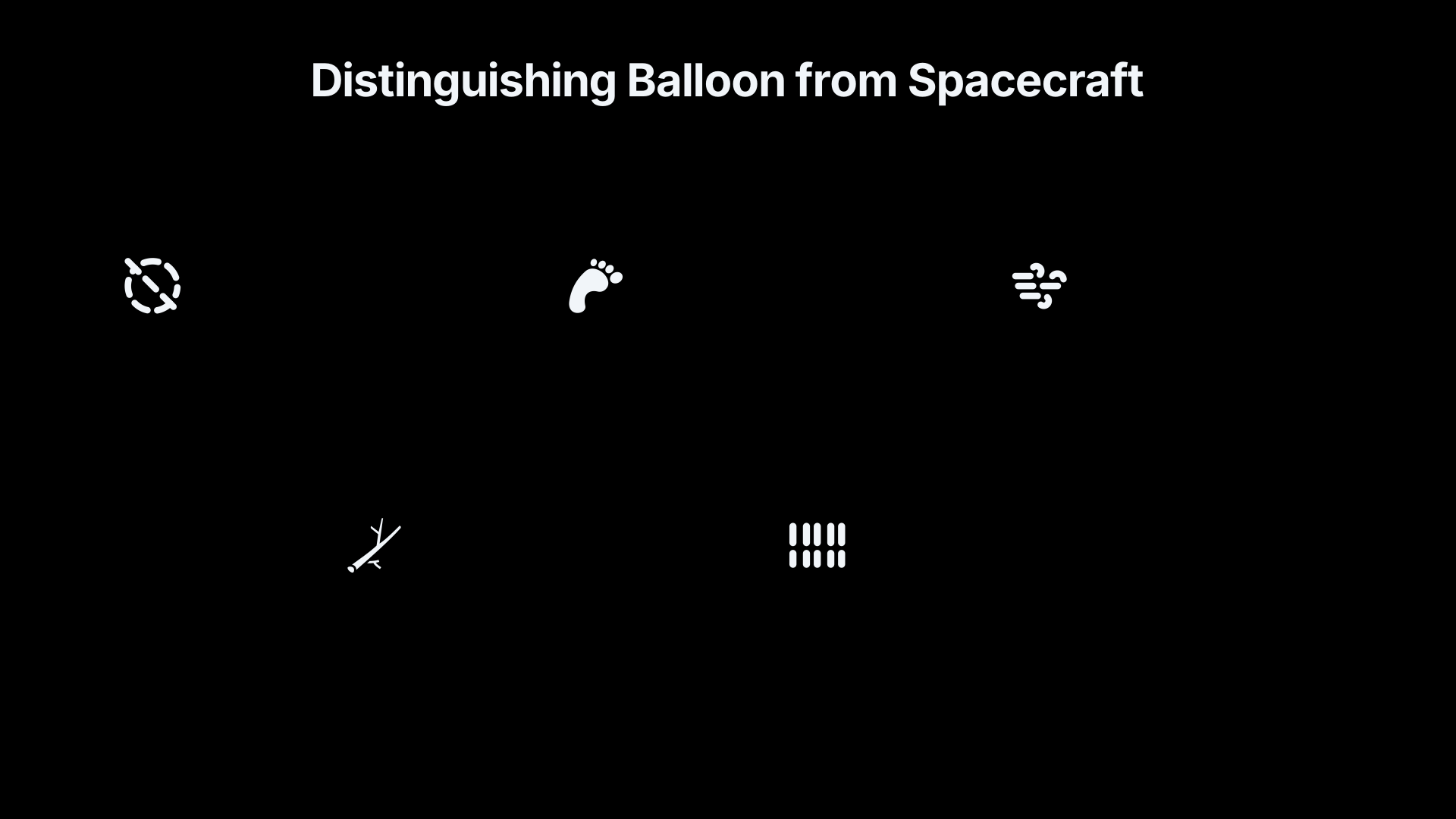
A balloon explanation becomes plausible when the evidence points to a lightweight, drifting, instrument-carrying object rather than a powered vehicle. In a practical assessment of a claimed UFO crash, the following signs matter more than the drama of the story:
- Lightweight debris: rubber, plastic, foil, paper, tape, twine, balsa-like sticks, parachute cloth or small electronics.
- No propulsion evidence: no engine, fuel system, power plant, heavy structure or heat damage consistent with an aircraft or spacecraft.
- No true impact signature: limited ground disturbance, no crater matching a high-speed crash, and debris spread consistent with wind drift or dragging.
- Recoverable identification clues: labels, serial numbers, manufacturer names, frequency markings, batteries, GPS modules or return instructions.
- Wind-compatible movement: sightings or sensor tracks that drift with prevailing winds rather than manoeuvring independently.
- Known launch activity: nearby weather-service, research, military or amateur high-altitude balloon launches within a plausible time window.
None of these signs alone proves a balloon. A radiosonde box may be separated from its balloon; a radar reflector may be damaged beyond recognition; older records may be incomplete. But together they can turn a mysterious “crash” into a traceable flight system.
The reverse is also important. A stronger non-balloon crash claim would need evidence balloons do not provide: robust chain-of-custody material, independently tested components with anomalous manufacturing or composition, clear photographs before disturbance, multiple contemporary records, and physical effects inconsistent with a lightweight descent. Without those, balloon debris remains one of the most economical explanations for many “recovered wreckage” stories.
Why the balloon explanation keeps returning
Balloons keep appearing in UFO crash discussions because they satisfy three conditions at once. They are airborne, they are sometimes strange-looking, and they come back down. Most misidentified lights or sensor returns leave nothing to collect, but balloons can produce exactly the kind of tangible aftermath that crash stories require.
They also sit at the intersection of public science and state secrecy. Weather balloons are routine; high-altitude surveillance or acoustic-detection balloons can be sensitive; military recovery can be opaque; and old records may be incomplete. That mix allows both sceptics and believers to find something plausible in the same case. The sceptic sees a known class of aerial object with known debris. The believer sees official confusion, secrecy and a story that changed.
The fairest reading is not that balloons explain every UFO crash claim. It is that balloons are a proven pathway by which ordinary or classified human technology can be mistaken for crashed craft. In the branch of UFO cases where witnesses report debris, recovery teams and unusual lightweight material, balloons are not a side issue. They are one of the main mechanisms by which a real event becomes a lasting mystery.
Amazon book picks
Further Reading
Books and field guides related to When Balloons Look Like Spaceships. Use these as the next step if you want deeper reading beyond the article.
UFO
Explains how UFO cases are investigated and where mundane explanations fit into larger UFO narratives.
UFO Crash at Roswell
Focuses on debris interpretations, balloon explanations and myth formation.
The Roswell Incident
Represents the influential crash narrative that balloon explanations seek to address.
Project Identification
Provides investigative context for distinguishing unusual observations from ordinary causes.
eBay marketplace picks
Marketplace Samples
Live-tested eBay searches with available results related to this page.
Endnotes
1.
Source: sgp.fas.org
Title: Project on Government Secrecy GAO Report on Roswell, NM UFO Crash
Link:https://sgp.fas.org/othergov/roswell.html
2.
Source: aaro.mil
Title: Official UAP Imagery
Link:https://www.aaro.mil/UAP-Cases/Official-UAP-Imagery/
Source snippet
AARO UAP Imagery...
3.
Source: weather.gov
Title: National Weather Service Weather Balloon Instrument/Radiosonde Information
Link:https://www.weather.gov/upperair/radiosonde
4.
Source: noaa.gov
Link:https://www.noaa.gov/jetstream/upperair/radiosondes
5.
Source: noaa.gov
Title: up up and away 6 benefits of automated weather balloon launches
Link:https://www.noaa.gov/stories/up-up-and-away-6-benefits-of-automated-weather-balloon-launches
6.
Source: ecfr.gov
Link:https://www.ecfr.gov/current/title-14/chapter-I/subchapter-F/part-101
7.
Source: faa.gov
Link:https://www.faa.gov/air_traffic/publications/atpubs/atc_html/chap9_section_6.html
8.
Source: ecfr.gov
Link:https://www.ecfr.gov/current/title-14/chapter-I/subchapter-F/part-101/subpart-D
9.
Source: science.nasa.gov
Link:https://science.nasa.gov/wp-content/uploads/2023/09/uap-independent-study-team-final-report.pdf
10.
Source: aaro.mil
Title: AARO Historical Record Report Vol 1 2024
Link:https://www.aaro.mil/Portals/136/PDFs/AARO_Historical_Record_Report_Vol_1_2024.pdf
11.
Source: aaro.mil
Link:https://www.aaro.mil/
12.
Source: science.nasa.gov
Link:https://science.nasa.gov/uap/
13.
Source: nasa.gov
Title: nasa to release discuss [unidentified]({{ ‘unidentified/’ | relative_url }}) anomalous phenomena report
Link:https://www.nasa.gov/news-release/nasa-to-release-discuss-unidentified-anomalous-phenomena-report/
14.
Source: faa.gov
Link:https://www.faa.gov/air_traffic/publications/atpubs/foa_html/chap19_section_5.html
15.
Source: faa.gov
Link:https://www.faa.gov/media/108586
16.
Source: weather.gov
Link:https://www.weather.gov/gjt/education_corner_balloon
17.
Source: weather.gov
Link:https://www.weather.gov/rah/virtualtourballoon
18.
Source: vault.fbi.gov
Title: Roswell UFO
Link:https://vault.fbi.gov/Roswell%20UFO
19.
Source: history.com
Title: u s air force reports on roswell
Link:https://www.history.com/this-day-in-history/june-24/u-s-air-force-reports-on-roswell
20.
Source: media.defense.gov
Title: FY24 CONSOLIDATED ANNUAL REPORT ON UAP 508
Link:https://media.defense.gov/2024/Nov/14/2003583603/-1/-1/0/FY24-CONSOLIDATED-ANNUAL-REPORT-ON-UAP-508.PDF
21.
Source: media.defense.gov
Title: AFD 101027 030
Link:https://media.defense.gov/2010/Oct/27/2001330219/-1/-1/0/AFD-101027-030.pdf
22.
Source: Wikipedia
Title: Project Mogul
Link:https://en.wikipedia.org/wiki/Project_Mogul
23.
Source: Wikipedia
Title: Weather balloon
Link:https://en.wikipedia.org/wiki/Weather_balloon
24.
Source: Wikipedia
Link:https://en.wikipedia.org/wiki/Radiosonde
25.
Source: science.howstuffworks.com
Title: weather balloon
Link:https://science.howstuffworks.com/nature/climate-weather/meteorological-instruments/weather-balloon.htm
26.
Source: pilotinstitute.com
Title: part 101
Link:https://pilotinstitute.com/part-101/
Additional References
27.
Source: youtube.com
Title: The Basement: James Fox | UFO Disclosure, [Varginha]({{ ‘varginha/’ | relative_url }}), and the Captured Creature
Link:https://www.youtube.com/watch?v=XFxnFHhqtts
Source snippet
Ross Coulthart Q&A: Alien hybrids, 'Disclosure Day' and a secret that changed things...
28.
Source: youtube.com
Title: World-changing confession: Doctor describes studying live alien | Reality Check
Link:https://www.youtube.com/watch?v=5Zit-08rtkE
Source snippet
The Basement: James Fox | UFO Disclosure, Varginha, and the Captured Creature...
29.
Source: youtube.com
Title: Ross Coulthart LIVE: UFO Files (2nd Drop) Analysis and Reaction
Link:https://www.youtube.com/watch?v=POD4iAL4teM
Source snippet
World-changing confession: Doctor describes studying live alien | Reality Check...
30.
Source: cia.gov
Link:https://www.cia.gov/readingroom/document/cia-rdp81r00560r000100010001-0
31.
Source: youtube.com
Title: Pentagon’s new UFO files show no evidence of aliens found
Link:https://www.youtube.com/watch?v=yY-iebpKygk
Source snippet
Ross Coulthart LIVE: UFO Files (2nd Drop) Analysis and Reaction...
32.
Source: academia.edu
Link:https://www.academia.edu/7482584/Project_Blue_Book_Archive
33.
Source: facebook.com
Link:https://www.facebook.com/itvnews/posts/a-nasa-report-into-unidentified-flying-objects-ufos-has-found-no-evidence-that-t/686500760179269/
34.
Source: facebook.com
Link:https://www.facebook.com/cspanhistory/posts/aliens-or-crash-test-dummies-the-roswell-reports-1997-us-air-force-film-on-the-1/3259805804132944/
35.
Source: reddit.com
Link:https://www.reddit.com/r/meteorology/comments/1aq94pr/are_we_still_just_doing_the_twice_a_day/
36.
Source: facebook.com
Link:https://www.facebook.com/cnninternational/videos/coordinated-twice-daily-weather-balloon-launches-make-up-the-backbone-of-weather/635785442552586/
Topic Tree