Within Balloons
How to Test a Balloon Crash Explanation
A strong balloon explanation must match the debris, launch context, wind path and payload details instead of dismissing odd features.
On this page
- The debris checklist for balloon recoveries
- Launch records, wind paths and likely landing zones
- Red flags that need a better explanation
Page outline Jump by section
Introduction
When a reported UFO crash is explained as a balloon recovery, the explanation should be tested against the physical evidence rather than accepted simply because balloons are common. A credible balloon explanation must account for the actual debris found, the type of balloon system that could have produced it, where and when such a launch occurred, how winds would have carried it, and whether the predicted landing area matches the recovery site. If those elements align, a balloon explanation becomes significantly stronger. If they do not, the explanation remains incomplete and requires further investigation.
 This approach is especially important in UFO crash cases because balloon systems can leave debris that appears unusual to witnesses. High-altitude weather balloons, research balloons and military balloon trains often contain parachutes, instrument packages, cords, radar reflectors and lightweight structural components that can look unfamiliar when scattered across a field. The question is not whether the debris looked strange, but whether its strange features can be matched to a known balloon system.[National Weather Service]weather.govNational Weather ServiceCollecting Meteorological Data by Radiosonde or…When the balloon has expanded beyond its elastic limit and bur…
The Debris Checklist for Balloon Recoveries
The first test is straightforward: can the reported materials be matched to components that are actually used in balloon operations?
Modern radiosonde systems typically consist of a balloon, suspension line, parachute and instrument package. After the balloon bursts at high altitude, the remaining equipment descends and may land many kilometres from the launch point. Recoveries often include torn balloon material, string or twine, a parachute and electronic instrumentation.[weather.gov]weather.govNational Weather ServiceCollecting Meteorological Data by Radiosonde or…When the balloon has expanded beyond its elastic limit and bur…
A useful debris checklist includes:
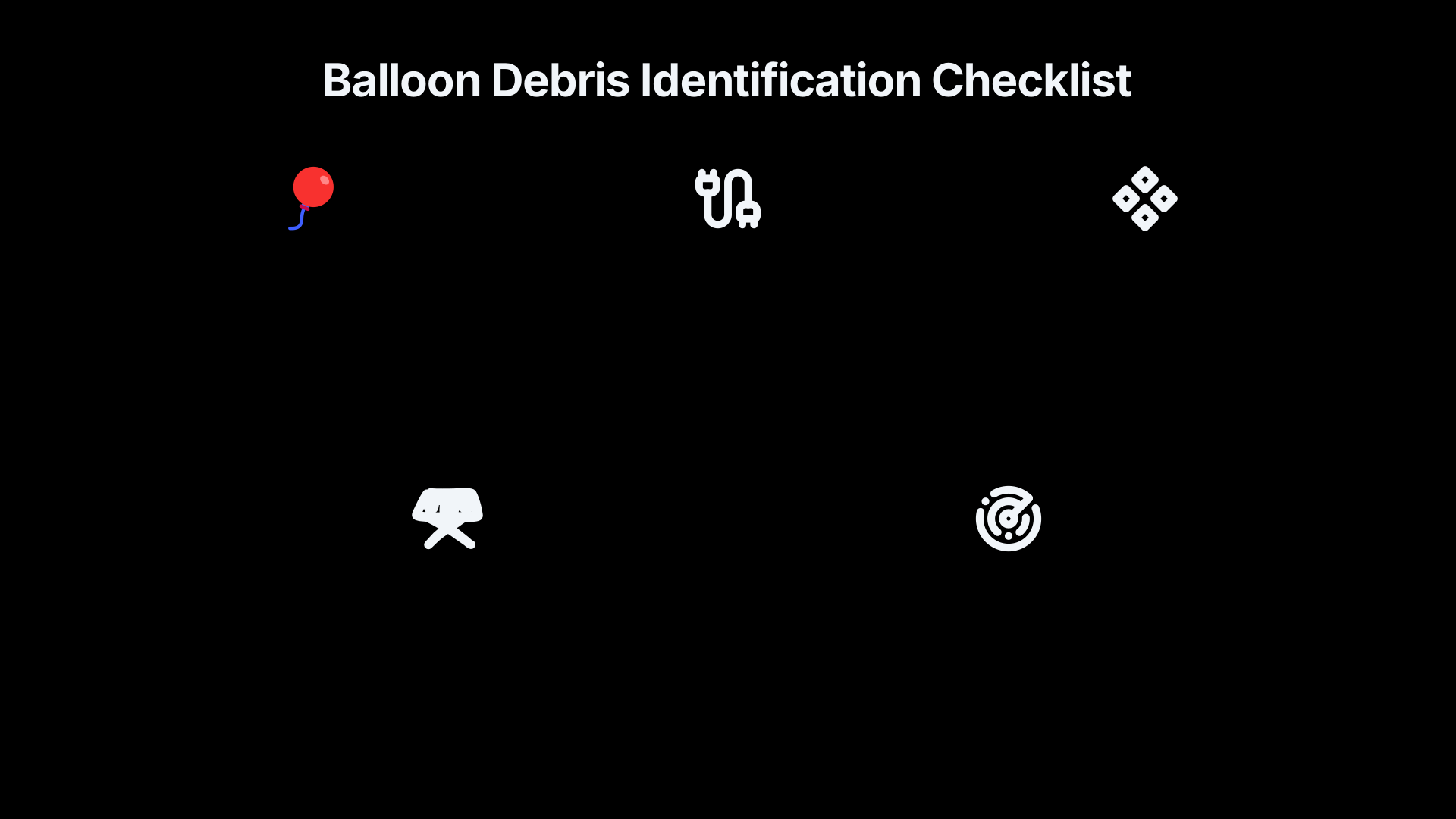
- Balloon remnants: shredded latex, rubber or plastic film.
- Suspension materials: cord, twine, cable or attachment points.
- Parachute components: fabric, shroud lines or harness fittings.
- Instrument payloads: radiosondes, batteries, transmitters or sensors.
- Tracking aids: radar reflectors, reflective foil or lightweight framework.
- Evidence of low-mass construction: materials designed to minimise weight rather than survive impact.
Finding several of these elements together strengthens a balloon explanation. By contrast, reports describing heavy structural metals, propulsion systems, heat-damaged engine components or dense aerospace alloys require additional explanation because such features are not characteristic of meteorological balloon systems.
The pattern of debris distribution also matters. Balloon systems are lightweight and fragile. When they descend, components may tear apart and spread across a wide area. Air Force analyses of Project Mogul noted that radar reflectors and other lightweight structures could break apart and become dispersed after ground contact while still being dragged by partially buoyant balloon material.[Muller Lab]muller.lbl.govMuller LabProject MogulAfter striking the ground, the radar reflectors, constructed of very light materials for minimum weight, would tea…
Launch Records, Wind Paths and Likely Landing Zones
A convincing balloon explanation should not stop with material similarities. It should also demonstrate that a balloon was actually capable of reaching the recovery site.
Weather agencies routinely launch radiosondes, and balloon trajectories can extend hundreds of kilometres from their launch points. National Weather Service guidance notes that a typical sounding may drift more than 300 kilometres before descent.[National Weather Service]weather.govNational Weather ServiceRadiosonde ObservationA typical NWS "weather balloon" sounding can last in excess of two hours. In that time, the…
Testing the explanation involves three questions:
- Was a launch conducted? Check launch schedules, meteorological records, military operations or research programmes active in the area. Determine the type of balloon and payload involved.
- Did the winds support the proposed path? Examine historical wind data at multiple altitudes rather than relying on surface winds. High-altitude winds can carry balloons in directions that differ dramatically from ground-level conditions.
- Does the predicted landing zone fit the recovery location? Modern balloon tracking systems routinely predict landing areas. Historical investigations can reconstruct likely flight paths using archived weather data and launch records.
The strength of a balloon explanation increases substantially when a documented launch, a plausible atmospheric path and a recovery location all align. A balloon theory that cannot identify a likely launch source remains weaker than one supported by operational records.
Why Roswell Became a Test Case
The Roswell incident illustrates how physical-evidence testing works in practice. The most influential balloon explanation links the debris to Project Mogul, a classified programme that used large balloon trains carrying acoustic sensors, transmitters and radar-reflector equipment intended to detect distant Soviet nuclear tests.[Wikipedia]WikipediaProject MogulProject Mogul
What made the Mogul explanation persuasive to many investigators was not simply the existence of balloons. It was the attempt to match reported debris characteristics to documented hardware.
Contemporary descriptions included lightweight foil-like material, sticks, tape, paper-backed components and a broad debris field. Project Mogul equipment incorporated unusual radar reflectors made from lightweight structural elements and reflective materials that could appear unfamiliar to people encountering them in isolation. Air Force reports later argued that the recovered materials were consistent with components from a Mogul balloon train.[wikipedia.org]WikipediaRoswell incidentRoswell incident
The explanation also benefited from an identifiable launch context. Historical investigations connected the debris to a missing Mogul flight launched from Alamogordo in June 1947 and reconstructed a flight path that could have placed wreckage near the reported recovery area.[Wikipedia]WikipediaRoswell incidentRoswell incident
Whether one accepts every aspect of that conclusion or not, the case demonstrates the correct evidential method: compare witness descriptions with known hardware, identify candidate launches and evaluate whether atmospheric conditions support the proposed trajectory.
Red Flags That Need a Better Explanation
Balloon explanations become less convincing when they fail specific evidential tests.
Missing Physical Matches
A common weakness is a poor correspondence between reported debris and known balloon components. If investigators cannot identify equivalent materials, attachment systems or payload elements in documented balloon designs, the explanation remains speculative.
The issue is not whether witnesses described something unusual. It is whether the unusual feature can be connected to a real component used in balloon operations.
No Plausible Launch Source
If no launch records, research programme or military activity can be identified within a reasonable time frame, the explanation loses explanatory power.
Balloons do not appear spontaneously. A credible reconstruction should identify who launched it, approximately when it was launched and what equipment it carried.
Flight Paths That Do Not Work
Wind analysis can eliminate otherwise attractive explanations. A balloon launched from the proposed source must be capable of reaching the recovery location under known atmospheric conditions. If reconstructed trajectories consistently miss the site, the theory requires revision.

Selective Use of Evidence
Perhaps the most important warning sign is selective matching. An explanation that accounts for foil fragments but ignores electronics, attachment hardware, witness measurements or documented field distribution is incomplete.
The strongest explanations explain the entire evidence package rather than only the parts that fit.
What Makes a Balloon Explanation Strong?
A robust balloon explanation succeeds when multiple independent lines of evidence converge:
- The debris matches known balloon hardware.
- The payload configuration matches reported components.
- Launch records show an actual balloon operation.
- Atmospheric conditions support the proposed route.
- The predicted landing area overlaps the recovery location.
- No major physical features remain unexplained.
In UFO crash investigations, balloons are most convincing not because they are ordinary, but because they can be tested. Their materials, launch schedules, flight behaviour and recovery patterns leave traces that can be compared against the evidence. When those traces line up, a balloon explanation gains substantial credibility. When they do not, the discrepancy identifies exactly where further investigation is needed.
Amazon book picks
Further Reading
Books and field guides related to How to Test a Balloon Crash Explanation. Use these as the next step if you want deeper reading beyond the article.
The UFO Experience
Emphasizes evaluating evidence and explanations systematically rather than accepting claims at face value.
UFOs
Focuses on assessing physical evidence, witness reliability, and competing explanations.
Roswell in the 21st Century
Examines the Roswell case, including arguments surrounding balloon and Project Mogul explanations.
The Report on Unidentified Flying Objects
Shows how investigators evaluate sightings, physical traces, and conventional explanations.
eBay marketplace picks
Marketplace Samples
Example marketplace items related to this page. Use the search link to explore similar finds on eBay.



Endnotes
1.
Source: weather.gov
Link:https://www.weather.gov/rah/virtualtourballoon
Source snippet
National Weather ServiceCollecting Meteorological Data by Radiosonde or...When the balloon has expanded beyond its elastic limit and bur...
2.
Source: noaa.gov
Link:https://www.noaa.gov/jetstream/upperair/radiosondes
Source snippet
National Oceanic and Atmospheric...16 Sept 2025 — The radiosonde is a small instrument package that is suspended below balloon filled wi...
3.
Source: weather.gov
Link:https://www.weather.gov/upperair/factsheet
Source snippet
National Weather ServiceRadiosonde ObservationA typical NWS "weather balloon" sounding can last in excess of two hours. In that time, the...
4.
Source: Wikipedia
Title: Project Mogul
Link:https://en.wikipedia.org/wiki/Project_Mogul
5.
Source: Wikipedia
Title: Roswell incident
Link:https://en.wikipedia.org/wiki/Roswell_incident
6.
Source: media.defense.gov
Title: AFD 101027 030
Link:https://media.defense.gov/2010/Oct/27/2001330219/-1/-1/0/AFD-101027-030.pdf
Source snippet
Department of WarU.S. Air Force: "The Roswell Report: Case Closed"Project MOGUL balloon train similar to one found on a ranch. 75 miles n...
7.
Source: Wikipedia
Link:https://en.wikipedia.org/wiki/Project
Source snippet
ProjectA project is a type of assignment, typically involving research or design, that is carefully planned to achieve a specific obje...
8.
Source: Wikipedia
Title: Weather balloon
Link:https://en.wikipedia.org/wiki/Weather_balloon
Source snippet
Weather balloonA weather balloon, also known as a sounding balloon, is a high-altitude balloon (HAB) that carries instruments into the...
9.
Source: weather.gov
Link:https://www.weather.gov/upperair/reqdahdr
Source snippet
A Brief History of Upper-air ObservationsTo supplement the kite and [aircraft]({{ 'aircraft/' | relative_url }}) data, Weather Bureau stations in 1909 began to track small...
10.
Source: muller.lbl.gov
Link:https://muller.lbl.gov/teaching/physics10/Roswell/USMogulReport.html
Source snippet
Muller LabProject MogulAfter striking the ground, the radar reflectors, constructed of very light materials for minimum weight, would tea...
11.
Source: dictionary.cambridge.org
Link:https://dictionary.cambridge.org/dictionary/english/project
Source snippet
English meaning - Cambridge Dictionarya piece of planned work or an activity which is done over a period of time and intended to achiev...
12.
Source: engr.colostate.edu
Link:https://www.engr.colostate.edu/~hillger/modern.htm
Source snippet
Era Contributors to Meteorologyby V Bjerknes — Below are checklists of Modern Era Contributors to Meteorology on postal items (stamps, so...
13.
Source: britannica.com
Title: Roswell incident
Link:https://www.britannica.com/event/Roswell-incident
Source snippet
Overview, Theories, Hoaxes, & Facts8 May 2026 — In 1994 it was finally revealed that the balloon was part of the top-secret Project Mogul...
Published: May 2026
Additional References
14.
Source: wired.com
Link:https://www.wired.com/story/roswell-aliens-fermi-paradox
Source snippet
However, an examination reveals a confluence of secret government projects and Cold War era activities rather than extraterrestrial invol...
15.
Source: merriam-webster.com
Link:https://www.merriam-webster.com/dictionary/project
Source snippet
PROJECT Definition & Meaning1. a: to devise in the mind: design b: to plan, figure, or estimate for the future 2. to throw or cast for...
16.
Source: daviddarling.info
Link:https://www.daviddarling.info/encyclopedia/M/Mogul.html
Source snippet
Project MogulProject Mogul was a program conducted by the U.S. Air Force to develop balloon-borne equipment to give early warning of Sovi...
17.
Source: sgp.fas.org
Link:https://sgp.fas.org/othergov/roswell.html
Source snippet
Report on Roswell, NM UFO CrashAt the time of the Roswell crash, project MOGUL was a highly classified U.S. effort to determine the state...
18.
Source: ethz.ch
Link:https://ethz.ch/content/dam/ethz/special-interest/usys/iac/iac-dam/documents/edu/courses/climatological_and_hydrological_field_work/Climatological_and_Hydrological_Field_Work_Balloon_Soundings.pdf
Source snippet
Radiosounding ExperimentThis lab will collect data from radiosondes attached to balloons. A meteorological bal- loon, carrying instrument...
19.
Source: pmi.org
Link:https://www.pmi.org/about/what-is-a-project
Source snippet
What is a Project, Examples and the Project LifecycleA project is a series of structured tasks, activities, and deliverables that are car...
20.
Source: physics.smu.edu
Link:https://www.physics.smu.edu/pseudo/UFOs/pt01a.pdf
Source snippet
MOGUL Balloon Train Components and Debris Recovered. Heights of Familiar Architectural Structures Relative to the Length of a Project MOG...
21.
Source: en.wiktionary.org
Link:https://en.wiktionary.org/wiki/project
Source snippet
terms borrowed from Latin · English terms derived from Proto-Italic · English terms derived from the Proto-Indo-European root *per- (befo...
22.
Source: sondehub.org
Link:https://sondehub.org/
Source snippet
SondeHub TrackerLive tracking of radiosonde flights. Data via SondeHub v2. Includes weather overlay, predictions, and access to historic...
23.
Source: skepticalinquirer.org
Link:https://skepticalinquirer.org/1995/07/the-roswell-incident-and-project-mogul/
Topic Tree