Within UFO Crashes
Did a Fireball Become a Crash Story?
Bright meteors can trigger dramatic reports of falling objects without leaving recoverable spacecraft debris.
On this page
- How fireballs are seen and reported
- Why direction and distance are hard to judge
- When meteor explanations fit crash claims
Page outline Jump by section
Introduction
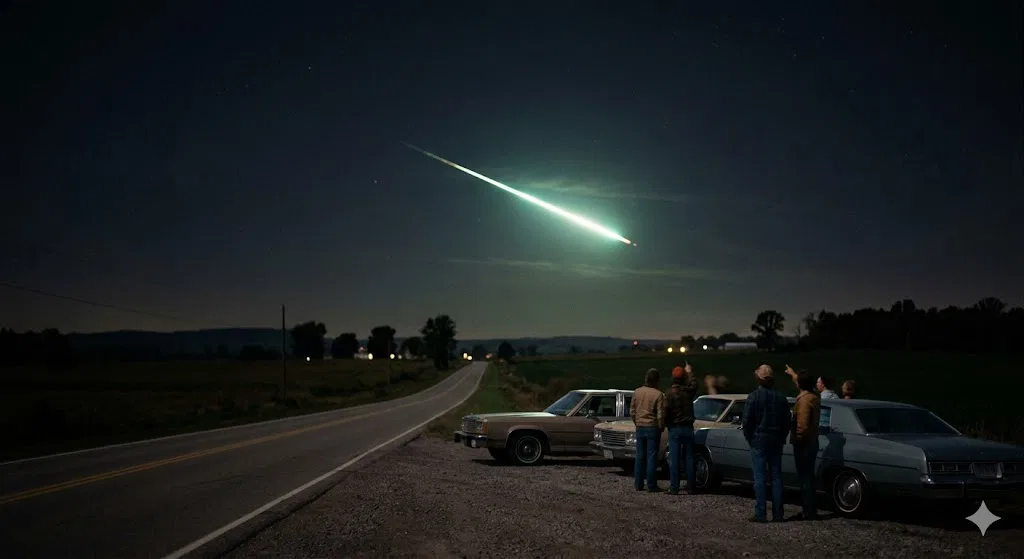
A bright meteor can become a “UFO crash” story because it gives witnesses three things that feel crash-like: a sudden brilliant object, an apparent downward path, and sometimes a delayed boom or ground-shaking sound. In most cases, however, the object is not falling nearby at all. It is a small natural body burning high in the atmosphere, often tens of kilometres above the ground, and it may disintegrate completely before anything can be recovered. A fireball is simply a very bright meteor; the American Meteor Society defines it as a meteor brighter than Venus, while the International Meteor Organization notes that even large fireballs usually last only a few seconds.[American Meteor Society]amsmeteors.orgAmerican Meteor SocietyFireballsA fireball is another term for a very bright meteor, generally brighter than magnitude -4, which is about…
This matters for UFO crash claims because “it looked like it came down over there” is not the same as evidence of a landed craft. Fireballs can be seen over several states or countries at once, can appear to pass behind local trees or hills, and can produce reports of impact, explosion or wreckage even when the physical event happened far away or entirely in the air. Meteor explanations do not settle every UFO report, but they explain a specific and recurring pathway by which a dramatic sky event becomes a crash narrative.
How a fireball turns into a crash report
A fireball begins as a meteoroid, a natural fragment of rock or metal from space, entering Earth’s atmosphere at very high speed. Friction and compression heat the air around it, producing a bright streak. If it fragments, it may flare, shed pieces, leave a glowing train, or produce a terminal flash. To someone on the ground, that can look less like a distant astronomical event and more like a vehicle descending under power, breaking apart, or exploding.
The most misleading feature is scale. A very small object can produce a huge visual impression. In June 2026, NASA-linked reporting on a Midwest fireball described an object only about 8 cm across and roughly 453 g in mass, yet it was estimated to have become many times brighter than Venus and was reported by more than 500 witnesses across a long path.[Space]space.comThe meteor, traveling at an astonishing speed of 56,000 mph (90,123 km/h), first appeared over Tupelo, Mississippi, at 11:26 p.m. EDT bef… That combination — tiny source, vast visibility — is exactly why fireballs can sound implausible when explained after the fact. The witness sees a sky-filling flash; the astronomer may be describing a stone smaller than a fist.
Fireballs also invite crash interpretations because some do produce sound. The American Meteor Society distinguishes delayed sonic booms from rarer reports of simultaneous “electrophonic” sounds. A delayed boom can arrive well after the flash because sound travels much more slowly than light.[American Meteor Society]amsmeteors.orgOpen source on amsmeteors.org. That delay can split one event into two perceived incidents: first, “something flew over”; then, “something hit”. In a dark, startled neighbourhood, that sequence can easily become a report of a nearby crash.
The strongest real-world example is the Chelyabinsk meteor of 15 February 2013. NASA described a house-sized asteroid entering over Russia at more than 11 miles per second, breaking apart about 14 miles above the ground and releasing energy equivalent to roughly 440,000 tons of TNT. The shock wave blew out windows across a wide area and injured more than 1,600 people, mostly through broken glass.[NASA]nasa.govFive Years after the Chelyabinsk MeteorFive Years after the Chelyabinsk Meteor Chelyabinsk was not a UFO crash, but it shows why witnesses can reasonably report explosion, damage and fear during a meteor event.
Why direction and distance are so hard to judge
Most crash confusion starts with an honest perceptual error. Human vision is poor at judging the distance of a bright object against a dark sky when there are no familiar size cues. A meteor may be 60, 80 or 100 kilometres away, but if it appears to descend towards the horizon it can feel as though it is falling into the next field, behind a row of houses, or beyond a nearby ridge.
The problem is not that witnesses are foolish. It is that a fireball gives the eye very little reliable depth information. A glowing streak high in the atmosphere can line up with a local tree, roofline or hill, making it appear to pass “behind” a nearby object. The observer’s brain then supplies a local distance. If several people in different places do the same thing, they may all report that the object came down “nearby”, even though their “nearby” locations are separated by many kilometres.
This is why meteor organisations ask for structured reports rather than just impressions. Fireball reporting forms ask where the observer was, which direction they faced, how high above the horizon the object began and ended, how long it lasted, and whether any sound followed.[Robert Ferguson Observatory]rfo.orgOpen source on rfo.org. The International Meteor Organization explains that reports from multiple witnesses can be combined to estimate a trajectory and assess whether a fall may have occurred.[imo.net]imo.netOpen source on imo.net.
Even then, eyewitness-only reconstruction has limits. A NASA-linked study comparing eyewitness-derived trajectories with observations from the NASA All Sky Fireball Network found that some cases produced good trajectory estimates while others produced poor ones, reflecting the difficulty of reconstructing a meteor’s path from human reports alone.[NASA Technical Reports Server]ntrs.nasa.govTechnical Reports Server Comparing eyewitness-derived trajectories of brightTechnical Reports Server Comparing eyewitness-derived trajectories of bright Dedicated fireball camera networks improve the situation because they capture the same event from multiple known locations, allowing scientists to triangulate the path and, in favourable cases, predict where meteorites may have fallen.
When a meteor explanation fits a UFO crash claim
A meteor explanation is strongest when the reported “crash” has the signature of a fireball rather than the signature of a recovered craft. The key is not one detail in isolation, but the pattern.
Meteor explanations fit especially well when:
- The event lasted only a few seconds. The International Meteor Organization states that large fireballs rarely last more than 5–10 seconds; objects lasting longer than that are more likely to be satellites, aircraft or other sources.[imo.net]imo.nets it is most likely a satellite or…Read more…
- The object was seen across a wide region. A genuine local crash normally has a local witness field. A high-altitude meteor can generate reports from several states, provinces or countries.
- Witnesses disagree about where it came down. Reports of “it landed just beyond town” from widely separated observers usually indicate a high, distant object rather than multiple nearby impacts.
- There is a delayed boom but no impact site. A sonic boom from fragmentation can shake buildings without any object striking the ground nearby.
- No debris, crater, burn scar or recovery trail appears. A crash story should become more evidential after daylight searches; many meteor-driven crash claims instead fade when no local wreckage is found.
- Meteor organisations record a matching fireball at the same time. Databases from groups such as the American Meteor Society and the International Meteor Organization are often decisive because they gather independent reports from a broad area.[American Meteor Society]amsmeteors.orgOpen source on amsmeteors.org.
The reverse is also true. A meteor explanation becomes weaker if the event involved prolonged hovering, repeated manoeuvres, low-altitude interaction with terrain, radar-confirmed controlled movement, or recoverable engineered debris with a documented chain of custody. Those are not typical fireball features. The point is not to force every UFO report into a meteor box; it is to recognise the particular conditions under which meteors are a good fit.
The Las Vegas backyard story shows the mechanism clearly
The 2023 Las Vegas “alien in the backyard” case is a modern example of how a fireball can become attached to a crash story. Around the time of the incident, a green fireball was reported across parts of the western United States. Business Insider reported that the American Meteor Society received 21 reports of a fireball before the Las Vegas family’s 911 call about a supposed crashed object and beings in a backyard.[Business Insider]businessinsider.comBusiness Insider Las Vegas Family Reports Aliens in Backyard but CopsBusiness Insider Las Vegas Family Reports Aliens in Backyard but Cops
NASA’s planetary defence officer Lindley Johnson was later reported as saying the green fireball was likely a bright meteor less than a metre across and not a UFO that had fallen into anyone’s backyard.[Skeptical Inquirer]skepticalinquirer.orgSkeptical Inquirer Aliens in a Las Vegas BackyardSkeptical Inquirer Aliens in a Las Vegas Backyard That distinction is important. A meteor can explain the sky flash without explaining every human reaction that followed. The family may have sincerely interpreted noises, shadows or fear through the lens of the fireball; the meteor explanation addresses the aerial trigger, not every later claim about what people thought they saw on the ground.
The case also shows how timing can weld separate elements into one narrative. A visible streak, a police body-camera flash, a frightened call, local rumours and online frame-by-frame analysis quickly became one story: a UFO crashed, and beings emerged. But the best-supported component was the regional fireball. The “crash” element did not produce the kind of physical evidence that a landed object should leave.
Not every meteor leaves a meteorite
A common objection is simple: if a fireball was real, where is the rock? The answer is that many meteoroids burn up or fragment so completely that no recoverable material is found. Others may drop small meteorites into forests, fields, water, mountains or private land where no one notices them. The absence of recovered stones does not by itself make the fireball suspicious.
Scientific recovery requires far more than someone pointing towards a horizon. Researchers need a calculated fall area, ideally from cameras, radar, satellite data or multiple well-located eyewitness reports. The Desert Fireball Network and similar systems exist for this reason: instrumented observations can turn a spectacular sight into a predicted search zone. One 2022 study reported a fresh meteorite recovery in Western Australia using fireball network data, drones and machine learning, with a 70 g meteorite found within 50 m of the calculated fall line.[arXiv]arxiv.orgOpen source on arxiv.org.
That kind of recovery work highlights the difference between a meteorite fall and a UFO crash claim. Meteorite search teams expect small, natural stones with fusion crusts, not machinery, cabins, propulsion systems or bodies. A successful meteorite recovery strengthens the natural explanation; a failed recovery usually means the object did not survive, fell somewhere inaccessible, or was too small to find.
Water landings complicate matters further. In May 2026, a meteor over New England produced widespread boom reports, and NASA-linked coverage indicated that any surviving fragments likely ended up in or near Cape Cod Bay, making recovery difficult.[Space]space.comNASA noted that the meteor was not part of a recognized meteor shower. The flash from the explosion was captured by the satellite's light… A witness could describe that as “something crashed”, while the practical evidence would be a high-altitude fragmentation event and perhaps unrecovered stones on the seabed.

Why green, blue or white fireballs feel especially “unearthly”
Colour often pushes a meteor report towards UFO language. Witnesses commonly describe green, blue-white, orange or red flashes, and green fireballs in particular have a long association with UFO speculation. The colour can seem technological, as if the object has lights or propulsion, but colour in a meteor can arise from a mix of speed, temperature, atmospheric gases and the material being ablated from the meteoroid.
The phrase “green fireball” has been part of UFO history since the early Cold War, especially in New Mexico, where unusual green fireball reports near sensitive military and nuclear sites attracted official and public concern. Popular histories of that period show how easily a striking meteor-like phenomenon could be interpreted through the fears of its time: secret weapons, foreign technology or extraterrestrial probes.[HISTORY CHANNEL ITALIA]history.comCHANNEL ITALIAWhen Mysterious Green Fireballs Worried the USCHANNEL ITALIAWhen Mysterious Green Fireballs Worried the US
Modern reporting has changed the speed but not the mechanism. A bright green streak appears on a doorbell camera or police body camera; social media clips detach it from astronomical context; nearby witnesses supply a crash location; and the story becomes a UFO incident before meteor observers have finished correlating reports. The colour feels meaningful, but by itself it is not evidence of control, structure or non-natural origin.
What would separate a meteor from a real crash?
The practical test is whether the evidence behaves like a transient sky event or like a physical accident scene. A meteor explanation becomes stronger when independent reports map to a high-altitude path, when the timing matches known fireball reports, when sound delays make sense, and when searches fail to find engineered debris. A crash explanation becomes stronger only if the aftermath produces durable, local, inspectable evidence.
For UFO crash assessment, the most useful questions are:
- Did independent observers across a wide area report the same short-lived streak?
- Is there an American Meteor Society, International Meteor Organization, NASA, ESA or satellite record for the same time?
- Did the reported sound arrive after the flash, consistent with a sonic boom?
- Are claimed impact locations consistent with each other, or scattered according to each witness’s viewing angle?
- Was any material recovered, and has it been identified by qualified laboratories?
- Is the alleged debris natural meteorite material, ordinary aircraft or balloon material, or something genuinely engineered and unexplained?
NASA’s UAP work emphasises the need for higher-quality data, because many reports suffer from limited observations, missing context and inadequate sensor information.[NASA Science]science.nasa.govOpen source on nasa.gov. Fireball confusion is a clear example of why that matters. A spectacular witness account can be sincere and still be physically mislocated; a dramatic boom can be real and still come from an airburst; a “falling object” can be natural and leave no spacecraft debris.
The useful takeaway for UFO crash cases
Meteor fireballs are not a lazy explanation for every UFO crash story. They are a well-documented mechanism that creates a specific kind of confusion: a brief, brilliant, high-altitude event is perceived as a nearby falling object, then amplified by sound, fear, darkness, social media and the expectation that something must have landed.
The strongest meteor cases usually resolve quickly once reports are compared across distance. The same object is seen from many places, the apparent landing point shifts with the observer, and the timing matches a known fireball. The weakest crash claims often do the opposite: they begin with an impressive sky event but never produce a coherent impact site, recoverable craft debris or a documented recovery operation.
That is why fireballs matter in the broader subject of UFO crashes. They show how a real event can sit at the centre of a mistaken story. The light was real. The boom may have been real. The fear was real. But the conclusion — that a craft came down nearby — may be the least reliable part of the experience.
Amazon book picks
Further Reading
Books and field guides related to Did a Fireball Become a Crash Story?. Use these as the next step if you want deeper reading beyond the article.
The UFO Experience
Directly addresses how UFO reports are interpreted and investigated, providing context for misidentified astronomical events.
Field Guide to Meteors and Meteorites
Helps readers understand fireball observation, meteor behavior, and evidence needed to distinguish real falls from mistaken reports.
Meteorites
Focuses on witnessed falls, recovered meteorites, and the human stories that emerge from dramatic sky events.
eBay marketplace picks
Marketplace Samples
Example marketplace items related to this page. Use the search link to explore similar finds on eBay.



Endnotes
1.
Source: imo.net
Link:https://www.imo.net/observations/fireballs/fireballs/
Source snippet
s it is most likely a satellite or...Read more...
2.
Source: space.com
Link:https://www.space.com/stargazing/meteor-showers/watch-a-fireball-burn-a-300-mile-path-above-the-midwest-us-video
Source snippet
The meteor, traveling at an astonishing speed of 56,000 mph (90,123 km/h), first appeared over Tupelo, Mississippi, at 11:26 p.m. EDT bef...
3.
Source: nasa.gov
Title: Five Years after the Chelyabinsk Meteor
Link:https://www.nasa.gov/solar-system/five-years-after-the-chelyabinsk-meteor-nasa-leads-efforts-in-planetary-defense/
4.
Source: imo.net
Link:https://www.imo.net/observations/fireballs/fireball-report-program/
5.
Source: ntrs.nasa.gov
Title: Technical Reports Server Comparing eyewitness-derived trajectories of bright
Link:https://ntrs.nasa.gov/api/citations/20160008877/downloads/20160008877.pdf
6.
Source: arxiv.org
Link:https://arxiv.org/abs/2203.01466
7.
Source: space.com
Link:https://www.space.com/stargazing/meteor-showers/massive-boom-over-northeastern-us-was-a-meteor-explosion-as-powerful-as-300-tons-of-tnt-nasa-confirms
Source snippet
NASA noted that the meteor was not part of a recognized meteor shower. The flash from the explosion was captured by the satellite's light...
8.
Source: history.com
Title: CHANNEL ITALIAWhen Mysterious Green Fireballs Worried the US
Link:https://www.history.com/articles/ufos-green-fireballs-nuclear-facilities-new-mexico
9.
Source: science.nasa.gov
Link:https://science.nasa.gov/uap/
10.
Source: cneos.jpl.nasa.gov
Link:https://cneos.jpl.nasa.gov/fireballs/
11.
Source: ntrs.nasa.gov
Link:https://ntrs.nasa.gov/citations/20120004179
12.
Source: nasa.gov
Title: its fireball season answering your meteor questions
Link:https://www.nasa.gov/blogs/watch-the-skies/2026/03/26/its-fireball-season-answering-your-meteor-questions/
13.
Source: nightsky.jpl.nasa.gov
Link:https://nightsky.jpl.nasa.gov/news/39/
14.
Source: ares.jsc.nasa.gov
Link:https://ares.jsc.nasa.gov/meteorite-falls/events/
15.
Source: nasa.gov
Title: 115 years ago the tunguska asteroid impact event
Link:https://www.nasa.gov/history/115-years-ago-the-tunguska-asteroid-impact-event/
16.
Source: science.nasa.gov
Title: uap independent study team final report
Link:https://science.nasa.gov/wp-content/uploads/2023/09/uap-independent-study-team-final-report.pdf
17.
Source: imo.net
Link:https://www.imo.net/
18.
Source: imo.net
Link:https://www.imo.net/observations/fireballs/observations/
19.
Source: fireball.imo.net
Title: browse events
Link:https://fireball.imo.net/members/imo_view/browse_events
20.
Source: neo.ssa.esa.int
Title: int Fireballs
Link:https://neo.ssa.esa.int/search-for-fireballs
21.
Source: planetary.org
Title: what was the chelyabinsk meteor event
Link:https://www.planetary.org/articles/what-was-the-chelyabinsk-meteor-event
22.
Source: war.gov
Title: dod examining [unidentified]({{ ‘unidentified/’ | relative_url }}) anomalous phenomena
Link:https://www.war.gov/News/News-Stories/Article/Article/3965403/dod-examining-unidentified-anomalous-phenomena/
23.
Source: space.com
Link:https://www.space.com/stargazing/meteor-showers/fireball-sightings-are-surging-across-the-us-heres-whats-really-going-on
24.
Source: amsmeteors.org
Link:https://www.amsmeteors.org/fireballs/
Source snippet
American Meteor SocietyFireballsA fireball is another term for a very bright meteor, generally brighter than magnitude -4, which is about...
25.
Source: amsmeteors.org
Link:https://www.amsmeteors.org/fireballs/faqf/
26.
Source: rfo.org
Link:https://rfo.org/index.php/report-a-fireball/
27.
Source: amsmeteors.org
Link:https://www.amsmeteors.org/fireballs/fireball-report/
28.
Source: businessinsider.com
Title: Business Insider Las Vegas Family Reports Aliens in Backyard but Cops
Link:https://www.businessinsider.com/las-vegas-family-reports-aliens-in-backyard-ufo-crash
29.
Source: skepticalinquirer.org
Title: Skeptical Inquirer Aliens in a Las Vegas Backyard
Link:https://skepticalinquirer.org/exclusive/aliens-in-a-las-vegas-backyard/
30.
Source: facebook.com
Link:https://www.facebook.com/danskoff/posts/new-update-american-meteor-society-has-a-report-on-thisfireball-meteor-did-you-h/2630929023584303/
31.
Source: youtube.com
Link:https://www.youtube.com/watch?v=TuZ-TP0UN30
32.
Source: Wikipedia
Title: Green fireballs
Link:https://en.wikipedia.org/wiki/Green_fireballs
33.
Source: Wikipedia
Title: Chelyabinsk meteor
Link:https://en.wikipedia.org/wiki/Chelyabinsk_meteor
34.
Source: amsmeteors.org
Link:https://www.amsmeteors.org/
35.
Source: amsmeteors.org
Title: ams q1 2026 fireball analysis
Link:https://amsmeteors.org/ams-q1-2026-fireball-analysis.html
37.
Source: fireball.amsmeteors.org
Title: browse reports
Link:https://fireball.amsmeteors.org/members/imo_view/browse_reports
38.
Source: fireball.amsmeteors.org
Title: view video
Link:https://fireball.amsmeteors.org/members/imo_video/view_video?video_id=22154
39.
Source: fireball.amsmeteors.org
Link:https://fireball.amsmeteors.org/
40.
Source: amsmeteors.org
Link:https://www.amsmeteors.org/videos/?video_id=13921
41.
Source: media.defense.gov
Title: DOPSR 2024 0263 [AARO]({{ ‘aaro/’ | relative_url }}) HISTORICAL RECORD REPORT VOLUME 1 2024
Link:https://media.defense.gov/2024/Mar/08/2003409233/-1/-1/0/DOPSR-2024-0263-AARO-HISTORICAL-RECORD-REPORT-VOLUME-1-2024.PDF
42.
Source: scistarter.org
Title: American Meteor Society
Link:https://scistarter.org/american-meteor-society-meteor-observing
Additional References
43.
Source: youtube.com
Link:https://www.youtube.com/watch?v=tU7WSHZye5w
Source snippet
Alleged Las Vegas alien sighting: What happened in 2023? | UFO Mysteries...
44.
Source: youtube.com
Title: When the UFO Hit the Woods! | UFO Witness | Full Episode | Discovery Channel
Link:https://www.youtube.com/watch?v=CVIKnA8cWak
Source snippet
Kecksburg UFO Crash: The Untold Story | The Government Lied! | Full Documentary | UFOTV®...
45.
Source: youtube.com
Title: The Kecksburg UFO Mystery: Secrets, Witnesses and Vanished Evidence
Link:https://www.youtube.com/watch?v=vkZszbMzl3Q
Source snippet
When the UFO Hit the Woods! | UFO Witness | Full Episode | Discovery Channel...
46.
Source: youtube.com
Title: Nearly 50 years later, Kecksburg UFO sighting remains mystery
Link:https://www.youtube.com/watch?v=VM68dQjp4-M
Source snippet
The Kecksburg UFO Mystery: Secrets, Witnesses and Vanished Evidence...
47.
Source: facebook.com
Link:https://www.facebook.com/WIONews/posts/like-an-explosion-plane-crash-meteor-triggers-sonic-boom-in-victoria-australia-f/1110396311199542/
48.
Source: reddit.com
Link:https://www.reddit.com/r/space/comments/dyhfv5/1111_missouri_meteor_fireball_position/
49.
Source: instagram.com
Link:https://www.instagram.com/p/DZCTpZCDWUg/
50.
Source: facebook.com
Link:https://www.facebook.com/StarWalkApp/posts/-a-mysterious-fireball-over-moscow-early-this-morning-a-spectacular-bolide-lit-u/1269614241872755/
51.
Source: thehistoryreader.com
Link:https://www.thehistoryreader.com/cultural-history/official-history-ufos/
52.
Source: reddit.com
Link:https://www.reddit.com/r/askastronomy/comments/1ot58qw/any_way_to_validate_a_large_meteor_sighting/
Topic Tree