Within UFO Crashes
Why Crashes Are Different From Sightings
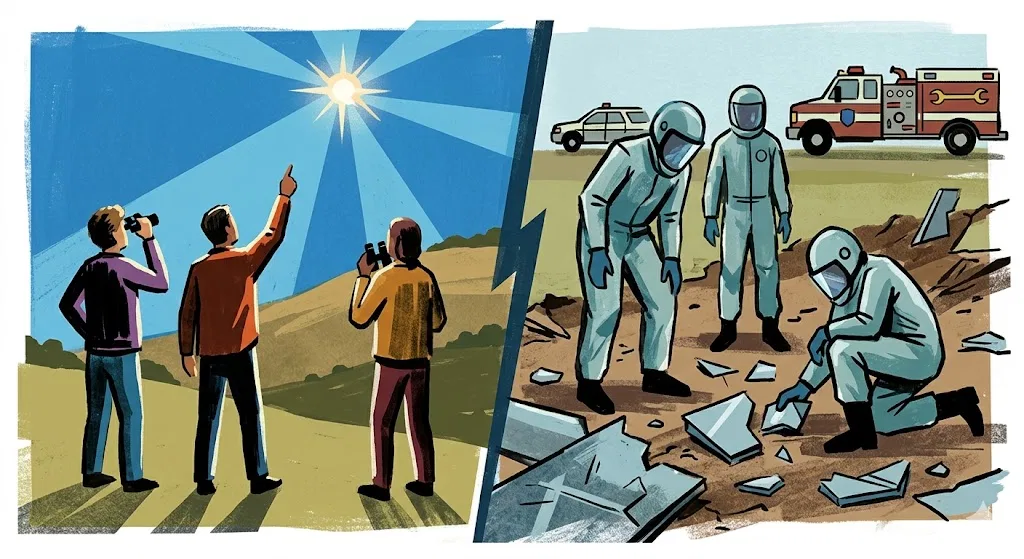
Crash claims deserve separate scrutiny because they imply recoverable evidence rather than only ambiguous observation.
On this page
- Why physical evidence changes the question
- Ambiguous lights versus alleged wreckage
- How standards should rise with the claim
Page outline Jump by section
Introduction
Crash claims are different from ordinary UFO sightings because they change the evidential question. A sighting usually asks whether a witness, camera or radar track recorded something that cannot yet be identified. A crash claim says something more demanding: an object came down, interacted with the ground or water, and should have left recoverable traces. That makes the claim potentially more testable, but also easier to overstate.
In the broader subject of UFO crashes, this distinction matters because “unidentified” is not the same as “recovered non-human craft”. Modern UAP agencies, including NASA’s independent study team and the US All-domain Anomaly Resolution Office, repeatedly stress that many reports remain unresolved because data are limited, not because the cause is extraordinary. NASA’s 2023 report found no conclusive peer-reviewed evidence for an extraterrestrial origin of UAP, while AARO’s public material says many resolved cases turn out to be balloons, drones, birds, satellites or other ordinary objects.[NASA Science]science.nasa.govNASA ScienceIndependent Study Team ReportSeptember 13, 2023 — To date, in the peer-reviewed scientific literature, there is no conclusive…
Why physical evidence changes the question
An ordinary UFO sighting can remain genuinely puzzling even when there is no physical residue. A pilot may report lights moving oddly; a thermal camera may capture a small object; radar may record something ambiguous; witnesses may disagree about distance, size or speed. The problem is often interpretive: the evidence exists, but the observer lacks enough context to identify the object.
A crash claim is more concrete. If something large enough to be mistaken for a craft struck land or water, investigators would expect at least some combination of:
- a documented search-and-rescue response;
- impact marks, fire damage, broken vegetation, disturbed soil or seabed traces;
- wreckage, fragments, fluids, ash, residues or biological material;
- photographs, maps, police logs, military records or press reports made close to the event;
- a chain of custody showing who collected any material, where it went, and how it was tested;
- independent laboratory results that can be repeated or challenged.
This is why crash claims deserve separate scrutiny. They are not merely “better sightings”. They are claims about physical events. If the alleged crash leaves no material trail, no contemporary records and no verifiable recovery path, it becomes less like an archaeological or accident-investigation problem and more like a late-developing story about missing evidence.
The contrast is visible in Roswell. The 1947 incident has a documentary core: a military press release, a corrected explanation, FBI communication and later government review. But the US Government Accountability Office found records describing the recovered object as a radar-tracking balloon or a high-altitude weather balloon with a radar reflector, not an alien craft. It also found that some relevant Roswell Army Air Field records had been destroyed, which helped sustain suspicion without providing positive evidence of a crashed spacecraft.[GAO]gao.govNSIAD-95-187 Government RecordsNSIAD-95-187 Government RecordsJuly 28, 1995 — 28 Jul 1995 — The 509th-RAAF report noted the recovery of a “flying disc” that was late…
Ambiguous lights versus alleged wreckage
Most ordinary sightings are built around perception. People see lights, shapes, speed changes, apparent hovering or odd trajectories. Even serious reports by pilots or military personnel can be hard to resolve if the record lacks calibrated sensor data, range, angle, weather context, metadata or multiple independent viewpoints. AARO’s 2024 annual report said it received 757 UAP reports for the covered period, but its ability to resolve cases remained constrained by the quality and timeliness of sensor data.[U.S. Department of War]media.defense.govFY24 CONSOLIDATED ANNUAL REPORT ON UAP 508FY24 CONSOLIDATED ANNUAL REPORT ON UAP 508
A crash claim narrows the field in one way but raises the stakes in another. If witnesses report a “light” descending into the sea, the sighting may be ambiguous. If they report a crash, investigators can ask: Was an aircraft missing? Did emergency services search? Was debris found? Did sonar, divers or local boats recover anything? Did the event leave pollution, foam, metal, oil, scorched material or official paperwork?
Shag Harbour in Nova Scotia is useful because it sits between the two categories. In October 1967, witnesses reported a lit object descending into the water, and Canadian authorities treated the initial report seriously enough to involve the Royal Canadian Mounted Police, the Coast Guard and military search activity. Library and Archives Canada describes it as Canada’s most famous UFO incident and notes that it was investigated by the RCMP and Canadian Forces.[recherche-research.bac-lac.gc.ca]recherche-research.bac-lac.gc.caOpen source on gc.ca.
Yet the case also shows the limit of “crash-like” evidence. A search can prove that authorities responded to a reported emergency; it does not by itself prove that a craft was recovered. Contemporary accounts and later summaries describe searches, missing-aircraft checks and the absence of confirmed wreckage. That makes Shag Harbour stronger than a simple lights-in-the-sky anecdote, but still short of a verified recovery case.[Wikipedia]WikipediaShag Harbour UFO incidentShag Harbour UFO incident
What a crash claim must prove that a sighting does not
A sighting report normally has to establish that the observer saw something real, that the account is not a hoax, and that common explanations have not yet solved it. A crash claim has to clear additional hurdles.
First, it must prove descent or impact rather than appearance. A light that seems to fall may be a meteor, aircraft light, flare, satellite re-entry, drone, balloon, reflection or misjudged distant object. The witness may be sincere and still misread distance or direction. A crash claim therefore needs evidence that something actually contacted land or water.
Second, it must separate emergency response from recovery. Police, coastguards, air forces and local responders investigate possible crashes because lives may be at risk. Their involvement proves that a report was treated as serious at the time. It does not automatically prove that an exotic object existed.
Third, it must preserve the material trail. Debris without provenance is weak evidence. A fragment said to come from a crash site becomes meaningful only if its collection, storage, handling and testing history are clear. Without that, ordinary industrial materials, slag, aircraft parts, balloon components or hoax items can be mislabelled as extraordinary.
Fourth, it must survive ordinary explanations that fit crash-like reports particularly well. Balloons and radar reflectors can leave strange lightweight debris. Aircraft accidents produce search operations. Missile tests and classified programmes produce secrecy. Meteors and re-entries can produce brilliant descent reports without recoverable local wreckage. Military exercises can create partial records that look suspicious later.
Roswell illustrates the last point especially well. The Air Force’s later explanation linked the debris to Project Mogul, a classified balloon programme intended to monitor Soviet nuclear tests. That explanation is contested by many UFO believers, but it explains why unusual debris, an initially dramatic public statement and later official embarrassment could coexist without requiring an extraterrestrial crash.[GAO]gao.govNSIAD-95-187 Government RecordsNSIAD-95-187 Government RecordsJuly 28, 1995 — 28 Jul 1995 — The 509th-RAAF report noted the recovery of a “flying disc” that was late…
Why “unresolved” is not the same as “crashed”
A frequent misunderstanding in UFO-crash discussions is to treat any unresolved case as a step towards a recovery claim. That is a logical leap. “Unresolved” usually means that available information is insufficient, conflicting or not yet analysed, not that investigators have evidence of wreckage.
NASA’s UAP study made this point in scientific terms: the problem is often poor data, missing metadata and lack of standardised collection rather than a shortage of speculation. AARO’s public trend data similarly shows that many closed UAP cases resolve into ordinary categories, including balloons, satellites, unmanned aircraft systems and birds.[NASA Science]science.nasa.govNASA ScienceIndependent Study Team ReportSeptember 13, 2023 — To date, in the peer-reviewed scientific literature, there is no conclusive…
This matters because crash stories often borrow credibility from ordinary sightings. A witness report becomes a “descent”. A descent becomes a “crash”. A crash becomes a “recovery”. A recovery becomes a hidden programme. Each step may be possible in theory, but each requires new evidence. Without that evidence, the story has not simply become more detailed; it has become more demanding.
The 2013 Aguadilla case shows how even instrumented UAP cases can remain contested without becoming crash claims. A thermal video recorded by a US Customs and Border Protection aircraft was analysed by independent UAP researchers, who argued for anomalous behaviour. AARO later assessed the case and reported with high confidence that the objects did not show anomalous speeds or performance beyond known capabilities, and that the video depicted two objects travelling near each other rather than one object splitting.[Zenodo]zenodo.orgOpen source on zenodo.org.
The important point is not that every official explanation is automatically final. It is that a video, radar trace or witness account belongs to a different evidence class from alleged recovered wreckage. Sightings are about identification. Crashes are about physical verification.
Material samples raise the bar, not lower it
Some UFO cases involve alleged materials rather than full crash sites. These are important because they sit closest to what crash claims promise: something that can be tested. But material evidence can cut both ways. It can strengthen a case if provenance is clear and the sample shows features that cannot be explained by known terrestrial processes. It can weaken a case if the material turns out to be ordinary, contaminated, misidentified or poorly documented.
A 2022 peer-reviewed paper by Garry Nolan, Jacques Vallée, Sizun Jiang and Larry Lemke reviewed modern analytical techniques, including isotopic analysis, for unusual materials with possible relevance to aerospace forensics. The paper is often cited because it treats alleged UAP-related materials as a scientific testing problem rather than a matter of belief.[ADS Astronomy Database]ui.adsabs.harvard.eduOpen source on harvard.edu.
That approach is useful for crash claims precisely because it avoids relying on the label attached to a sample. A fragment is not persuasive because someone calls it “debris”. It becomes persuasive only if investigators can answer practical questions: where it was found, who collected it, what controls were used, what known materials it resembles, whether independent laboratories agree, and whether the findings require an extraordinary origin.
This is where many crash narratives struggle. A dramatic story may include claims of bodies, secret convoys, military lockdowns or hangar storage, but the testable object is absent. The stronger the claimed recovery, the less satisfying it is to rely only on anonymous testimony, late recollection or documents that do not directly mention the alleged artefact.

How standards should rise with the claim
A fair standard does not require dismissing every UFO crash claim in advance. It requires matching the evidence threshold to the claim being made.
For ordinary sightings, reasonable questions include whether the witness was credible, whether the object could be a known aircraft or astronomical body, whether sensor data exist, and whether multiple independent reports agree. For crash claims, those questions are only the start. The claim should also be judged by accident-investigation logic: site, debris, records, recovery chain, laboratory testing and alternative explanations.
A useful decision path is:
- Was there a real incident? Contemporary records, emergency calls, press reports or official logs matter more than later retellings.
- Was there an actual impact or only an apparent descent? Many “crashes” begin as lights that seemed to fall.
- Was anything recovered? If yes, the material should have a documented chain of custody.
- Has the material been independently tested? Extraordinary claims should not rest on a single opaque analysis.
- Do prosaic explanations fit the evidence? Balloons, aircraft, missiles, drones, meteors, hoaxes and classified programmes must be considered before exotic conclusions.
- Did the story grow after the fact? Additions made decades later should be treated differently from contemporary records.
These standards are not designed to make UFO crashes impossible to prove. They are designed to make the claim clearer. A crash, unlike a fleeting sighting, should leave a trail. When that trail exists, the case becomes more investigable. When it does not, the missing evidence becomes part of the assessment.
The practical difference for readers
The simplest way to separate crash claims from ordinary UFO sightings is to ask what evidence the claim itself predicts. A sighting predicts reports, images, sensor records or witness testimony. A crash predicts those things plus physical consequences. That difference is why crash stories are so compelling, and why they should be judged more strictly.
Roswell remains famous because it has records, debris claims, official confusion and later mythology. Shag Harbour remains interesting because there was a real search for something reported in the water. But neither case becomes a verified recovered non-human craft merely because it is unresolved, contested or culturally important. The evidential burden rises when the claim moves from “something was seen” to “something crashed”.
That is the core distinction. Ordinary UFO sightings ask whether an observation can be identified. UFO crash claims ask whether an alleged physical event can be reconstructed. The second question is more promising because it should produce evidence, but it is also less forgiving when that evidence is missing.
Amazon book picks
Further Reading
Books and field guides related to Why Crashes Are Different From Sightings. Use these as the next step if you want deeper reading beyond the article.
The UFO Experience
Directly supports the distinction between sightings, close encounters, evidence quality, and investigation standards.
Crash at Corona
Represents the classic crash-claim lane, useful for contrasting alleged wreckage with ordinary sightings.
The Report on Unidentified Flying Objects
Helps readers understand how official investigators classified sightings and handled evidence.
UFOs: Generals, Pilots, and Government Officials Go on the Re...
Frames serious UFO evidence around testimony, documentation, and standards of proof rather than sensational claims.
eBay marketplace picks
Marketplace Samples
Live-tested eBay searches with available results related to this page.



Endnotes
1.
Source: science.nasa.gov
Link:https://science.nasa.gov/wp-content/uploads/2023/09/uap-independent-study-team-final-report.pdf
Source snippet
NASA ScienceIndependent Study Team ReportSeptember 13, 2023 — To date, in the peer-reviewed scientific literature, there is no conclusive...
Published: September 13, 2023
2.
Source: aaro.mil
Link:https://www.aaro.mil/UAP-Cases/UAP-Reporting-Trends/
Source snippet
UAP Reporting TrendsClosed Cases Resolution Outcomes; Bird(s), 28, 2.9%; Satellite(s), 314, 32.1%; Balloon(s), 510, 52.1%; UAS, 7...
3.
Source: gao.gov
Title: NSIAD-95-187 Government Records
Link:https://www.gao.gov/assets/nsiad-95-187.pdf
Source snippet
NSIAD-95-187 Government RecordsJuly 28, 1995 — 28 Jul 1995 — The 509th-RAAF report noted the recovery of a “flying disc” that was late...
Published: July 28, 1995
4.
Source: recherche-research.bac-lac.gc.ca
Link:https://recherche-research.bac-lac.gc.ca/eng/public/list/43130
5.
Source: Wikipedia
Title: Shag Harbour UFO incident
Link:https://en.wikipedia.org/wiki/Shag_Harbour_UFO_incident
6.
Source: zenodo.org
Link:https://zenodo.org/records/7844175
7.
Source: aaro.mil
Title: Puerto Rico UAP Case Resolution
Link:https://www.aaro.mil/Portals/136/PDFs/case_resolution_reports/AARO_Puerto_Rico_UAP_Case_Resolution.pdf
8.
Source: Wikipedia
Title: Roswell incident
Link:https://en.wikipedia.org/wiki/Roswell_incident
9.
Source: Wikipedia
Title: Project Mogul
Link:https://en.wikipedia.org/wiki/Project_Mogul
10.
Source: Wikipedia
Title: All domain Anomaly Resolution Office
Link:https://en.wikipedia.org/wiki/All-domain_Anomaly_Resolution_Office
11.
Source: Wikipedia
Title: NASA Unidentified Anomalous Phenomena Independent Study Team
Link:https://en.wikipedia.org/wiki/NASA_Unidentified_Anomalous_Phenomena_Independent_Study_Team
12.
Source: Wikipedia
Title: Investigation of UFO reports by the United States government
Link:https://en.wikipedia.org/wiki/Investigation_of_UFO_reports_by_the_United_States_government
13.
Source: Wikipedia
Title: Project Blue Book
Link:https://en.wikipedia.org/wiki/Project_Blue_Book
14.
Source: Wikipedia
Title: Condon Committee
Link:https://en.wikipedia.org/wiki/Condon_Committee
15.
Source: war.gov
Link:https://www.war.gov/UFO/release/03/?type=.aud
16.
Source: war.gov
Title: media engagement with acting aaro director tim phillips on the historical recor
Link:https://www.war.gov/News/Transcripts/Transcript/Article/3702219/media-engagement-with-acting-aaro-director-tim-phillips-on-the-historical-recor/
17.
Source: war.gov
Title: department of defense releases the annual report on unidentified anomalous phen
Link:https://www.war.gov/News/Releases/Release/Article/3964824/department-of-defense-releases-the-annual-report-on-unidentified-anomalous-phen/
18.
Source: aaro.mil
Link:https://www.aaro.mil/
19.
Source: aaro.mil
Title: UAP Records
Link:https://www.aaro.mil/UAP-Records/
20.
Source: aaro.mil
Link:https://www.aaro.mil/UAP-Cases/Official-UAP-Imagery/
21.
Source: aaro.mil
Title: Congressional Press Products
Link:https://www.aaro.mil/Congressional-Press-Products/
22.
Source: aaro.mil
Link:https://www.aaro.mil/Submit-A-Report/
23.
Source: aaro.mil
Title: UNCLASSIFIED FY23 Consolidated Annual Report on UAP Oct 25 2023 1236
Link:https://www.aaro.mil/Portals/136/PDFs/UNCLASSIFIED-FY23_Consolidated_Annual_Report_on_UAP-Oct_25_2023_1236.pdf
24.
Source: science.nasa.gov
Link:https://science.nasa.gov/uap/
25.
Source: science.nasa.gov
Link:https://science.nasa.gov/uap/faqs/
26.
Source: archives.gov
Title: Project BLUE BOOK
Link:https://www.archives.gov/research/military/air-force/ufos
27.
Source: vault.fbi.gov
Title: Roswell UFO
Link:https://vault.fbi.gov/Roswell%20UFO
28.
Source: fbi.gov
Title: ufos and the guy hottel memo
Link:https://www.fbi.gov/news/stories/ufos-and-the-guy-hottel-memo
29.
Source: media.defense.gov
Title: FY24 CONSOLIDATED ANNUAL REPORT ON UAP 508
Link:https://media.defense.gov/2024/Nov/14/2003583603/-1/-1/0/FY24-CONSOLIDATED-ANNUAL-REPORT-ON-UAP-508.PDF
30.
Source: ui.adsabs.harvard.edu
Link:https://ui.adsabs.harvard.edu/abs/2022PrAeS.12800788N/abstract
31.
Source: media.defense.gov
Title: DOPSR 2024 0263 AARO HISTORICAL RECORD REPORT VOLUME 1 2024
Link:https://media.defense.gov/2024/Mar/08/2003409233/-1/-1/0/DOPSR-2024-0263-AARO-HISTORICAL-RECORD-REPORT-VOLUME-1-2024.PDF
32.
Source: media.defense.gov
Title: AFD 101027 030
Link:https://media.defense.gov/2010/Oct/27/2001330219/-1/-1/0/AFD-101027-030.pdf
33.
Source: ui.adsabs.harvard.edu
Link:https://ui.adsabs.harvard.edu/abs/2025PrAeS.15601097K/abstract
34.
Source: dvidshub.net
Link:https://www.dvidshub.net/video/988675/pr-017-unresolved-uap-report-europe-2024
Additional References
35.
Source: sgp.fas.org
Link:https://sgp.fas.org/othergov/roswell.html
Source snippet
FAS Project on Government SecrecyGAO Report on Roswell, NM UFO CrashThe FBI message stated that the military had reported that an object...
36.
Source: arxiv.org
Link:https://arxiv.org/html/2502.06794v2
37.
Source: youtube.com
Title: Nasa UFO report: What we learned from UAP study
Link:https://www.youtube.com/watch?v=eTaltOQLVLU
Source snippet
NASA: No evidence to suggest UFOs are 'extra-terrestrial in origin'...
38.
Source: cia.gov
Link:https://www.cia.gov/readingroom/docs/CIA-RDP81R00560R000100060001-5.pdf
39.
Source: nsa.gov
Link:https://www.nsa.gov/Helpful-Links/NSA-[FOIA
40.
Source: youtube.com
Title: Unidentified Anomalous Phenomena Independent Study Report
Link:https://www.youtube.com/watch?v=TQcqOW39ksk
Source snippet
Nasa UFO report: What we learned from UAP study - BBC News...
41.
Source: researchgate.net
Link:https://www.researchgate.net/publication/374373111_UFOs_and_Unidentified_Anomalous_Phenomena_The_NASA_report_1492023_has_found_no_evidence_to_suggest_that_UAPs_are_extraterrestrial_in_origin
42.
Source: researchgate.net
Link:https://www.researchgate.net/publication/380829743_A_novel_thin_plate_spline_methodology_to_model_tissue_surfaces_and_quantify_tumor_cell_invasion_in_organ-on-chip_models
43.
Source: aui.edu
Link:https://aui.edu/aaro-releases-report-on-unidentified-anomalous-phenomena-uap/
44.
Source: medium.com
Link:https://medium.com/quantum-psychology-and-engineering/an-inquiry-into-the-material-evidence-of-non-human-intelligence-04dc38a85103
Topic Tree