Within UFO Crashes
Do Missing Files Prove a Cover Up?
Destroyed or missing files can fuel suspicion, but they do not automatically supply evidence of alien recovery.
On this page
- Roswell records and archival gaps
- Ordinary reasons records disappear
- How to avoid arguing from absence
Page outline Jump by section
Introduction
Missing or destroyed files are one of the main reasons UFO crash stories keep returning to public debate. They matter because a crash claim should, in theory, leave a paper trail: incident reports, base messages, transport logs, photographs, laboratory records, security orders, and later archival transfers. When those records cannot be found, suspicion grows.
But missing files do not, by themselves, prove an alien recovery. They prove an evidential gap. The key question is what kind of gap it is: a suspiciously targeted destruction, an ordinary records-management loss, a file that was never required, a record held under another name, or a genuine absence where stronger evidence should have survived. Roswell is the central example because official searches did find some missing military records from the right period, while also finding no government record that documented a recovered extraterrestrial craft.[GovInfo]govinfo.govGAOREPORTS NSIADResults of a Search for Records Concerning the 1947…Government Records: Results of a Search for Records Concerning the 1947 Cra…
Why missing records feel so powerful in UFO crash cases
UFO crash claims are different from ordinary sightings because they imply recoverable evidence. A bright object in the sky can vanish without leaving much behind; a crashed machine should leave materials, logistics, witnesses, accident paperwork, and storage records. That is why an empty archive can feel almost as dramatic as a discovered file. If the expected records are gone, believers may read the absence as the shape of a cover-up.
The risk is that this can become an argument from absence: “the records are missing, therefore the most extraordinary explanation is true.” That reasoning is tempting but weak. Missing records can support a narrower claim, such as “the archive is incomplete” or “the destruction was poorly documented”. They cannot, on their own, establish what the lost records contained. To move from missing files to alien recovery, a case still needs positive evidence: contemporary documentation, verifiable physical material, consistent chain of custody, or independent corroboration from records that survived elsewhere.
This distinction is not just sceptical caution. It is the normal standard used in historical research. Archives are not complete mirrors of the past. They are the residue of decisions about what to create, classify, retain, transfer, declassify, redact, misfile, or destroy. In UFO crash debates, that messy reality is often mistaken for a single hidden design.
Roswell records and archival gaps
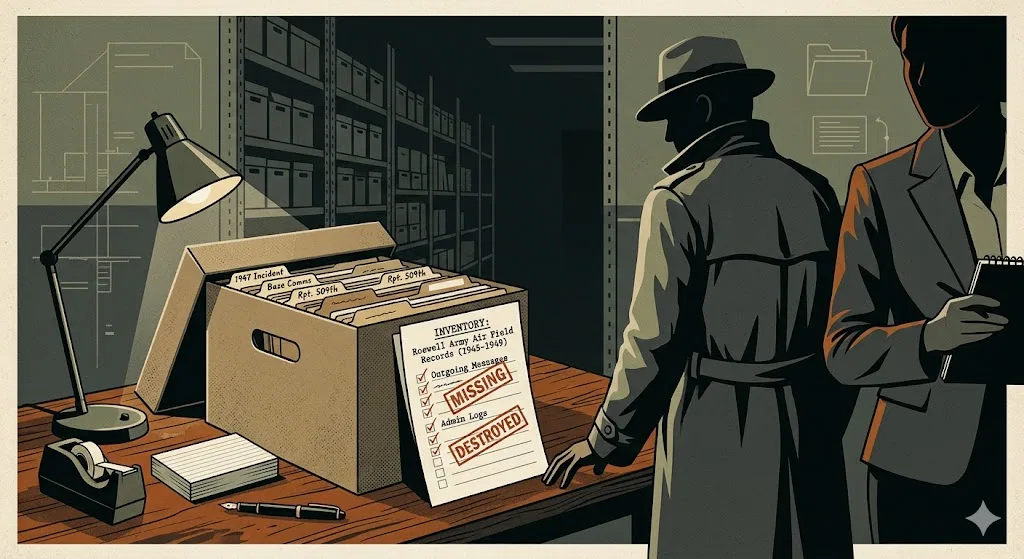
Roswell is the strongest case study for this problem because there really were missing records. In 1995, the United States General Accounting Office, now the Government Accountability Office, reported the results of a search for records concerning the 1947 crash near Roswell, New Mexico. The search was prompted by congressional interest and examined whether government records existed and whether they had been properly handled.[GovInfo]govinfo.govGAOREPORTS NSIADResults of a Search for Records Concerning the 1947…Government Records: Results of a Search for Records Concerning the 1947 Cra…
The GAO found that some Roswell Army Air Field records from the relevant period had been destroyed. In particular, administrative records from March 1945 through December 1949 and outgoing messages from October 1946 through December 1949 were destroyed. The disposition form did not show who destroyed them, when, or under what authority. That is a real archival problem, and it understandably gave critics a reason to question the official record.[FAS Project on Government Secrecy]sgp.fas.orgFAS Project on Government SecrecyGAO Report on Roswell, NM UFO CrashIn our search for records concerning the Roswell crash, we learned th…
The same report, however, also matters for what it did find. GAO located two 1947 records directly concerning Roswell: a combined 509th Bomb Group and Roswell Army Air Field history report, and an FBI teletype dated 8 July 1947. The 509th/RAAF history described the recovered “flying disc” as later determined to be a radar-tracking balloon, and the FBI teletype reported that the object resembled a high-altitude weather balloon with a radar reflector.[Justia GAO Reports]gao.justia.comGAO Reports NSIADGAO Reports NSIAD
That creates the central tension. The missing outgoing messages could have clarified what Roswell officers told higher commands in real time. Their absence weakens the completeness of the archive. But the surviving contemporary records do not say “alien craft”, “bodies”, “non-human technology”, or anything equivalent. The strongest documented conclusion is therefore not “Roswell is solved by missing files”, nor “missing files prove a cover-up”. It is that the archive is incomplete, while the available contemporary record points towards a balloon-related explanation rather than extraterrestrial recovery.
The National Archives adds another important boundary. Its Project Blue Book guidance states that it has been unable to locate documentation among the Blue Book records discussing the 1947 Roswell incident. That absence is significant for researchers, but it is not the same as proof that a hidden Blue Book Roswell file once existed and was removed. It means that the surviving Blue Book holdings do not contain such documentation.[National Archives]archives.govNational Archives Project BLUE BOOKNational Archives Project BLUE BOOK
What the Roswell gap can and cannot prove
The Roswell missing-records issue is often made to carry more weight than it can bear. It can support reasonable suspicion about record handling. It can justify further searches in related archives. It can make official certainty look less tidy than a public-relations summary suggests. It cannot, by itself, identify the contents of destroyed files.
A useful way to frame the evidential value is to separate three claims:
The archive is incomplete. This is supported. GAO reported destroyed RAAF administrative records and outgoing messages from the relevant years, with inadequate documentation of the destruction.[FAS Project on Government Secrecy]sgp.fas.orgFAS Project on Government SecrecyGAO Report on Roswell, NM UFO CrashIn our search for records concerning the Roswell crash, we learned th…
The missing files could have contained useful context. This is plausible. Outgoing base messages might have shown how Roswell personnel reported the incident up the chain of command, and administrative records might have clarified base activity around the date.
The missing files prove recovery of an alien craft. This is not supported. The surviving 1947 records found by GAO described a balloon-like object, while GAO did not identify records documenting extraterrestrial wreckage, alien bodies, or a crash-retrieval programme.[Justia GAO Reports]gao.justia.comGAO Reports NSIADGAO Reports NSIAD
This distinction is important because UFO crash narratives often slide from the first claim to the third without passing through evidence. A gap may be suspicious, but suspicion is not the same as identification.
Ordinary reasons records disappear
Destroyed records sound sinister in a UFO crash context, but destruction is also a normal part of government records management. Agencies do not keep every document forever. Records schedules set retention periods and disposition instructions: some records are permanent and eventually transferred to archives, while temporary records are destroyed after they are no longer needed for business, legal, or historical purposes.[National Archives]archives.govNational Archives NARA Records ScheduleNational Archives NARA Records Schedule
That does not mean every destruction is harmless. The problem in the Roswell case is not merely that records were destroyed; it is that GAO found the relevant disposition form did not show who destroyed them, when, or under what authority. Proper records destruction is supposed to be traceable. Poorly documented destruction creates a legitimate question, even when it does not answer the larger UFO claim.[FAS Project on Government Secrecy]sgp.fas.orgFAS Project on Government SecrecyGAO Report on Roswell, NM UFO CrashIn our search for records concerning the Roswell crash, we learned th…
Several ordinary mechanisms can produce missing files without requiring an alien-crash cover-up:
- Retention schedules. Temporary administrative records may be destroyed after a set period if they are not designated permanent.
- Misclassification of importance. A record that later becomes historically valuable may have looked routine to the office that created it.
- Decentralised filing. A base, command, intelligence office, police agency, and contractor may each keep different fragments under different titles.
- Name drift. A file may not use the later popular label “Roswell” or “UFO crash”; it may be filed under weather, balloon, accident, intelligence, public affairs, or communications headings.
- Redaction and classification. A record may exist but be withheld, partly released, or stripped of names and operational details.
- Accidental loss. Moves, reorganisations, fires, poor cataloguing, obsolete media, and routine administrative churn can all break the record trail.
These possibilities do not “debunk” suspicion automatically. They simply stop absence from doing too much work. A missing file becomes more probative when the missing series is highly specific, uniquely relevant, improperly destroyed, and contradicted by surviving independent evidence. It becomes less probative when the absence fits common record-retention patterns or when surviving records point in a more ordinary direction.
Secrecy can explain suspicion without proving aliens
UFO crash suspicion often grows in the space between secrecy and evidence. Roswell is a clear example because the official story changed quickly in July 1947, and later Air Force reporting connected the debris to Project Mogul, a then-classified balloon programme intended to detect Soviet nuclear tests. A classified Cold War balloon project could produce secrecy, misleading public explanations, and unusual debris without requiring a crashed spacecraft.
This matters because cover stories are not all equal. A government can hide a classified balloon programme, reconnaissance aircraft, sensor system, nuclear test detection project, or intelligence source. That kind of concealment may be real, yet still not be evidence of extraterrestrial recovery. The existence of secrecy proves that officials had something to protect; it does not automatically identify what they were protecting.
Modern UAP reviews reinforce this caution. NASA’s 2023 independent study team said there was no conclusive evidence in peer-reviewed scientific literature suggesting an extraterrestrial origin for UAP, and it emphasised that many cases suffer from poor data, missing metadata, and inadequate sensor information.[NASA Science]science.nasa.govScience Independent Study Team ReportScience Independent Study Team Report
The Pentagon’s All-domain Anomaly Resolution Office made a similar point in its 2024 historical review. AARO reported that it found no empirical evidence that any U.S. government, private, academic, domestic, or foreign UAP investigatory effort since 1945 had uncovered verifiable information about the recovery or existence of extraterrestrial beings or craft.[U.S. Department of War]war.govdepartment of war releases unidentified anomalous phenomena files in historic tdepartment of war releases unidentified anomalous phenomena files in historic t(https://media.defense.gov/2024/Mar/08/2003409233/-1/-1/0/DOPSR-2024-0263-AARO-HISTORICAL-RECORD-REPORT-VOLUME-1-2024.PDF)
These findings do not mean every missing file has been explained. They mean that, when official reviewers examined the broader historical record, missing-record suspicion did not translate into verified evidence of alien crash retrieval.
When “no file found” is not the end of the question
A missing record can still be historically useful if handled carefully. It can show where to search next, what agencies were involved, and which claims are overreaching. In Roswell-like cases, the absence of a file should trigger a set of disciplined follow-up questions rather than a leap to a predetermined conclusion.
First, ask whether the record was required. GAO noted that 1947 Army regulations required air accident reports to be permanently maintained, but Air Force officials said there was no requirement to prepare such a report for a weather balloon crash. That distinction matters: if no formal report was required for the kind of incident officials believed they were handling, a missing accident report is less suspicious than it first appears.[Justia GAO Reports]gao.justia.comGAO Reports NSIADGAO Reports NSIAD
Second, ask whether parallel records survived. A genuine crash recovery would normally leave traces in more than one place: local base messages, higher-command correspondence, transport orders, medical records, security logs, contractor files, budget lines, storage inventories, or later declassification reviews. The absence of one series is weaker if no independent series confirms the extraordinary claim.
Third, separate contemporary records from later recollections. Many UFO crash narratives became more elaborate decades after the alleged event. Late testimony can be valuable, but it is vulnerable to memory distortion, media influence, and story convergence. A missing 1947 file cannot automatically validate a claim first developed much later.
Fourth, test the ordinary explanations with the same seriousness given to extraordinary ones. In Roswell, the surviving official records and later Air Force reports point towards balloon-related material. A critic may dispute that conclusion, but the dispute has to engage the evidence, not merely point to missing files as a substitute.
The newer UAP archive changes the debate, but not the standard of proof
Recent UAP transparency efforts have made the archive question more concrete. The National Archives has established Record Group 615, the Unidentified Anomalous Phenomena Records Collection, under the 2024 National Defense Authorization Act. NARA says the collection will contain copies of government, government-provided, or government-funded records relating to UAP, technologies of unknown origin, and non-human intelligence or equivalent subjects.[National Archives]archives.govNational Archives Unidentified Anomalous Phenomena Records CollectionNational Archives Unidentified Anomalous Phenomena Records Collection
That is important for future UFO crash debates because it creates a more explicit archival channel. Instead of arguing only about scattered historic files, researchers can ask what agencies have transferred, what has been withheld, what exemptions are claimed, and whether the collection grows over time. NARA’s Record Group 615 page says it will be updated as additional UAP records are received from federal agencies.[National Archives]archives.govNational Archives Record Group 615: Unidentified Anomalous PhenomenaNational Archives Record Group 615: Unidentified Anomalous Phenomena
Still, a new records collection does not reverse the burden of proof. It may reveal overlooked material, clarify old rumours, or expose poor recordkeeping. It may also show that some claims were built from circular reporting, repeated anecdotes, or misidentified programmes. AARO’s discussion of KONA BLUE is a useful example: some interviewees described it as connected to alleged non-human biologics, but AARO reported that KONA BLUE was a proposed Department of Homeland Security programme that was never approved or formally established.[AARO]aaro.milUAP RecordsUAP Records
For readers, the practical lesson is that transparency improves the record, but it does not make every archival gap meaningful in the same way. The stronger the archive becomes, the more carefully missing pieces can be evaluated.
How to avoid arguing from absence
The safest way to read destroyed or missing UFO crash records is to treat them as a clue, not a verdict. A gap can justify suspicion, but it should not be allowed to become a blank screen onto which any desired conclusion is projected.
A good test is to ask what would change your mind. If missing records count as evidence for a crash retrieval, would surviving records pointing to a balloon count against it? If a destroyed message file is treated as suspicious, would a routine retention schedule reduce that suspicion? If no physical debris with a reliable chain of custody exists, how much work is the missing archive being asked to do?
A balanced assessment uses three categories:
Known facts. Roswell-related RAAF administrative records and outgoing messages from relevant years were destroyed, and GAO could not determine from the disposition form who destroyed them, when, or under what authority.[FAS Project on Government Secrecy]sgp.fas.orgFAS Project on Government SecrecyGAO Report on Roswell, NM UFO CrashIn our search for records concerning the Roswell crash, we learned th…
Reasonable inferences. Those missing records might have contained useful information about how the base described the incident internally, and their absence makes the public record less complete.
Unsupported leaps. The missing records do not prove alien wreckage, bodies, reverse engineering, or a secret recovery programme. Those claims require positive evidence beyond the fact that records are absent.
This approach keeps the question open where the evidence is genuinely incomplete, while resisting a common mistake in UFO crash debates: treating silence as if it were testimony. Missing files can explain why suspicion persists. They do not, by themselves, prove what crashed.

Amazon book picks
Further Reading
Books and field guides related to Do Missing Files Prove a Cover-Up?. Use these as the next step if you want deeper reading beyond the article.
The Demon-Haunted World
Rating: 4.5/5 from 43 Google Books ratings
Addresses reasoning errors such as arguments from absence.
Area 51
Rating: 4.0/5 from 20 Google Books ratings
Examines government secrecy claims and documentary gaps.
UFOs and the National Security State
Discusses records, secrecy and government responses.
eBay marketplace picks
Marketplace Samples
Example marketplace items related to this page. Use the search link to explore similar finds on eBay.



Endnotes
1.
Source: govinfo.gov
Title: GAOREPORTS NSIAD 95 187
Link:https://www.govinfo.gov/content/pkg/GAOREPORTS-NSIAD-95-187/html/GAOREPORTS-NSIAD-95-187.htm
Source snippet
Results of a Search for Records Concerning the 1947...Government Records: Results of a Search for Records Concerning the 1947 Cra...
2.
Source: sgp.fas.org
Link:https://sgp.fas.org/othergov/roswell.html
Source snippet
FAS Project on Government SecrecyGAO Report on Roswell, NM UFO CrashIn our search for records concerning the Roswell crash, we learned th...
3.
Source: gao.gov
Title: nsiad 95 187
Link:https://www.gao.gov/products/nsiad
4.
Source: gao.justia.com
Title: GAO Reports NSIAD-95-187
Link:https://gao.justia.com/department-of-defense/1995/7/government-records-nsiad-95-187/
5.
Source: vault.fbi.gov
Title: Roswell UFOOn
Link:https://vault.fbi.gov/Roswell%20UFO
6.
Source: archives.gov
Title: National Archives Project BLUE BOOK
Link:https://www.archives.gov/research/military/air-force/ufos
7.
Source: archives.gov
Title: National Archives NARA Records Schedule
Link:https://www.archives.gov/about/records-schedule
8.
Source: archives.gov
Link:https://www.archives.gov/records-mgmt/resources/unauthorizeddispositionoffederalrecords
9.
Source: science.nasa.gov
Title: Science Independent Study Team Report
Link:https://science.nasa.gov/wp-content/uploads/2023/09/uap-independent-study-team-final-report.pdf
10.
Source: science.nasa.gov
Link:https://science.nasa.gov/uap/
11.
Source: media.defense.gov
Title: DOPSR 2024 0263 AARO HISTORICAL RECORD REPORT VOLUME 1 2024
Link:https://media.defense.gov/2024/Mar/08/2003409233/-1/-1/0/DOPSR-2024-0263-AARO-HISTORICAL-RECORD-REPORT-VOLUME-1-2024.PDF
12.
Source: archives.gov
Title: National Archives Unidentified Anomalous Phenomena Records Collection
Link:https://www.archives.gov/research/topics/uaps/faqs
13.
Source: archives.gov
Link:https://www.archives.gov/research/topics/uaps
14.
Source: archives.gov
Title: National Archives Record Group 615: Unidentified Anomalous Phenomena
Link:https://www.archives.gov/research/topics/uaps/rg-615
15.
Source: aaro.mil
Title: UAP Records
Link:https://www.aaro.mil/UAP-Records/
16.
Source: archives.gov
Title: General Records Schedules
Link:https://www.archives.gov/records-mgmt/grs/intro.html
17.
Source: science.nasa.gov
Link:https://science.nasa.gov/uap/faqs/
18.
Source: sgp.fas.org
Link:https://sgp.fas.org/library/moynihan/chap3.html
19.
Source: sgp.fas.org
Link:https://sgp.fas.org/bulletin/sec52.html
20.
Source: sgp.fas.org
Link:https://sgp.fas.org/library/ciaufo.html
21.
Source: aaro.mil
Link:https://www.aaro.mil/UAP-Cases/Official-UAP-Imagery/
22.
Source: media.defense.gov
Title: GENERAL ACCOUNTING OFFICE S SCHIFF
Link:https://media.defense.gov/2021/Jul/13/2002761373/-1/-1/0/GENERAL_ACCOUNTING_OFFICE_S_SCHIFF.PDF
23.
Source: space.com
Title: nasa ufo uap study team first results revealed
Link:https://www.space.com/nasa-ufo-uap-study-team-first-results-revealed
24.
Source: war.gov
Title: department of war releases unidentified anomalous phenomena files in historic t
Link:https://www.war.gov/News/Releases/Release/Article/4480582/department-of-war-releases-unidentified-anomalous-phenomena-files-in-historic-t/
25.
Source: nationalarchives.gov.uk
Link:https://www.nationalarchives.gov.uk/help-with-your-research/research-guides/ufos/
26.
Source: cdn.nationalarchives.gov.uk
Link:https://cdn.nationalarchives.gov.uk/documents/information-management/sched_info_management.pdf
27.
Source: cdn.nationalarchives.gov.uk
Link:https://cdn.nationalarchives.gov.uk/documents/information-management/sched_disposal.pdf
28.
Source: Wikipedia
Title: Roswell incident
Link:https://en.wikipedia.org/wiki/Roswell_incident
29.
Source: Wikipedia
Title: National Archives and Records Administration
Link:https://en.wikipedia.org/wiki/National_Archives_and_Records_Administration
30.
Source: Wikipedia
Title: Project Blue Book
Link:https://en.wikipedia.org/wiki/Project_Blue_Book
31.
Source: nationalarchives.ie
Link:https://nationalarchives.ie/wp-content/uploads/2025/01/20201006_CivilServiceRetentionSchedule_Final.pdf
32.
Source: muller.lbl.gov
Title: Roswell Incident
Link:https://muller.lbl.gov/teaching/physics10/Roswell/RoswellIncident.html
33.
Source: catalog.hathitrust.org
Link:https://catalog.hathitrust.org/Record/002786035
34.
Source: rense.com
Link:https://rense.com/general25/finalde.htm
35.
Source: usgs.gov
Link:https://www.usgs.gov/data-management/disposition
Additional References
36.
Source: youtube.com
Title: UFO files: Congressional hearings, [crash reports]({{ ‘crash-reports/’ | relative_url }}) & intelligence revelations
Link:https://www.youtube.com/watch?v=j5ob3xQRltI
Source snippet
Roswell: The World's Biggest Alien Cover-Up Finally Exposed...
37.
Source: youtube.com
Title: Roswell: The World’s Biggest Alien Cover-Up Finally Exposed
Link:https://www.youtube.com/watch?v=5RueuqXrQE4
Source snippet
The Age of Disclosure: Who Actually Controls the UAP Secrets? | w/ Dan Farah | SSHQ...
38.
Source: doi.gov
Link:https://www.doi.gov/ocio/policy-mgmt-support/information-and-records-management/records-management-policies-guidance
39.
Source: ed.gov
Link:https://www.ed.gov/about/ed-overview/required-notices/federal-records-act
40.
Source: federalregister.gov
Link:https://www.federalregister.gov/documents/2023/05/04/2023-09050/federal-records-management-digitizing-permanent-records-and-reviewing-records-schedules
41.
Source: archivesfoundation.org
Link:https://archivesfoundation.org/documents/50-years-ago-government-stops-investigating-ufos/
42.
Source: facebook.com
Link:https://www.facebook.com/SkyNewsAustralia/posts/a-second-batch-of-unidentified-anomalous-phenomena-uap-files-is-expected-to-be-r/1433343908823203/
43.
Source: hsdl.org
Link:https://www.hsdl.org/c/unidentified-anomalous-phenomena-uap/
44.
Source: reuters.com
Link:https://www.reuters.com/technology/space/pentagon-ufo-report-says-most-sightings-ordinary-objects-phenomena-2024-03-08/
45.
Source: scribd.com
Link:https://www.scribd.com/document/455791958/Retention-and-Disposal-Schedule-290509-3-pdf
Topic Tree