Within Custody
When Lab Tests Make a UFO Claim Ordinary
The Ohio aluminum specimen shows how cross-checked lab work can turn a claimed anomaly into a conventional casting-alloy explanation.
On this page
- What was reportedly recovered in Ohio
- How the tests matched common casting alloys
- Why ordinary results still matter in crash retrieval debates
Page outline Jump by section
Introduction
Among the many fragments claimed to be linked to UFO crashes, the Ohio aluminium specimen is notable because it moved in the opposite direction from popular expectation. Rather than becoming more mysterious as testing progressed, laboratory analysis increasingly pointed toward a conventional explanation. The case is often cited as an example of how metallurgical investigation can separate an unusual story from the material evidence itself.
 In discussions of crash retrievals and chain of custody, the Ohio specimen illustrates a crucial point: a laboratory can determine what a piece of metal is, but it cannot automatically verify the story attached to it. When researchers subjected the fragment to chemical and structural analysis, the results were consistent with known industrial aluminium alloys and ordinary manufacturing techniques rather than an exotic or non-human origin. That outcome did not make the case unimportant. Instead, it demonstrated how careful testing can narrow possibilities and prevent speculation from outrunning evidence.
What Was Reportedly Recovered in Ohio
The specimen entered UFO-related discussion after being presented as a potentially unusual metallic fragment recovered in Ohio and associated by some enthusiasts with unidentified aerial phenomena. As with many alleged crash-retrieval artefacts, the object’s evidentiary value depended not only on its composition but also on the reliability of its documented history.
A recurring difficulty was provenance. Public accounts typically focused on the fragment’s appearance and alleged significance rather than on a fully documented recovery record showing where it was found, who collected it, how it was stored, and how it reached laboratories for examination. This gap is common in UFO material cases and complicates efforts to connect any tested sample to a specific event.
Because the fragment was available for scientific examination, however, investigators were able to ask a more limited but more answerable question: what exactly was the metal?
How the Tests Matched Common Casting Alloys
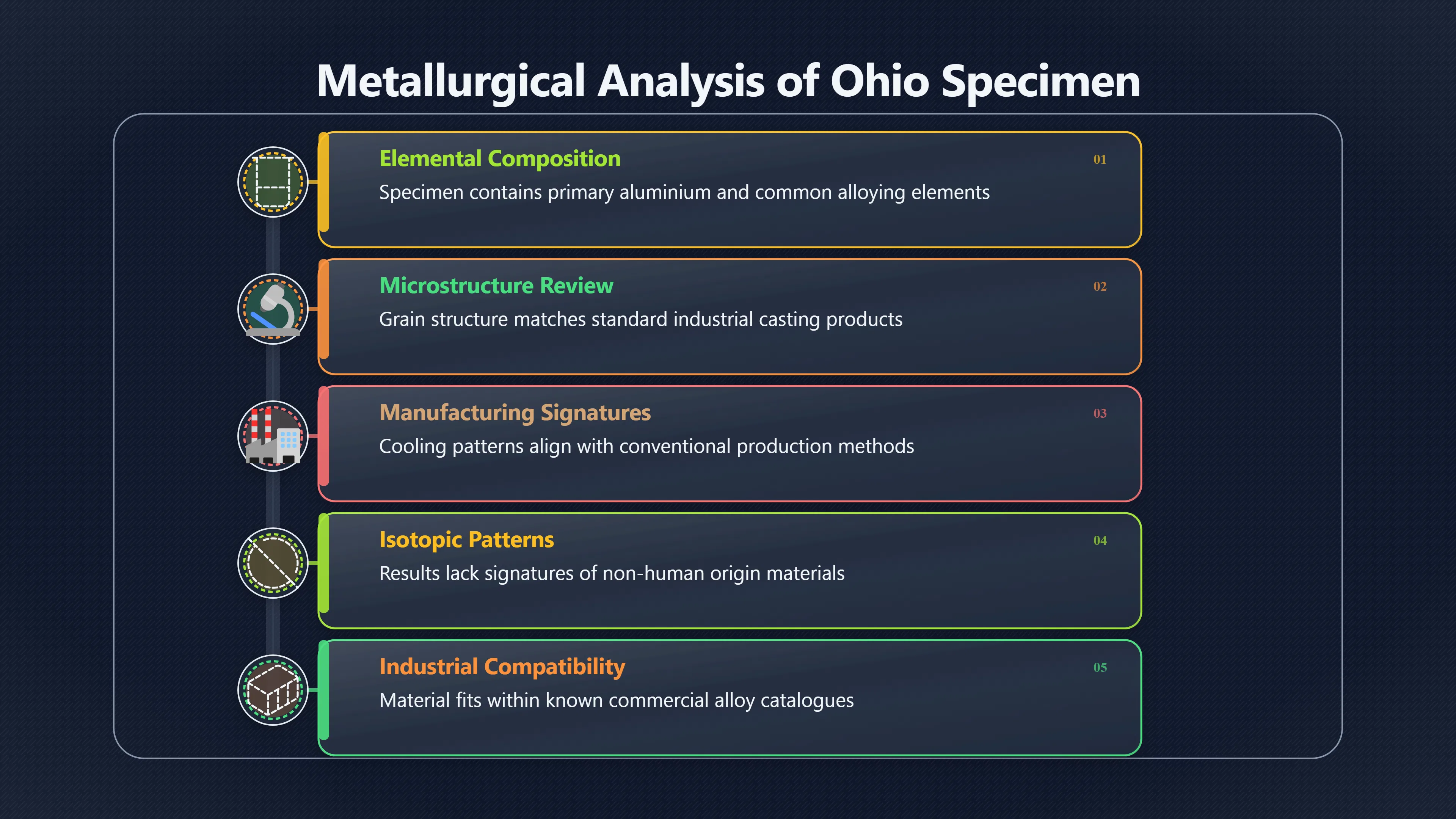
Metallurgical examination focused on elemental composition, microstructure and manufacturing characteristics. These are standard techniques used throughout materials science to identify alloys, determine production methods and assess whether a specimen differs from known industrial materials.
The reported findings indicated that the specimen was composed primarily of aluminium and contained alloying elements consistent with commercially produced casting alloys. Rather than displaying a composition outside known metallurgical practice, the material fell within ranges associated with ordinary industrial manufacture. Its structure likewise resembled what metallurgists expect to see in cast aluminium products produced through conventional processes.[Facebook]facebook.coma possible ufo metal went to a national labheres what the tests revealedA 'Possible UFO Metal' Went to a National Lab—Here's…A metal fragment long believed to be linked to the 1947 Roswell UFO crash…
This distinction matters. A genuinely anomalous material would not merely look unusual. Researchers would expect to find characteristics difficult to reconcile with known metallurgy, such as highly improbable elemental combinations, manufacturing signatures beyond current capabilities, or isotopic patterns requiring extraordinary explanation. The Ohio specimen did not produce that kind of evidence.
Instead, the testing pointed toward a familiar conclusion: the fragment appeared compatible with material that could have originated from industrial casting operations. In practical terms, metallurgists recognised features that already existed in the catalogue of known aluminium alloys and production methods.[Facebook]facebook.coma possible ufo metal went to a national labheres what the tests revealedA 'Possible UFO Metal' Went to a National Lab—Here's…A metal fragment long believed to be linked to the 1947 Roswell UFO crash…
Why Metallurgists Look Beyond Composition
An alloy’s elemental recipe is only part of the story. Researchers also examine grain structure, inclusions, cooling patterns and other microscopic features left behind during manufacture.
In the Ohio case, the significance of the findings came from the combination of chemical and structural evidence. A sample can contain uncommon elements and still be entirely terrestrial if its manufacturing signatures match known industrial processes. Conversely, an apparently ordinary chemical composition could become interesting if its structure suggested a production method unavailable to modern industry.
The available analyses pointed toward the former scenario: ordinary metallurgy explaining a supposedly unusual fragment.
Why Ordinary Results Still Matter in Crash-Retrieval Debates
Some observers treat a conventional laboratory result as a disappointing outcome. From an evidentiary perspective, however, such results are valuable.
First, they demonstrate that UFO-related material claims can be tested. The Ohio specimen did not remain permanently suspended between belief and disbelief. Researchers obtained physical evidence and subjected it to analysis, producing conclusions that could be compared against established metallurgical knowledge.
Second, the case highlights the difference between an unusual narrative and an unusual material. A fragment may be accompanied by dramatic claims, but laboratory findings must stand independently of those claims. If the metal behaves like a common casting alloy, that fact remains important regardless of the surrounding story.
Third, the case reinforces the importance of chain of custody. Even if a fragment were found to possess unusual characteristics, investigators would still need to establish a documented path from recovery site to laboratory. Without that documentation, uncertainty remains about where the object originated and whether it is connected to the event being described. The Ohio specimen shows the reverse side of the same principle: once testing identified a conventional material, the lack of extraordinary physical evidence became a stronger factor than the extraordinary narrative.
What the Ohio Alloy Case Ultimately Shows
The Ohio aluminium specimen occupies an instructive place in UFO crash literature because it demonstrates how claims can become less mysterious under scrutiny. Laboratory work did not reveal impossible metallurgy, unknown elements or manufacturing methods beyond recognised industry. Instead, the fragment’s composition and structure were consistent with known aluminium casting alloys and conventional production processes.[Facebook]facebook.coma possible ufo metal went to a national labheres what the tests revealedA 'Possible UFO Metal' Went to a National Lab—Here's…A metal fragment long believed to be linked to the 1947 Roswell UFO crash…
For readers interested in crash-retrieval evidence, the lesson is straightforward. Physical specimens gain credibility through two separate tests: documented provenance and scientific analysis. The Ohio case struggled on the first measure and produced ordinary results on the second. Far from being a failure of investigation, that outcome illustrates the value of careful materials science. Sometimes the most important finding is that a claimed UFO fragment turns out to be exactly the sort of metal that modern industry has been producing for decades.[Facebook]facebook.coma possible ufo metal went to a national labheres what the tests revealedA 'Possible UFO Metal' Went to a National Lab—Here's…A metal fragment long believed to be linked to the 1947 Roswell UFO crash…
Amazon book picks
Further Reading
Books and field guides related to When Lab Tests Make a UFO Claim Ordinary. Use these as the next step if you want deeper reading beyond the article.
Forensic Science: From the Crime Scene to the Crime Lab
Shows how ordinary explanations are tested against claims.
eBay marketplace picks
Marketplace Samples
Live-tested eBay searches with available results related to this page.



Endnotes
1.
Source: facebook.com
Title: a possible ufo metal went to a national labheres what the tests revealed
Link:https://www.facebook.com/popularmechanics/posts/a-possible-ufo-metal-went-to-a-national-labheres-what-the-tests-revealed/1321115933208973/
Source snippet
A 'Possible UFO Metal' Went to a National Lab—Here's...A metal fragment long believed to be linked to the 1947 Roswell UFO crash...
2.
Source: facebook.com
Link:https://www.facebook.com/tony.brunt.173094/posts/putting-a-face-to-someone-who-lived-in-the-shadows/3086145091774975/
Source snippet
otographs taken at Zanesville, Ohio. The analysis...
3.
Source: facebook.com
Link:https://www.facebook.com/TheOhioChannel/videos/the-us-investigation-into-ufos-was-headquartered-in-ohio-/1697718287325872/
Additional References
4.
Source: cia.gov
Link:https://www.cia.gov/readingroom/document/cia-rdp81r00560r000100010001-0
Source snippet
THE NATIONAL INVESTIGATIONS COMMITTEE ON...Blue Book UFO investigation, prepared analyses of UFO data for AF, liaison officer between Da...
5.
Source: scribd.com
Link:https://www.scribd.com/document/293042073/GROSS-Mystery-of-UFOs-a-Prelude
Source snippet
GROSS Mystery of UFOs A Prelude | PDFThe metal fragments removed for analysis were dug up from the well site and yard. The [Aurora]({{ 'aurora/' | relative_url }}) cemeter...
6.
Source: skepticalinquirer.org
Link:https://skepticalinquirer.org/wp-content/uploads/sites/29/2019/03/Issue-02-2.pdf
Source snippet
Skeptical InquirerTHE SKEPTICAL INQUIRER (formerly THE ZETETIC) is the official journal of the Committee for the Scientific Investigation...
7.
Source: skepticalinquirer.org
Link:https://skepticalinquirer.org/wp-content/uploads/sites/29/2019/03/Issue-01-13.pdf
Source snippet
near-death experiencesTHE SKEPTICAL INQUIRER is the official journal of the Committee for the Scientific Investigation of Claims of the P...
8.
Source: arxiv.org
Link:https://arxiv.org/html/2502.06794v2
Source snippet
only been observed by professional engineers, scientists, and astronomers...
9.
Source: docs.house.gov
Title: HHRG 118 GO12 Wstate ShellenbergerM 20241113
Link:https://docs.house.gov/meetings/GO/GO12/20241113/117721/HHRG-118-GO12-Wstate-ShellenbergerM-20241113.pdf
Source snippet
United States Department Of Defense And The...13 Nov 2024 — allegedly had traces of metal abrasions from the landing gear of a UFO was a...
10.
Source: kirkmcd.princeton.edu
Title: Analysis does not, as such, constitute any
Link:https://kirkmcd.princeton.edu/JEMcDonald/bloecher_67.pdf
Source snippet
on the UFO Wave of 1947by T Bloecher · 1967 · Cited by 47 — aluminum, carbonate, it is probably the only UFO on record that has bee Case...
11.
Source: reddit.com
Link:https://www.reddit.com/r/aliens/comments/m3x3nb/not_made_on_earth_the_atomic_structure_of_ufo/
Source snippet
n her possession. This is a common find among inspected...
12.
Source: ia600507.us.archive.org
Title: 36258531 Battelledoc
Link:https://ia600507.us.archive.org/6/items/BattelledocTopSecretWithOrcon.theWorldIsDividedInToThreeClassesOf/36258531-Battelledoc.pdf
Source snippet
very small group that makes things happen, a somew1 Jul 1992 — Based at Wright-Patterson AFB, Dayton, Ohio, it collected several hundred...
13.
Source: youtube.com
Link:https://www.youtube.com/watch?v=J6xtxZwrGLY
Source snippet
UFO Crash Debris! (Art's Parts) - Jimmy Akin's Mysterious World...
Topic Tree