Within Retrieval Claims
What records should a crashed craft leave?
A genuine recovered-craft programme should create mundane records for transport, storage, security, budgets, contracts and lab testing.
On this page
- Site recovery and transport records
- Budgets, contracts and facility access
- Scientific testing and chain of custody
Page outline Jump by section
Introduction
If a government or contractor genuinely recovered a crashed non-human craft and kept it for years or decades, the strongest evidence would not necessarily be dramatic photographs or eyewitness testimony. It would be paperwork. Recovering, moving, storing, securing and studying a large physical object requires people, facilities, budgets, transport, inventories and technical analysis. Those activities normally generate records at every stage. The central question for crash-retrieval claims is therefore not only whether extraordinary material exists, but whether the ordinary administrative traces of possession exist as well.
 This matters because possession claims are fundamentally different from sighting reports. A sighting can remain unresolved because data are incomplete. A recovered object, by contrast, should create a chain of documentation connecting the recovery site to laboratories, warehouses, security systems and funding streams. The stronger the claim of long-term possession and reverse engineering, the stronger the expectation that such records should exist somewhere in government or contractor archives.[U.S. Department of War]media.defense.govDOPSR 2024 0263 AARO HISTORICAL RECORD REPORT VOLUMEU.S. Department of WarAARO Historical Record Report Volume 18 Mar 2024 — Although AARO continues to conduct interviews, research programs…
What records should appear at the recovery site?
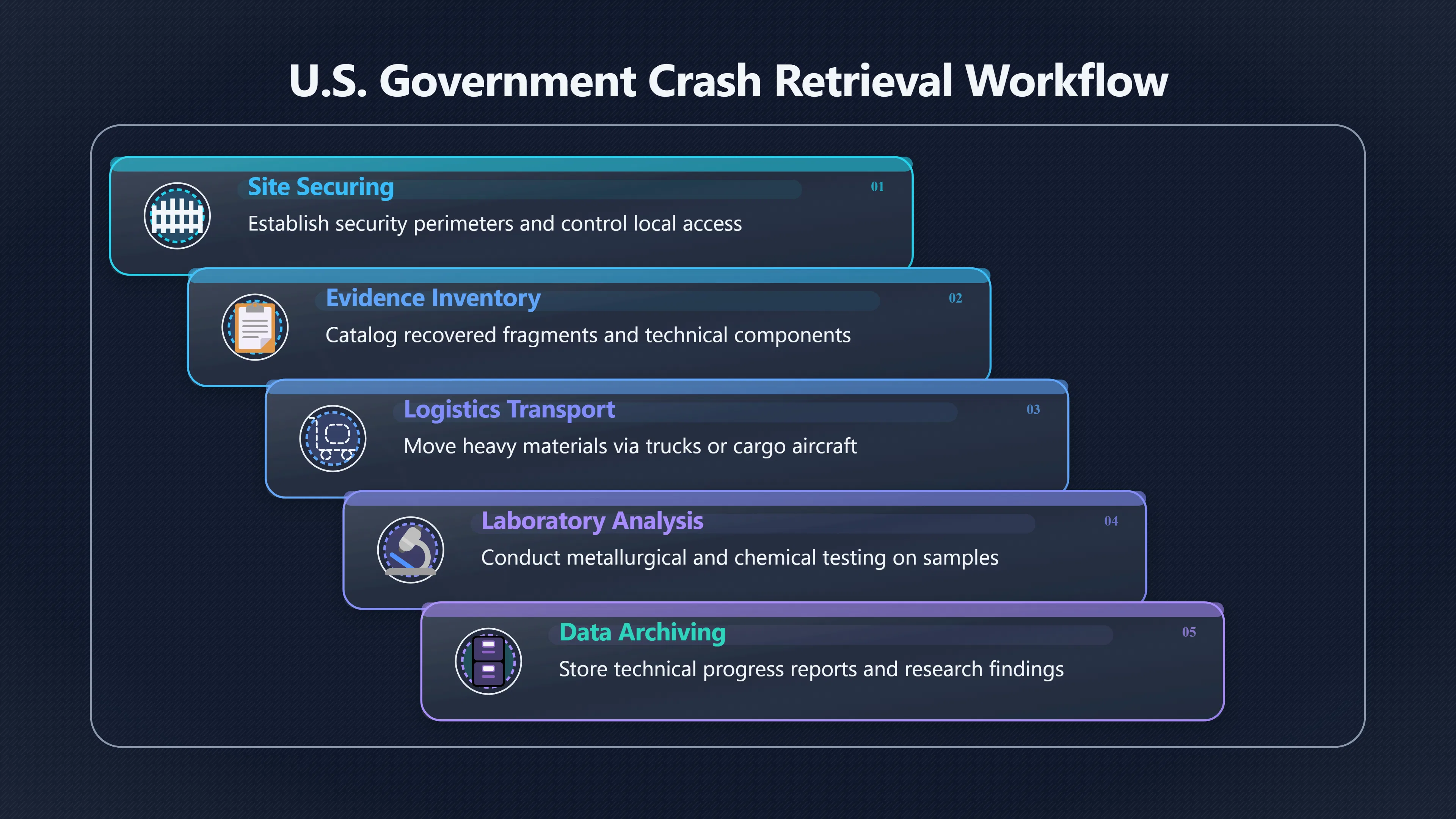
A real recovery operation would begin with the same practical problems faced after any aircraft accident, weapons incident or classified equipment loss: securing the area, controlling access and preserving evidence.
Modern accident investigations routinely generate site logs, personnel rosters, photographs, evidence inventories, witness interviews, transport authorisations and recovery reports. Agencies such as the U.S. National Transportation Safety Board (NTSB) document accident scenes through formal evidence-gathering procedures, collecting records ranging from flight logs to maintenance documentation and interview transcripts.[ntsb.gov]ntsb.govThe Investigative ProcessNTSB investigators gather the data and information needed to analyze the accident and determine a probable cause…
For an alleged UFO crash retrieval, expected records would include:
- Initial incident notifications and dispatch orders.
- Security perimeter logs identifying authorised personnel.
- Vehicle and aircraft movement records.
- Evidence inventories listing recovered fragments or components.
- Communications traffic between military units, contractors and command authorities.
- Photographic and mapping records of the site.
- Hazard assessments if unknown materials were involved.
Even highly classified programmes generally create documentation. Classification normally changes who can access records, not whether records are created in the first place.
Why transport records are especially important
Large objects rarely move invisibly through bureaucratic systems.
A substantial recovered craft would likely require trucks, cargo aircraft, rail transport or specialised handling equipment. Each step normally produces shipping manifests, loading records, maintenance logs, fuel expenditures, security escorts and destination confirmations.
Military and intelligence organisations can conceal destinations and compartmentalise information, but moving heavy or unusual material across facilities typically leaves traces in logistics systems. The larger the claimed object, the more difficult it becomes to explain decades of transport activity without corresponding documentation.
This is one reason investigators often focus on transport chains rather than dramatic eyewitness stories. Transport is repetitive, expensive and difficult to conduct entirely outside administrative systems.
Budgets, contracts and facility access
A long-running retrieval programme would not only recover material; it would have to maintain it.
Storage facilities require buildings, security staff, environmental controls, maintenance contracts and periodic inspections. Scientific work requires laboratories, equipment, personnel clearances and procurement systems. Even black-budget programmes generally generate accounting structures because salaries, infrastructure and contractor payments must be funded somehow.
In practical terms, investigators would expect to find evidence such as:
- Budget line items or special access programme funding.
- Contractor agreements and subcontractor records.
- Security clearance rosters.
- Facility access logs.
- Construction or renovation contracts for specialised storage areas.
- Procurement records for analytical equipment.
- Personnel assignments tied to programme activities.
The exact details could be classified, but the supporting infrastructure would still consume resources. A decades-long effort involving multiple facilities and contractors would likely leave a broader administrative footprint than a short-term recovery operation.
This logic explains why congressional investigators and journalists frequently search for procurement records, contractor relationships and facility histories when examining retrieval allegations. Such records are often easier to verify than witness recollections years after the fact.
The contractor problem
Many retrieval narratives propose that recovered materials were transferred to private aerospace contractors.
From an implementation perspective, this creates both opportunities and difficulties for secrecy. Contractors can operate under classified agreements and may be shielded from some public-records requests. However, contractor involvement also expands the number of people, facilities, invoices and compliance systems involved.
A programme hidden within multiple corporations would still need legal authorities, payment mechanisms, security procedures and government oversight relationships. The administrative burden increases rather than disappears.
This is why debates over crash-retrieval claims often centre on contractor records and special-access structures. If materials truly exist, many researchers argue that contractor archives may be among the most promising places to look for indirect evidence.
Scientific testing and chain of custody
The most revealing paperwork would probably emerge after recovery rather than during it.
Once material enters a laboratory, researchers need to know exactly what they are examining and where it came from. Scientific institutions and accident investigators rely on chain-of-custody procedures that track evidence from collection through storage, testing and final disposition. Transportation-investigation guidance defines chain of custody as documentation of the movement, location and possession history of evidence throughout its lifecycle.[transit.dot.gov]transit.dot.govEffective Practices in Bus Transit Accident InvestigationsDecember 20, 2021 — Chain of custody documents the movement and location of evidence and the history of persons and entities who had it i…
For an alleged recovered craft, a scientific paper trail would likely include:
- Sample accession numbers.
- Custody-transfer forms.
- Laboratory work orders.
- Metallurgical and chemical analyses.
- Imaging and microscopy records.
- Test reports and technical memoranda.
- Inventory reconciliation records.
- Disposal or archival documentation.
These records would be especially significant because they connect physical objects to specific analytical results. Without such links, claims about exotic materials become difficult to verify.
What decades of research would probably generate
A reverse-engineering effort lasting many years would normally create a substantial body of technical documentation.
Engineers studying unknown materials would write reports, propose experiments, request equipment, record failures and publish internal findings. Scientists would debate interpretations, revise conclusions and archive raw data. Managers would track milestones and funding.
The resulting documentation could include:
- Technical progress reports.
- Materials-characterisation studies.
- Patent-related filings.
- Internal briefing slides.
- Research proposals.
- Laboratory notebooks.
- Security reviews and programme audits.
Many historical classified programmes became known precisely because such administrative and technical records eventually surfaced through declassification, archival releases or oversight reviews.
Why missing paperwork matters
The absence of publicly available records does not automatically disprove a secret programme. Classified projects can remain hidden for years, and some records may be destroyed, misfiled or remain inaccessible.
However, the paper-trail question cuts both ways. Extraordinary claims about decades-long possession of recovered craft imply a level of organisational activity that would normally generate extensive documentation. The larger and more sophisticated the alleged programme, the larger the expected documentary footprint.
This expectation is reflected in recent official reviews. NASA’s UAP study emphasised that robust conclusions require high-quality, traceable data rather than anecdotes, while the Pentagon’s All-domain Anomaly Resolution Office (AARO) reported that its historical investigation found no verifiable evidence that the U.S. government or private industry possessed extraterrestrial technology and stated that examined claims lacked supporting empirical documentation. U.S. Department of War+3NASA Science+3NASA Science[science.nasa.gov]science.nasa.govNASA ScienceIndependent Study Team ReportThe study of Unidentified Anomalous Phenomena (UAP) presents a unique scientific opportunity tha…
For that reason, the most important evidence for any future retrieval claim may not be a photograph of a recovered object. It may be the mundane records showing who recovered it, where it went, who paid for it, who studied it and how its custody was documented over time. Those records are precisely what a real possession programme would be expected to leave behind.
Amazon book picks
Further Reading
Books and field guides related to What records should a crashed craft leave?. Use these as the next step if you want deeper reading beyond the article.
The UFO Experience
Provides a framework for evaluating evidence and documentation claims.
The Report on Unidentified Flying Objects
Written by a Project Blue Book leader and centered on official records.
UFO
"The full story of our national obsession with UFOs--and the covert, decades-long search by scientists, the United States military, and t...
Skinwalkers at the Pentagon
Examines claims involving government research structures and evidence trails.
eBay marketplace picks
Marketplace Samples
Live-tested eBay searches with available results related to this page.




Endnotes
1.
Source: science.nasa.gov
Link:https://science.nasa.gov/wp-content/uploads/2023/09/uap-independent-study-team-final-report.pdf
Source snippet
NASA ScienceIndependent Study Team ReportThe study of Unidentified Anomalous Phenomena (UAP) presents a unique scientific opportunity tha...
2.
Source: ntsb.gov
Link:https://www.ntsb.gov/investigations/process/Pages/default.aspx
Source snippet
The Investigative ProcessNTSB investigators gather the data and information needed to analyze the accident and determine a probable cause...
3.
Source: transit.dot.gov
Title: Effective Practices in Bus Transit Accident Investigations
Link:https://www.transit.dot.gov/sites/fta.dot.gov/files/2021-12/FTA-Report-No-0204-rev.pdf
Source snippet
December 20, 2021 — Chain of custody documents the movement and location of evidence and the history of persons and entities who had it i...
Published: December 20, 2021
4.
Source: science.nasa.gov
Link:https://science.nasa.gov/uap/faqs/
Source snippet
NASA ScienceUAP FAQsIn 2023, NASA commissioned the UAP Independent Study Team to examine unidentified anomalous phenomena from a scientif...
5.
Source: war.gov
Title: dod report discounts sightings of extraterrestrial technology
Link:https://www.war.gov/News/News-Stories/Article/Article/3701297/dod-report-discounts-sightings-of-extraterrestrial-technology/
Source snippet
Department of WarDOD Report Discounts Sightings of Extraterrestrial...8 Mar 2024 — "AARO has found no verifiable evidence that any UAP s...
6.
Source: science.nasa.gov
Link:https://science.nasa.gov/uap/
Source snippet
nasa.govUAP9 Jun 2022 — The UAP Independent Study shall report on the following questions: What types of scientific data currently collec...
7.
Source: nasa.gov
Link:https://www.nasa.gov/news-release/nasa-to-release-discuss-unidentified-anomalous-phenomena-report/
Source snippet
NASA to Release, Discuss Unidentified Anomalous...The UAP independent study team is a counsel of 16 community experts across diverse are...
8.
Source: aaro.mil
Title: UAP Records
Link:https://www.aaro.mil/UAP-Records/
Source snippet
/Information Papers13 Feb 2026 — The All-domain Anomaly Resolution Office (AARO) first learned of the KONA BLUE program from interviews c...
9.
Source: aaro.mil
Link:https://www.aaro.mil/
Source snippet
AARO HomeWelcome to the website for the All-domain Anomaly Resolution Office (AARO). Our team of experts leads the U.S. government's effo...
10.
Source: media.defense.gov
Title: DOPSR 2024 0263 AARO HISTORICAL RECORD REPORT VOLUME 1 2024
Link:https://media.defense.gov/2024/Mar/08/2003409233/-1/-1/0/DOPSR-2024-0263-AARO-HISTORICAL-RECORD-REPORT-VOLUME-1-2024.PDF
Source snippet
U.S. Department of WarAARO Historical Record Report Volume 18 Mar 2024 — Although AARO continues to conduct interviews, research programs...
11.
Source: rev.com
Title: unidentified anomalous phenomena independent study report from nasa transcript
Link:https://www.rev.com/transcripts/unidentified-anomalous-phenomena-independent-study-report-from-nasa-transcript
Source snippet
UAP Independent Study Report from NASA18 Sept 2023 — The Unidentified Anomalous Phenomena from NASA released a report to the public. Read...
12.
Source: decur.org
Title: AAR O Historical Record Report Volume 1
Link:https://decur.org/documents/aaro-historical-record-vol1
Source snippet
AARO Historical Record Report Volume 1 - DECUR8 Mar 2024 — Summary. A 63-page unclassified historical record report produced by AARO cove...
Additional References
13.
Source: reddit.com
Link:https://www.reddit.com/r/UFOs/comments/1b9wlqy/calling_out_aaros_bullshit_in_detail/
Source snippet
Calling out AARO's bullshit in detail: r/UFOsAARO investigated numerous named, and described, but unnamed programs alleged to involve UA...
14.
Source: tsb.gc.ca
Link:https://www.tsb.gc.ca/eng/enquetes-investigations/index.html
Source snippet
Investigation processThere are three phases to a TSB investigation: the field phase, the examination and analysis phase, and the report p...
15.
Source: reddit.com
Link:https://www.reddit.com/r/space/comments/16ij6ui/nasa_shares_unidentified_anomalous_phenomena/
Source snippet
NASA Shares Unidentified Anomalous Phenomena...The evidence of aliens that NASA will find is going to be "We've detected animal farts on...
16.
Source: reddit.com
Link:https://www.reddit.com/r/Futurology/comments/16ijwyl/nasa_shares_unidentified_anomalous_phenomena/
Source snippet
NASA Shares Unidentified Anomalous Phenomena...The report contains the external study team's findings and recommendations which aim to i...
17.
Source: reddit.com
Link:https://www.reddit.com/r/nasa/comments/16ij1ym/nasa_has_released_the_unidentified_anomalous/
Source snippet
NASA has released the Unidentified Anomalous...DOD and NASA now both say there are objects in the air that they can't identify. This UAP...
18.
Source: facebook.com
Link:https://www.facebook.com/OrbitalInsights/posts/in-a-series-of-high-profile-disclosures-former-us-intelligence-officer-david-gru/1315212270811394/
Source snippet
Orbital InsightsKey Claims from the Interview Existence of a Secret UAP Retrieval Program: Grusch alleged that the U.S. has been operatin...
19.
Source: laws-lois.justice.gc.ca
Link:https://laws-lois.justice.gc.ca/eng/acts/c-23.4/page-4.html
Source snippet
Transportation Accident Investigation and Safety...(3) Any on-board recording that relates to a transportation occurrence being investig...
20.
Source: defensescoop.com
Link:https://defensescoop.com/2023/10/31/dod-invites-past-and-present-military-personnel-and-contractors-to-report-uap-activity-via-new-portal/
Source snippet
DOD invites past and present military personnel...31 Oct 2023 — Those reports will support the making of AARO's in-the-works Historical...
21.
Source: youtube.com
Link:https://www.youtube.com/watch?v=bR0PaotZxD0
Source snippet
NASA UFO report finds no evidence UAP have extraterrestrial...NASA UFO report finds no evidence UAP have extraterrestrial origins | FULL...
22.
Source: youtube.com
Link:https://www.youtube.com/watch?v=TQcqOW39ksk
Source snippet
Unidentified Anomalous Phenomena Independent Study ReportNASA commissioned an independent study team to examine unidentified anomalous ph...
Topic Tree