Within UFO Crashes
Why the Cold War Fed UFO Crashes
Balloons, missiles, reconnaissance systems, and nuclear-security concerns created fertile ground for UFO crash rumors.
On this page
- Secret platforms and public misidentification
- Nuclear test detection and surveillance
- Fear, secrecy, and overloaded reporting systems
Page outline Jump by section
Introduction
Cold War technology fed UFO crash rumours because it put strange, secret, and sometimes recoverable objects into ordinary landscapes while giving officials strong reasons not to explain them plainly. High-altitude balloons, radar reflectors, missile tests, reconnaissance aircraft, nuclear-test detection systems, and overloaded air-defence reporting channels all created situations where witnesses could see debris, lights, wreckage, search parties or military secrecy and reasonably suspect something larger than a routine accident. In the context of UFO crashes, the crucial point is not that every case was “just a balloon”. It is that Cold War secrecy repeatedly produced the exact ingredients from which crash legends grow: unfamiliar materials, partial explanations, missing records, classified purposes, and a public already primed to think in terms of flying saucers.
This matters because many famous crash narratives sit at the boundary between a real event and an enlarged interpretation. A real balloon train could leave odd debris. A real classified aircraft could generate misleading UFO reports. A real nuclear-security incident could be folded into a wider story about non-human intervention. The historical record shows that those ambiguities were not accidental background noise; they were built into the Cold War security environment. U.S. Air Force+2FAS Project on Government Secrecy[af.mil]af.milU.S. Air ForceUnidentified Flying Objects and Air Force Project Blue Book > Air Force > Fact Sheet Display…
Secret Platforms Made Ordinary Skies Look Impossible
The early Cold War changed what could appear in the sky faster than the public’s expectations could adapt. Commercial airliners and familiar military aircraft flew within known altitude ranges, while experimental reconnaissance platforms operated above or beyond what many observers thought possible. When people saw something bright, silent, high, slow, fast, oddly shaped, or apparently hovering, they were not always misperceiving a mundane object. Sometimes they were seeing a real machine whose purpose, altitude or design was deliberately hidden.
The U-2 is the clearest example for sightings rather than crashes. CIA and Navy historical material describes how high-altitude U-2 testing in the mid-1950s produced a “tremendous increase” in UFO reports, partly because the aircraft flew above 60,000 feet while most airliners flew far lower and most military jets were not publicly associated with those heights. Blue Book investigators reportedly checked sightings against U-2 flight logs, which allowed them to identify some cases internally while the aircraft itself remained classified.[cia.gov]cia.govOpen source on cia.gov.
That pattern is directly relevant to crash confusion. A classified platform did not need to crash in front of a crowd to influence UFO-crash culture. It only had to teach the public that the government might deny or disguise unusual aerial events. Once people learned, or suspected, that “weather”, “research” or “training” explanations could mask secret programmes, later debris cases became harder to settle in public. The official explanation might be correct, incomplete, or intentionally bland, and outsiders had no simple way to tell which.
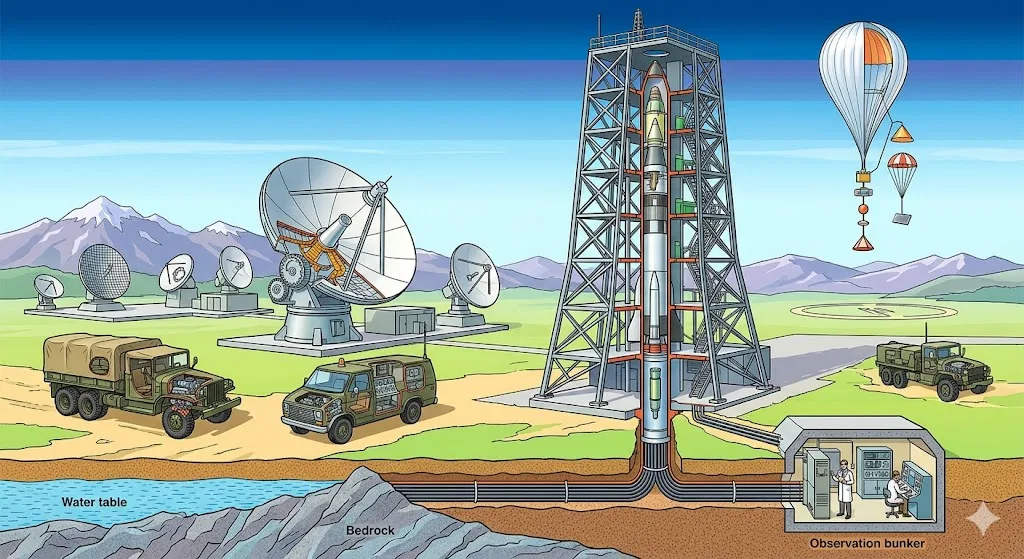
Balloons were even more fertile because they could actually come down in fields, deserts, forests or seas. Unlike a high-flying aircraft glimpsed at dusk, a balloon train could leave physical material: foil, tape, sticks, fabric, cord, batteries, instruments, parachutes or camera equipment. To an unbriefed rancher, police officer or local reporter, that debris might look too elaborate for a weather balloon and too lightweight for an aircraft. In crash folklore, that combination is potent: it gives witnesses something tangible while leaving room for disagreement over what the object had been.
Balloons Were Not a Joke Explanation
“Balloon” became a dismissive word in UFO culture, but Cold War balloon programmes were not trivial. They were part of serious military and intelligence work: gathering atmospheric data, testing high-altitude flight, carrying cameras, tracking winds, and exploring ways to detect nuclear explosions. Some were large, multi-component systems whose wreckage could look unlike anything a civilian expected from a meteorological balloon.
Project Mogul is the central case because it connects Cold War technology directly to the most famous UFO crash story. The US Air Force’s Roswell report described Mogul as an experimental attempt to detect suspected Soviet nuclear explosions and ballistic missile launches using balloon-borne acoustic sensors. The programme used balloon arrays and associated equipment, and its purpose was classified even when some university balloon work around it was not.[U.S. Department of War]war.govdepartment of war releases unidentified anomalous phenomena files in historic tdepartment of war releases unidentified anomalous phenomena files in historic t(https://media.defense.gov/2010/Oct/27/2001330219/-1/-1/0/AFD-101027-030.pdf)
That explains why Roswell became such a durable confusion point. If the recovered debris was part of Mogul, then the military had a real secret to protect, but not the secret later imagined by crash believers. The famous “weather balloon” explanation could be misleading in ordinary language while still pointing towards a real balloon-based system. In other words, the cover story and the prosaic explanation were not cleanly separable: Cold War classification made the technically accurate answer difficult to state openly.
Other balloon programmes widened the problem. Project Moby Dick and Project Genetrix used high-altitude balloons for reconnaissance-related work, including photographic surveillance of the Soviet bloc. Search results from historical and archival summaries describe Genetrix as authorised in the Eisenhower era and connected with earlier balloon work such as Moby Dick, Skyhook and Mogul. Such programmes showed that balloons could be strategic assets, not just weather instruments.[Wikipedia]WikipediaProject Moby DickProject Moby Dick
For crash claims, the practical effect was simple: balloon debris could be both ordinary and classified. A local recovery might involve military personnel, controlled access, hurried removal, or a weak public explanation. Those behaviours are exactly what later narrators treat as signs of a recovered spacecraft. The same facts can therefore support two very different readings: a secret military balloon recovered under Cold War rules, or an extraordinary craft hidden under a balloon cover.
Nuclear-Test Detection Put Strange Hardware in Remote Places
Nuclear security was one of the strongest drivers behind Cold War aerial experiments. The United States needed ways to detect Soviet nuclear tests, monitor missile development, and reduce the risk of strategic surprise. That need produced platforms and sensors that were technically unusual and operationally secret. In the crash-rumour ecosystem, nuclear detection matters because it links strange airborne hardware with the highest level of national secrecy.
Mogul’s purpose makes this especially clear. It was not merely “weather research”; it was a long-range detection effort aimed at Soviet nuclear and missile activity. A balloon system built for that purpose could use acoustic instruments, radar-tracking targets and long trains of equipment that were unfamiliar to civilians. The oddness of the materials was therefore not evidence of alien manufacture. It was evidence of a classified technical mission whose components were not designed to be publicly recognisable.[U.S. Department of War]war.govdepartment of war releases unidentified anomalous phenomena files in historic tdepartment of war releases unidentified anomalous phenomena files in historic t(https://media.defense.gov/2010/Oct/27/2001330219/-1/-1/0/AFD-101027-030.pdf)
This also helps explain why nuclear-themed UFO crash and landing stories became so persuasive to many people. Military nuclear sites were guarded, remote, secretive and symbolically charged. Reports of lights, equipment failures or aerial objects near missile fields could easily be interpreted through an extraterrestrial lens, especially when witnesses believed officials were withholding information. The CIA’s historical review noted that intelligence officials considered UFO reports partly in relation to Soviet rockets and missiles, showing that unexplained aerial reports were taken seriously as possible security signals even when not treated as alien evidence.[FAS Project on Government Secrecy]sgp.fas.orgOpen source on fas.org.
The important distinction is between “nuclear context” and “alien conclusion”. Nuclear-security concerns made officials secretive, made witnesses anxious, and made unusual aerial objects more consequential. They did not, by themselves, prove non-human origin. They did, however, create a setting in which mundane recoveries could feel unusually important and in which ambiguous incidents could be remembered as suppressed evidence.
Reconnaissance Secrecy Taught the Public to Distrust Simple Answers
Cold War governments faced a dilemma: unidentified reports could not be ignored, because some might represent Soviet aircraft, missiles, balloons or intelligence activity; but explaining every case honestly could reveal American capabilities. That tension encouraged bland public language, selective disclosure and compartmentalised knowledge.
Project Blue Book illustrates the official side of the problem. The US Air Force investigated UFO reports from 1947 to 1969 and recorded 12,618 sightings, of which 701 remained unidentified when the project ended. Its stated conclusions were that no investigated UFO indicated a threat to US national security, no evidence showed technology beyond modern scientific knowledge, and no evidence indicated extraterrestrial vehicles.[U.S. Air Force]af.milUnidentified Flying Objects and Air Force Project Blue Book > Air Force > Fact Sheet Display…
Yet those conclusions did not remove the distrust created by secrecy. The National Archives notes that Blue Book’s records were later declassified and transferred for public research, but it also records repeated public interest in alleged “MJ-12” documents and Roswell-related material. Searches for certain alleged Majestic 12 documents were largely negative, but the very need to address them shows how official secrecy and UFO crash culture had become intertwined.[National Archives]archives.govNational Archives Project BLUE BOOKNational Archives Project BLUE BOOK
The CIA’s own historical review is unusually revealing on this point. It says CIA interest in UFOs was substantial until the early 1950s, later more limited, and that the Agency’s programmes had an impact on UFO sightings while officials also tried to conceal CIA involvement in the issue. The same review describes how declassified documents produced “no smoking gun” but were still interpreted by parts of the press and public as proof of deeper hidden activity.[FAS Project on Government Secrecy]sgp.fas.orgOpen source on fas.org.
That dynamic is central to crash confusion. In a normal accident investigation, secrecy might be a temporary procedural matter. In a Cold War UFO crash claim, secrecy became part of the evidence in the public imagination. If officials withheld details to protect sources, methods or aircraft, believers could argue that the withholding itself confirmed a more extraordinary recovery.
Overloaded Reporting Systems Favoured Quick Explanations
The Cold War also created bureaucratic pressure to reduce noise. Air-defence systems had to distinguish real threats from harmless reports. A flood of UFO calls could distract personnel, clog channels, or create opportunities for an adversary to hide real activity among false alarms.
The Robertson Panel, convened in 1953, addressed this problem directly. Declassified CIA-linked summaries describe the panel’s concern that UFO reports could interfere with the recognition of genuine hostile objects and overload channels needed for prompt reaction to real threats. The panel did not find evidence that UFOs represented hostile foreign artefacts or required revisions to scientific concepts, but it did worry about the reporting burden and public anxiety.[cia.gov]cia.govOpen source on cia.gov.
This helps explain why official UFO handling could seem dismissive. Investigators were not only asking “what did the witness see?” They were also asking “how do we keep the warning system usable?” That institutional goal encouraged classification schemes, public reassurance, and sometimes rapid mundane explanations. In ordinary cases, that may have been efficient. In crash-like cases involving debris or military retrieval, it could look like a cover-up.
Project Blue Book’s large archive reflects the scale of the reporting problem. The National Archives describes 37 cubic feet of chronological case files, plus administrative and investigative records, with the microfilmed collection spread across 94 rolls. This was not a small pile of curiosities. It was an administrative burden generated by a society watching the sky during an age of air defence, nuclear fear and rapid aerospace change.[National Archives]archives.govNational Archives Project BLUE BOOKNational Archives Project BLUE BOOK
For UFO crash narratives, overloaded systems mattered because thin investigations left gaps. A report might be classified, filed, summarised, miscommunicated, or closed without satisfying witnesses. Decades later, those gaps could be read as evidence that something had been removed from the record, even when the original cause was bureaucracy rather than conspiracy.
Why “Misidentification” Does Not Always Mean “Nothing Happened”
A common mistake is to treat misidentification as a claim that witnesses were foolish or that no event occurred. Cold War crash confusion usually worked differently. Many witnesses saw something real: debris in a field, a bright object at high altitude, a military recovery, a radar track, a search operation, or a restricted area. The dispute was over interpretation.
A balloon recovery could be real and still misidentified as a crashed disc. A reconnaissance aircraft could be real and still reported as a UFO. A missile or rocket test could be real and still generate reports of falling objects or strange lights. A classified explanation could be real and still be unavailable to the people most affected by the incident.
Modern UAP reviews make the same distinction. AARO’s 2024 historical report says US government investigations since 1945 examined whether UAP represented flight safety risks, competitor technology, or off-world technology; it also states that AARO had found no empirical evidence that any UAP sighting represented off-world technology or that an unreported classified programme had recovered extraterrestrial material. At the same time, AARO acknowledges that many reports remain unresolved and argues that better-quality data would probably resolve most as ordinary objects or phenomena.[AARO]aaro.milUnclassified Final DSD AARO Historical ReportUnclassified Final DSD AARO Historical Report
That is a useful frame for Cold War crash cases. The most careful conclusion is not that every witness invented everything, nor that every secret recovery hid alien material. It is that the Cold War produced many real but poorly understood events whose official explanations were constrained by classification. That combination is enough to sustain crash rumours even when the best available evidence points to balloons, aircraft, missiles, satellites, natural phenomena or incomplete records.
What Cold War Technology Changed About UFO Crash Stories
Before the Cold War, mysterious things in the sky could be interpreted as meteors, airships, omens, secret inventions or wartime aircraft. After 1947, they increasingly entered a world of nuclear rivalry, radar networks, jet development, classified test ranges and official UFO investigations. Crash stories changed because the technological environment changed.
Three features made the Cold War especially productive for crash confusion.
First, secret technology became visually strange. High-altitude balloons, radar reflectors, reconnaissance aircraft and experimental platforms did not always match public expectations of aircraft. Their debris, if recovered, could seem too odd for ordinary aviation but too fragile for conventional wreckage.
Second, secrecy became plausible. Officials really did hide programmes such as the U-2, and they really did have reasons to protect nuclear-detection and reconnaissance work. This gave later UFO crash claims a ready-made logic: if the government lied about one thing, perhaps it lied about something larger.
Third, reporting systems were built for threat management, not public trust. Air Force and intelligence agencies were trying to identify hazards, protect classified capabilities and avoid overloaded warning channels. Those priorities did not always produce explanations that felt complete to witnesses, journalists or local communities. U.S. Air Force+2FAS Project on Government Secrecy[af.mil]af.milU.S. Air ForceUnidentified Flying Objects and Air Force Project Blue Book > Air Force > Fact Sheet Display…
The result was a durable pattern. A strange object comes down or appears to come down. Local witnesses see debris, lights or military activity. Officials provide a partial or unconvincing explanation. Records are classified, missing, scattered or technical. Years later, the incident is retold as a crash retrieval. Cold War technology did not create every UFO crash story, but it supplied the machinery, secrecy and atmosphere that made many of them believable.
Amazon book picks
Further Reading
Books and field guides related to Why the Cold War Fed UFO Crashes. Use these as the next step if you want deeper reading beyond the article.
eBay marketplace picks
Marketplace Samples
Live-tested eBay searches with available results related to this page.




Endnotes
1.
Source: af.mil
Title: U.S. Air Force
Link:https://www.af.mil/About-Us/Fact-Sheets/Display/Article/104590/unidentified-flying-objects-and-air-force-project-blue-book/
Source snippet
Unidentified Flying Objects and Air Force Project Blue Book > Air Force > Fact Sheet Display...
2.
Source: sgp.fas.org
Link:https://sgp.fas.org/library/ciaufo.html
3.
Source: aaro.mil
Title: Unclassified Final DSD AARO Historical Report
Link:https://www.aaro.mil/Portals/136/PDFs/AARO_Historical_Record_Report_Vol_1_2024.pdf
4.
Source: cia.gov
Link:https://www.cia.gov/readingroom/docs/CIA-RDP80B01676R004000110001-7.pdf
5.
Source: history.navy.mil
Title: u2s ufos and operation blue book
Link:https://www.history.navy.mil/browse-by-topic/disasters-and-phenomena/u2s-ufos-and-operation-blue-book.html
6.
Source: cia.gov
Link:https://www.cia.gov/readingroom/document/cia-rdp80b01676r004000110001-7
7.
Source: archives.gov
Title: National Archives Project BLUE BOOK
Link:https://www.archives.gov/research/military/air-force/ufos
8.
Source: Wikipedia
Title: Project Moby Dick
Link:https://en.wikipedia.org/wiki/Project_Moby_Dick
9.
Source: Wikipedia
Title: Project Genetrix
Link:https://en.wikipedia.org/wiki/Project_Genetrix
10.
Source: cia.gov
Link:https://www.cia.gov/readingroom/docs/CIA-RDP79B00752A000300100010-4.pdf
11.
Source: documents.theblackvault.com
Link:https://documents.theblackvault.com/documents/ufos/robertsonpanelreport.pdf
12.
Source: cia.gov
Link:https://www.cia.gov/readingroom/docs/DOC_0005516124.pdf
13.
Source: Wikipedia
Title: Project Mogul
Link:https://en.wikipedia.org/wiki/Project_Mogul
14.
Source: Wikipedia
Title: Roswell incident
Link:https://en.wikipedia.org/wiki/Roswell_incident
15.
Source: Wikipedia
Link:https://en.wikipedia.org/wiki/Project
16.
Source: Wikipedia
Title: Project Blue Book
Link:https://en.wikipedia.org/wiki/Project_Blue_Book
17.
Source: Wikipedia
Title: All domain Anomaly Resolution Office
Link:https://en.wikipedia.org/wiki/All-domain_Anomaly_Resolution_Office
18.
Source: Wikipedia
Title: Robertson Panel
Link:https://en.wikipedia.org/wiki/Robertson_Panel
19.
Source: Wikipedia
Title: Unidentified flying object
Link:https://en.wikipedia.org/wiki/Unidentified_flying_object
20.
Source: cia.gov
Link:https://www.cia.gov/readingroom/docs/DOC_0000253109.pdf
21.
Source: cia.gov
Link:https://www.cia.gov/readingroom/docs/2002-07-16.pdf
22.
Source: cia.gov
Link:https://www.cia.gov/readingroom/docs/CIA-RDP81R00560R000100060001-5.pdf
23.
Source: cia.gov
Title: DOC 0005517565
Link:https://www.cia.gov/readingroom/docs/DOC_0005517565.pdf
24.
Source: aaro.mil
Link:https://www.aaro.mil/
25.
Source: aaro.mil
Link:https://www.aaro.mil/UAP-Cases/Official-UAP-Imagery/
26.
Source: archives.gov
Link:https://www.archives.gov/files/declassification/iscap/pdf/2014-004-doc01.pdf
27.
Source: history.navy.mil
Link:https://www.history.navy.mil/research/library/online-reading-room/title-list-alphabetically/u/u2s-ufos-and-operation-blue-book.html
28.
Source: war.gov
Title: department of war releases unidentified anomalous phenomena files in historic t
Link:https://www.war.gov/News/Releases/Release/Article/4480582/department-of-war-releases-unidentified-anomalous-phenomena-files-in-historic-t/
29.
Source: war.gov
Title: department of defense releases the annual report on unidentified anomalous phen
Link:https://www.war.gov/News/Releases/Release/Article/3964824/department-of-defense-releases-the-annual-report-on-unidentified-anomalous-phen/
30.
Source: war.gov
Link:https://www.war.gov/medialink/ufo/061226/release_03/documents/CIA-UAP-002_Scientific-Advisory-Panel-on-Unidentified-Flying-Objects_Report_1952-1953.pdf
31.
Source: sgp.fas.org
Link:https://sgp.fas.org/othergov/roswell.html
32.
Source: media.defense.gov
Link:https://media.defense.gov/2010/Oct/27/2001330219/-1/-1/0/AFD-101027-030.pdf
33.
Source: media.defense.gov
Title: DOPSR 2024 0263 AARO HISTORICAL RECORD REPORT VOLUME 1 2024
Link:https://media.defense.gov/2024/Mar/08/2003409233/-1/-1/0/DOPSR-2024-0263-AARO-HISTORICAL-RECORD-REPORT-VOLUME-1-2024.PDF
34.
Source: media.defense.gov
Title: FY24 CONSOLIDATED ANNUAL REPORT ON UAP 508
Link:https://media.defense.gov/2024/Nov/14/2003583603/-1/-1/0/FY24-CONSOLIDATED-ANNUAL-REPORT-ON-UAP-508.PDF
35.
Source: dictionary.cambridge.org
Link:https://dictionary.cambridge.org/dictionary/english/project
36.
Source: britannica.com
Title: Project Blue Book
Link:https://www.britannica.com/topic/Project-Blue-Book
Additional References
37.
Source: youtube.com
Link:https://www.youtube.com/watch?v=iE-sQN2v4K8
Source snippet
This video explains how the Roswell crash rumors actually stemmed from Project Mogul, a secret Cold War program utilizing specialized bal...
38.
Source: govinfo.gov
Link:https://www.govinfo.gov/content/pkg/CHRG-118hhrg57440/html/CHRG-118hhrg57440.htm
39.
Source: nsa.gov
Link:https://www.nsa.gov/portals/75/documents/news-features/declassified-documents/ufo/usaf_fact_sheet_95_03.pdf
40.
Source: youtube.com
Title: The Cold War Mystery of the Space Race Era
Link:https://www.youtube.com/watch?v=TJnbEwnXA5s
Source snippet
The UnBelievable: The FLYING SAUCER Developed to Fight Soviets (Season 1) | History...
41.
Source: facebook.com
Link:https://www.facebook.com/WIONews/posts/message-from-space-did-the-cia-destroy-an-alien-message-newly-released-ufo-files/1366355248936979/
42.
Source: facebook.com
Link:https://www.facebook.com/HISTORY/posts/during-the-cold-war-as-project-blue-book-investigated-potential-ufo-threats-a-sh/1473622884330683/
43.
Source: merriam-webster.com
Link:https://www.merriam-webster.com/dictionary/project
44.
Source: docsteach.org
Link:https://docsteach.org/document/project-blue-book-status-report-number-eight/
45.
Source: reddit.com
Link:https://www.reddit.com/r/UFOB/comments/1k6hdsj/the_robertson_panel_was_a_committee_established/
46.
Source: gutenberg.org
Link:https://www.gutenberg.org/files/63659/old/63659-h/63659-h.htm
Topic Tree