Within Story Growth
Can Sincere Witnesses Remember the Wrong Source?
Witnesses may sincerely misremember whether a detail came from the event itself or from years of books, interviews and rumours.
On this page
- What source monitoring means
- Repetition, interviews and suggestion
- How to weigh late crash testimony
Page outline Jump by section
Introduction
Late witness testimony plays a major role in many UFO crash stories. Decades after an alleged event, witnesses may provide detailed accounts of unusual debris, military recoveries, or even non-human bodies. The difficulty is that human memory does not function like a recording. One of the best-established findings in cognitive psychology is that people can sincerely remember a detail while being mistaken about where that detail came from. Researchers call this a source monitoring error: a failure to correctly identify whether information originated from direct experience, a conversation, a book, a news report, or later reflection.[PubMed]pubmed.ncbi.nlm.nih.govPub Med Source monitoringSource monitoring - PubMed - NIHby MK Johnson · 1993 · Cited by 6798 — It is argued that source monitoring is based on qualities of…
 This mechanism is especially relevant to long-running UFO crash narratives because witnesses are often exposed to decades of interviews, documentaries, rumours, books and community discussions before giving their most detailed statements. The question is not whether witnesses are honest. The question is whether they can accurately distinguish what they personally observed from what they learned later.
What Source Monitoring Means
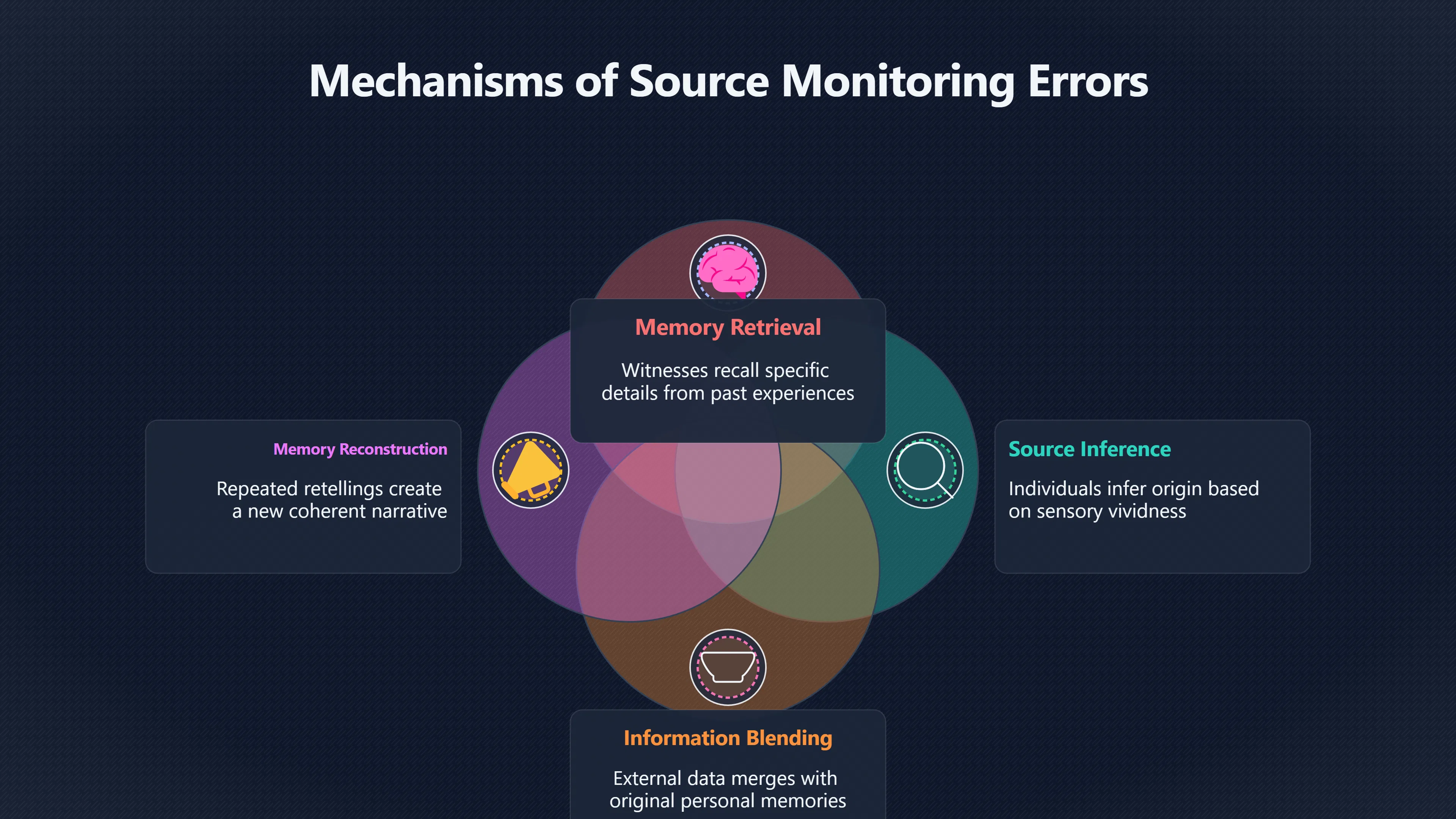
Psychologists use the term source monitoring to describe the mental process of identifying the origin of a memory. When people recall an event, they do not simply retrieve a stored label saying “I saw this myself”. Instead, they infer the source from characteristics of the memory itself, such as sensory detail, emotional vividness and contextual information. Those inferences can be wrong.[PubMed]pubmed.ncbi.nlm.nih.govPub Med Source monitoringSource monitoring - PubMed - NIHby MK Johnson · 1993 · Cited by 6798 — It is argued that source monitoring is based on qualities of…
A source monitoring mistake occurs when a person correctly remembers a piece of information but incorrectly remembers where it came from. For example, someone may remember hearing about unusual symbols on debris and later come to believe they personally saw those symbols. Alternatively, a witness may merge a genuine memory of military activity with details absorbed years later from books or interviews.
Research on eyewitness testimony has repeatedly shown that post-event information can become incorporated into memory. People may eventually recall the combined memory as a single coherent experience even when parts of it originated elsewhere.[PMC]pmc.ncbi.nlm.nih.govPMCA Behavioral Account of the Misinformation EffectOne cognitive account of the misinformation effect is that memory errors are due to source monitoring errors (Lindsay, 1990; Lindsay…R…
For UFO crash cases, this distinction is crucial. A witness can be entirely sincere and still misattribute a later-acquired detail to the original event.
How Repetition Changes Memory
One reason source monitoring errors become more likely in older cases is repetition. Every retelling is also a reconstruction.
Memory researchers have found that exposure to later information can alter recollection of an original event. As time passes and the original memory weakens, people become more susceptible to incorporating external information into what they remember.[PMC]pmc.ncbi.nlm.nih.govThe impact of recall timing on the preservation of eyewitness…by C Chevroulet · 2021 · Cited by 15 — As a witness' memory of the ev…
In UFO crash stories, witnesses may encounter:
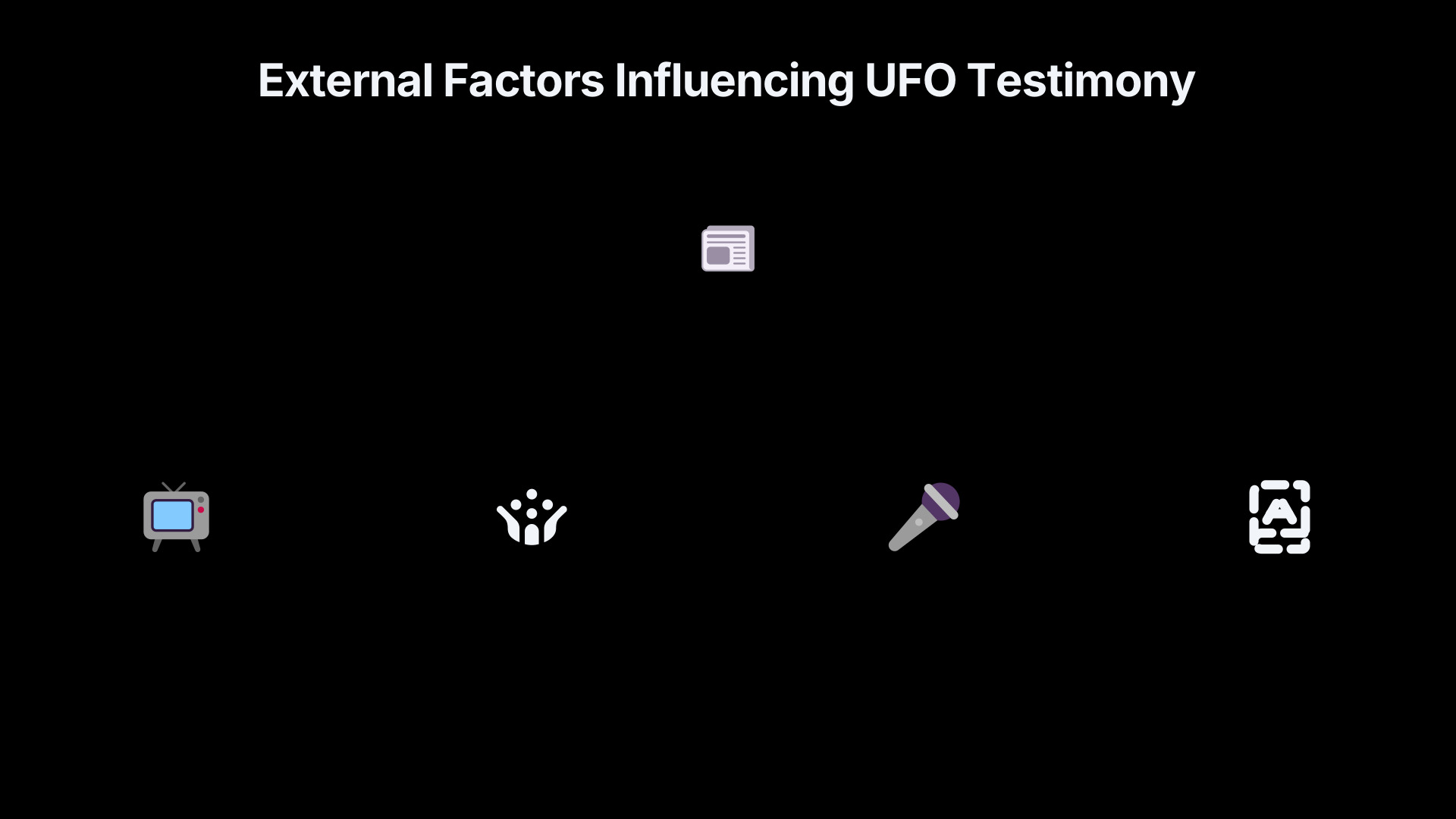
- Newspaper accounts and magazine articles.
- Television documentaries.
- Books proposing specific interpretations.
- Interviews with other witnesses.
- Researcher questions that imply details.
- Community rumours that become widely repeated.
After years of exposure, a witness may remember a detail vividly without remembering whether it came from personal observation or from one of these later sources.
The problem is compounded because repetition often increases confidence. A memory that has been recalled and discussed many times can feel increasingly familiar and convincing, even if parts of it entered the memory later. Psychological research has consistently shown that confidence and accuracy do not always rise together.[nih.gov]pmc.ncbi.nlm.nih.govAccordingly, post-event information supplied by the police, prosecutors, media, other eyewitnesses, family, and friends…Read more…
Interviews Can Become Part of the Memory
Witness interviews are often treated as a way of recovering information, but they can also shape later recollections.
Research on eyewitness memory shows that suggestive questions can influence what people later remember. Even subtle wording changes may alter recollections of an event. The classic work of Elizabeth Loftus and colleagues demonstrated that post-event questioning can affect later memory reports.[Simply Psychology]simplypsychology.orgloftus palmerSimply PsychologyLoftus and Palmer 1974 | Car Crash Experimentby S McLeod · Cited by 3 — Aim. To test their hypothesis that the language…
This does not mean UFO researchers intentionally create false memories. The issue is more subtle. If a witness is interviewed repeatedly over decades, each interview may encourage the witness to think about possibilities they had not previously considered. Eventually, those possibilities can become difficult to separate from the original experience.
When a witness is asked variations of questions such as “Did you see bodies?”, “Could those have been bodies?”, or “What do you remember about the bodies?”, the interview itself can become part of the witness’s later memory landscape. Cognitive research identifies this type of contamination as a known pathway by which misinformation and source confusion emerge.[PMC]pmc.ncbi.nlm.nih.govPMCA Behavioral Account of the Misinformation EffectOne cognitive account of the misinformation effect is that memory errors are due to source monitoring errors (Lindsay, 1990; Lindsay…R…
Why UFO Crash Stories Are Especially Vulnerable
Most alleged UFO crashes share characteristics that make source monitoring problems more likely.
First, many cases involve long delays between the event and the most dramatic testimony. In several famous crash narratives, the extraordinary details appeared decades after the alleged incident rather than in the earliest records.
Second, the events are often ambiguous from the beginning. Ambiguous experiences are easier to reinterpret later because there is less original information available to constrain memory. When witnesses encounter new explanations, rumours or theories, those ideas can become woven into recollection.[PMC]pmc.ncbi.nlm.nih.govCognitive and neural mechanisms underlying false memoriesby AG Lentoor · 2023 · Cited by 14 — This theory proposed that false memory o…
Third, UFO crash stories tend to generate extensive discussion communities. Witnesses may spend years hearing others describe what supposedly happened. Under those conditions, remembering that a detail was discussed can gradually transform into remembering having witnessed the detail personally.
The result is not necessarily fabrication. Instead, multiple streams of information become blended into a single narrative that feels authentic to the person recalling it.
Roswell as a Case Study in Source Confusion
Roswell provides the most discussed example because many of the most dramatic claims emerged long after 1947.
Contemporary reports focused on recovered debris. The highly developed stories involving alien bodies became prominent decades later through interviews, books and retrospective testimony. The U.S. Air Force’s later investigations argued that some body-recovery accounts reflected memories of unrelated activities, including later military recovery operations and anthropomorphic test dummies, being mentally compressed into the Roswell narrative. The report specifically suggested that witnesses had combined experiences from different periods into a single remembered event.[DAF History]dafhistory.af.milAFD 101201 038DAF HistoryThe Roswell Report… crash of an unidentified flying object (UFO) that occurred in the state in 1947. This publication duplic…
Whether one accepts the Air Force explanation or not, the proposed mechanism is notable because it closely resembles what psychologists describe as source monitoring failure. A person may accurately remember seeing military personnel, recovery operations, unusual equipment or human-shaped objects, yet misremember when and in what context those observations occurred.[wikipedia.org]WikipediaRoswell incidentRoswell incident
Importantly, this interpretation differs from accusing witnesses of dishonesty. The Air Force itself argued that the pattern of accounts suggested something other than deliberate deception.[Wikipedia]WikipediaRoswell incidentRoswell incident

How to Weigh Late Crash Testimony
Source monitoring research does not prove that any particular UFO crash claim is false. Instead, it provides a framework for evaluating testimony that appears many years after an event.
Several questions become important:
When was the detail first reported?
A claim appearing forty years after an event generally deserves more scrutiny than one documented immediately.
What information was the witness exposed to before reporting it?
Books, documentaries, media coverage and previous interviews can all become potential sources of contamination.
Has the account changed over time?
Evolving narratives may indicate normal memory reconstruction rather than intentional deception.
Is the witness recalling observation or interpretation?
A person may accurately remember seeing unusual debris while later-added explanations about its origin come from subsequent reflection.
Does independent contemporary evidence support the claim?
Documents, photographs and early records help distinguish original observations from later additions.
These questions are standard tools in eyewitness evaluation because memory researchers have repeatedly found that recollection is reconstructive rather than perfectly reproductive.[nih.gov]pmc.ncbi.nlm.nih.govAccordingly, post-event information supplied by the police, prosecutors, media, other eyewitnesses, family, and friends…Read more…
The Key Lesson
Source monitoring mistakes offer a plausible explanation for why UFO crash stories often become more detailed, dramatic and internally coherent as decades pass. Human memory is capable of preserving genuine experiences for many years, but it is also vulnerable to confusion about where particular details originated.[PubMed]pubmed.ncbi.nlm.nih.govPub Med Source monitoringSource monitoring - PubMed - NIHby MK Johnson · 1993 · Cited by 6798 — It is argued that source monitoring is based on qualities of…
For that reason, late testimony is usually most valuable when read alongside contemporary records rather than in isolation. A detailed account given fifty years after an alleged crash may contain authentic memories, later interpretations, absorbed rumours and repeated cultural narratives all intertwined. Understanding source monitoring helps explain how those elements can merge without requiring fraud, conspiracy or deliberate invention.[PMC]pmc.ncbi.nlm.nih.govPMCA Behavioral Account of the Misinformation EffectOne cognitive account of the misinformation effect is that memory errors are due to source monitoring errors (Lindsay, 1990; Lindsay…R…
Amazon book picks
Further Reading
Books and field guides related to Can Sincere Witnesses Remember the Wrong Source?. Use these as the next step if you want deeper reading beyond the article.
The Invisible Gorilla
Explains perception and memory errors relevant to witness testimony.
eBay marketplace picks
Marketplace Samples
Example marketplace items related to this page. Use the search link to explore similar finds on eBay.




Endnotes
1.
Source: pmc.ncbi.nlm.nih.gov
Link:https://pmc.ncbi.nlm.nih.gov/articles/PMC4131297/
Source snippet
Accordingly, post-event information supplied by the police, prosecutors, media, other eyewitnesses, family, and friends...Read more...
2.
Source: pmc.ncbi.nlm.nih.gov
Link:https://pmc.ncbi.nlm.nih.gov/articles/PMC9225701/
Source snippet
The impact of recall [timing]({{ 'timing/' | relative_url }}) on the preservation of eyewitness...by C Chevroulet · 2021 · Cited by 15 — As a witness' memory of the ev...
3.
Source: pmc.ncbi.nlm.nih.gov
Link:https://pmc.ncbi.nlm.nih.gov/articles/PMC10567586/
Source snippet
Cognitive and neural mechanisms underlying false memoriesby AG Lentoor · 2023 · Cited by 14 — This theory proposed that false memory o...
4.
Source: Wikipedia
Title: Roswell incident
Link:https://en.wikipedia.org/wiki/Roswell_incident
5.
Source: Wikipedia
Title: Shag Harbour UFO incident
Link:https://en.wikipedia.org/wiki/Shag_Harbour_UFO_incident
Source snippet
Shag Harbour UFO incidentThe Shag Harbour UFO incident was the reported impact of an unknown large object into waters near Shag Harbou...
6.
Source: Wikipedia
Title: Misinformation effect
Link:https://en.wikipedia.org/wiki/Misinformation_effect
Source snippet
Misinformation effectThe misinformation effect occurs when a person's recall of episodic memories becomes less accurate because of pos...
7.
Source: pubmed.ncbi.nlm.nih.gov
Title: Pub Med Source monitoring
Link:https://pubmed.ncbi.nlm.nih.gov/8346328/
Source snippet
Source monitoring - PubMed - NIHby MK Johnson · 1993 · Cited by 6798 — It is argued that source monitoring is based on qualities of...
8.
Source: pmc.ncbi.nlm.nih.gov
Title: PMCA Behavioral Account of the Misinformation Effect
Link:https://pmc.ncbi.nlm.nih.gov/articles/PMC3213001/
Source snippet
One cognitive account of the misinformation effect is that memory errors are due to source monitoring errors (Lindsay, 1990; Lindsay...R...
9.
Source: simplypsychology.org
Title: loftus palmer
Link:https://www.simplypsychology.org/loftus-palmer.html
Source snippet
Simply PsychologyLoftus and Palmer 1974 | Car Crash Experimentby S McLeod · Cited by 3 — Aim. To test their hypothesis that the language...
10.
Source: dafhistory.af.mil
Title: AFD 101201 038
Link:https://www.dafhistory.af.mil/Portals/16/documents/AFD-101201-038.pdf
Source snippet
DAF HistoryThe Roswell Report... crash of an [unidentified]({{ 'unidentified/' | relative_url }}) flying object (UFO) that occurred in the state in 1947. This publication duplic...
11.
Source: pmc.ncbi.nlm.nih.gov
Link:https://pmc.ncbi.nlm.nih.gov/articles/PMC9451081/
Source snippet
by PU Gustafsson · 2022 · Cited by 23 — The major goal of the current study was to examine how time and repetition might influence the...
12.
Source: pmc.ncbi.nlm.nih.gov
Link:https://pmc.ncbi.nlm.nih.gov/articles/PMC1692093/
Source snippet
Memory distortion reflects failures to identify the sources of mental experience (reality monitoring failures or source misattributions)...
Additional References
13.
Source: researchgate.net
Link:https://www.researchgate.net/publication/236104265_Monitoring_the_source_monitoring
Source snippet
(PDF) Monitoring the source monitoringThis research has potential applications for eyewitness memory because it shows that confidence can...
14.
Source: apa.org
Link:https://www.apa.org/news/podcasts/speaking-of-psychology/memory-manipulated
Source snippet
American Psychological AssociationHow memory can be manipulated, with Elizabeth Loftus, PhDElizabeth Loftus, PhD, is an expert on human m...
15.
Source: nobaproject.com
Link:https://nobaproject.com/modules/eyewitness-testimony-and-memory-biases
Source snippet
Eyewitness Testimony and Memory BiasesHundreds of subsequent studies have demonstrated that memory can be contaminated by erroneous infor...
16.
Source: ovid.com
Link:https://www.ovid.com/00006823-199307000-00001
Source snippet
Source Monitoring: Psychological BulletinSource monitoring refers to the set of processes involved in making attributions about the orig...
17.
Source: researchgate.net
Link:https://www.researchgate.net/publication/14853629_Source_Monitoring
Source snippet
Source MonitoringA framework for understanding source monitoring and relevant empirical evidence is described, and several related phenom...
18.
Source: encyclopedia.com
Link:https://www.encyclopedia.com/psychology/encyclopedias-almanacs-transcripts-and-maps/source-monitoring
19.
Source: researchgate.net
Link:https://www.researchgate.net/publication/284052703_Source_Monitoring
Source snippet
Source MonitoringThe source monitoring (SM) framework is an evolving set of ideas regarding the cognitive processes by which thoughts, im...
20.
Source: thedecisionlab.com
Link:https://thedecisionlab.com/reference-guide/psychology/the-misinformation-effect
Source snippet
The Misinformation EffectThe misinformation effect happens when our memory for past events is altered after exposure to misleading inform...
21.
Source: linkedin.com
Link:https://www.linkedin.com/pulse/where-did-i-hear-source-monitoring-memory-tim-schukar-k2yac
Source snippet
Where Did I Hear That? Source Monitoring in MemorySource monitoring reduces misattribution errors by making the AI cite origins rather th...
22.
Source: onlineacademiccommunity.uvic.ca
Link:https://onlineacademiccommunity.uvic.ca/lindsaylab/wp-content/uploads/sites/4861/2020/10/Lindsay-SM-Chap-4.pdf
Source snippet
Source Monitoring AppliedSuch source misattributions are especially likely if current orientation or expectations bias remembers toward t...
Topic Tree