Within UFO Crashes
What Would Prove a UFO Crash?
Crash claims are strongest only when debris, records, custody, and independent testing point in the same direction.
On this page
- Debris, impact marks, and chain of custody
- Witness testimony versus testable material
- Why extraordinary claims need recoverable evidence
Page outline Jump by section
Introduction
A UFO crash claim is not just a dramatic version of a sighting. It is a claim about an event that should have left recoverable evidence: debris, ground disturbance, contamination, photographs, recovery records, transport logs, laboratory results and a documented chain of custody. The strongest crash-retrieval case would not rest on one impressive witness or one unusual metal fragment. It would be persuasive because the material, the scene, the paperwork and independent testing all pointed in the same direction.
That is why physical evidence standards matter so much. A crash story can be emotionally powerful while still being evidentially weak if the artefact cannot be traced from the alleged scene to the laboratory, if it could have ordinary industrial origins, or if the most extraordinary parts of the account appeared years later. NASA’s 2023 UAP study framed the wider problem clearly: serious UAP research needs rigorous data acquisition, structured data curation and evidence-based analysis, not merely intriguing reports.[NASA Science]science.nasa.govNASA Science…
Why a crash claim has a higher burden than a sighting
A sighting can remain unresolved because the observer was far away, the image was blurred, the radar data were incomplete, or the object was seen too briefly. A crash claim is different. If an object hit the ground, broke apart, burned, leaked, or was retrieved by a military or civilian team, it should in principle create a larger evidence trail.
That does not mean every crash scene would be easy to prove. A secret aircraft accident, a balloon recovery, a meteorite fall, a drone crash, a re-entering space object or a military clean-up could all produce confusion. But the evidential expectation is still higher. A claimed crash should leave more than memory.
A useful standard is to ask whether the claim contains several independent classes of evidence:
- Scene evidence: impact marks, burn patterns, soil disturbance, broken vegetation, radiation readings, chemical residue, GPS locations and contemporaneous photographs.
- Material evidence: fragments, alloys, composites, electronics, biological material, residue, or recovered structural parts.
- Custody evidence: who collected each item, where it was stored, who handled it, and whether tampering or contamination can be ruled out.
- Document evidence: incident logs, police reports, military communications, transport records, laboratory tasking, inventory numbers and archival matches.
- Independent replication: testing by qualified laboratories that can reproduce or challenge the first result.
Forensic standards are useful here even when the alleged event is not a crime. The US National Institute of Standards and Technology’s forensic guidance defines physical evidence broadly as anything that can be collected, lifted or imaged to understand an incident; it also stresses preservation, contamination control, packaging and documented chain of custody from collection through final disposition.[NIST]nist.govOpen source on nist.gov.
Debris, impact marks and chain of custody
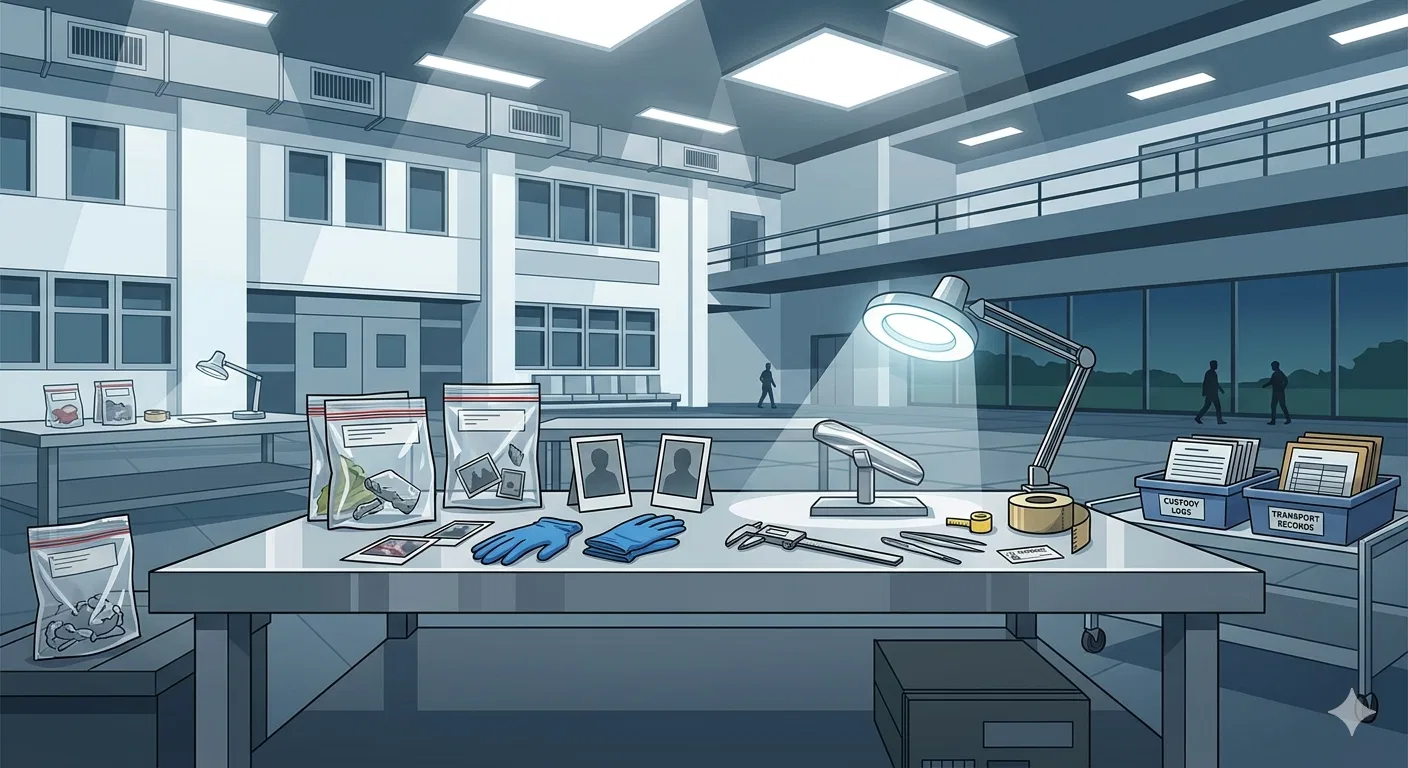
The most basic question is not “does the object look strange?” but “can the object be tied to the alleged crash?” A piece of metal, foil, slag or composite is not strong evidence by itself. It becomes meaningful only when its origin is documented.
Chain of custody is the chronological record of possession and handling. In practice, that means the item should have a unique identifier, a collection location, the name of the collector, dates and times of transfer, storage conditions, packaging records, test requests and laboratory reports. NIST guidance on biological evidence preservation gives the same core logic: documentation should include a description of the evidence, where it was collected and stored, who possessed it, what was done to it, and date and time information.[NIST]nist.govHandbook on Biological Evidence PreservationHandbook on Biological Evidence Preservation
For a claimed UFO crash, weak custody looks like this: a fragment was allegedly picked up at an old crash site, kept privately for years, passed through several hands, and then tested without a verified scene record. Strong custody would look very different: investigators photographed the fragment in place, mapped it, sealed it, logged each transfer, preserved possible contamination evidence, and retained enough material for independent laboratories.
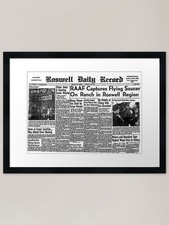
That is why famous crash narratives often lose force at the material stage. The story may include claims of wreckage, bodies or secret transport, but the public record may contain no recoverable object that can be traced from the alleged crash scene to an open laboratory result. Roswell is the classic example: the US Government Accountability Office found two 1947 records directly concerning the incident, one noting that a “flying disc” was later determined by military officials to be a radar-tracking balloon, and an FBI teletype describing an object resembling a high-altitude weather balloon with a radar reflector. The GAO also found gaps caused by destroyed records, but it did not identify documents showing an extraterrestrial craft retrieval.[GovInfo]govinfo.govGAOREPORTS NSIADGAOREPORTS NSIAD
The missing-record problem matters, but it cuts both ways. Destroyed or absent records can reasonably prompt questions about completeness. They do not, by themselves, supply the missing debris, custody trail or test results needed to prove an extraordinary crash-retrieval claim.
Witness testimony versus testable material
Witnesses matter, especially when they are trained observers, first responders, pilots, radar operators or recovery personnel. But testimony and physical evidence do different jobs. Testimony can establish what someone says they saw or handled. Material evidence can be examined by people who were not there.
This difference is central to modern crash-retrieval claims. Former intelligence official David Grusch testified in 2023 that he had been told of a multi-decade UAP crash-retrieval and reverse-engineering programme and of “non-human biologics”, but his public testimony did not include a recoverable artefact, laboratory report or publicly testable sample. Reporting on subsequent congressional hearings has noted the same evidential gap: major claims were made, but direct physical evidence was not produced in public.[Time]time.comOpen source on time.com.
AARO, the Pentagon’s All-domain Anomaly Resolution Office, has taken the opposite position in its public historical review. Its 2024 historical report said it found no empirical evidence that any US government investigation, academic-sponsored research or official review had confirmed a UAP sighting as extraterrestrial technology, and no evidence that the US government or private companies had possessed or reverse-engineered extraterrestrial materials.[U.S. Department of War]media.defense.govDOPSR 2024 0263 AARO HISTORICAL RECORD REPORT VOLUMEDOPSR 2024 0263 AARO HISTORICAL RECORD REPORT VOLUME
That does not settle every classified-access dispute. It does, however, define the current public evidence problem. Crash-retrieval allegations are being discussed at the level of oversight, whistleblower claims and classified briefings, while the proof demanded by physical evidence standards would require actual objects, records and reproducible analysis.
What laboratory testing can and cannot prove
A metal fragment can be unusual without being alien. Laboratories can identify elemental composition, isotopic ratios, crystal structure, manufacturing marks, corrosion history, heat exposure, contamination and possible industrial processes. Those results can rule out some explanations and suggest others. They rarely speak for themselves.
Peer-reviewed and technical discussions of UAP-related materials have focused on whether modern analytical tools, including mass spectrometry and isotopic analysis, could help characterise unusual samples. A 2022 paper by Garry Nolan, Jacques Vallée, Sizun Jiang and Larry Lemke reviewed instrumental techniques applicable to unusual materials with possible aerospace-forensics relevance, but this type of work is best understood as method development and sample characterisation, not as proof that a crash-retrieved vehicle exists.[ADSabs]ui.adsabs.harvard.eduOpen source on harvard.edu.
The key issue is comparison. A laboratory might find an unexpected isotopic ratio or unusual layering in a sample. The next questions are less glamorous but more important:
- Could this result come from known industrial processing, contamination, weathering, smelting, welding, aerospace material, military debris or laboratory artefact?
- Are the results repeatable on the same sample and on separate fragments from the same alleged event?
- Were control samples tested from the surrounding soil, nearby industrial sources, packaging and handling environment?
- Did more than one qualified laboratory reach the same conclusion without relying on the same assumptions?
- Is there enough material left for sceptical re-testing?
Space science shows what high-quality material handling looks like. NASA’s OSIRIS-REx mission returned asteroid Bennu material under a carefully planned contamination-control and curation regime, including clean rooms, archived witness materials and comparison records for possible contamination sources. That level of discipline exists because tiny material differences can change scientific interpretation. A UFO crash sample making a far more extraordinary claim would need at least comparable care.[nih.gov]pmc.ncbi.nlm.nih.govOpen source on nih.gov.

The problem with “interesting debris”
Some UFO cases involve alleged physical traces rather than full crash wreckage. These can include molten metal, slag-like material, scorched soil, magnetic anomalies, broken branches, impressions or residue. Such cases are valuable because they move the discussion beyond testimony, but they also show why material alone is not enough.
The Council Bluffs, Iowa case from 1977 is often cited because witnesses reported an object and molten material that was later analysed. The case remains interesting as a physical-trace report, but the existence of a metallic residue does not automatically establish an exotic vehicle. Molten or slag-like material can have mundane origins, and without a complete chain from event to sample to replicated analysis, the strongest conclusion is usually narrower: something unusual was reported and material was collected, not that a non-human craft crashed.[The Historical Society]thehistoricalsociety.orgThe Historical Society UFO Crash at Big Lake ParkThe Historical Society UFO Crash at Big Lake Park
This is the recurring trap in crash-retrieval debates. “Unusual” becomes “unknown”, “unknown” becomes “not human”, and “not human” becomes “recovered spacecraft”. Each step needs its own evidence. A gap in explanation is not the same as a positive identification.
Records matter because crashes create bureaucracy
A real recovery operation usually creates paperwork. Even a secret recovery creates logistics: personnel orders, transport aircraft, vehicle dispatch, security cordons, medical or hazardous-material precautions, contracting records, photographs, inventory numbers, laboratory tasking and archival retention decisions. Some records may be classified, but the existence of a large recovery effort should still leave administrative traces.
That is why archival findings are so important. Project Blue Book, the US Air Force’s public UFO investigation programme, collected 12,618 reports between 1947 and 1969, with 701 remaining unidentified, but the Air Force’s public summary did not conclude that unidentified cases established extraterrestrial vehicles or crash retrievals.[National Archives]archives.govNational Archives Project BLUE BOOKNational Archives Project BLUE BOOK
AARO’s historical report similarly reviews earlier government programmes and repeatedly finds that better data would likely explain many unresolved cases, while reporting no discovered evidence of extraterrestrial origin in the historical government record it examined. It also notes that NASA’s 2023 study focused on how to find better data streams rather than on proving extraterrestrial origin.[U.S. Department of War]media.defense.govDOPSR 2024 0263 AARO HISTORICAL RECORD REPORT VOLUMEDOPSR 2024 0263 AARO HISTORICAL RECORD REPORT VOLUME
For crash claims, this means the strongest public case would probably not be a single leaked memo. It would be a convergence of records: recovery logs matching witness accounts, transport documents matching material custody, laboratory reports matching inventory numbers, and independent tests matching the alleged artefact.
A practical evidence ladder for UFO crash claims
Crash-retrieval claims can be assessed without assuming they are true or false in advance. The useful question is where the claim sits on an evidence ladder.
Lowest evidential value: late stories without documents. These may be culturally important, but they are weak as proof. A witness may be sincere, but memory changes, stories circulate, and details often grow over time.
Moderate value: contemporary reports and multiple witnesses. Police logs, newspaper reports, military messages, photographs and independent witnesses raise the value of a case, especially when they were created before the story became famous.
Higher value: physical traces with documented collection. Soil samples, fragments, impressions and residues become more useful when they were collected promptly, mapped, photographed and preserved.
Very high value: independently tested material with custody. A sample that can be traced from scene to storage to laboratory, tested by multiple qualified teams, and compared against ordinary sources would be far more serious than an anecdotal fragment.
Decisive value: integrated recovery evidence. The strongest case would combine an artefact, scene documentation, official records, custody logs, independent laboratory results and no adequate conventional explanation. That is the level a claimed non-human crash retrieval would need to reach.

Why extraordinary claims need recoverable evidence
The phrase “extraordinary claims require extraordinary evidence” can sound like a slogan, but in crash-retrieval cases it has a specific meaning. The claim is not merely that someone saw something unusual in the sky. The claim is that a vehicle of unknown or non-human origin failed, struck or landed on Earth, was recovered, and was hidden or studied. That claim implies many testable consequences.
It should produce material that can be examined. It should produce records that can be audited. It should produce a custody chain that can be checked. It should produce technical findings that survive hostile review. It should also withstand comparison with known sources of confusion: balloons, aircraft, classified tests, satellites, drones, meteors, hoaxes, industrial debris and folklore.
NASA’s UAP study did not dismiss the value of investigation; it argued for better data, better curation and more rigorous methods. AARO’s public historical review went further in its conclusion, saying it found no empirical evidence for extraterrestrial technology or reverse-engineered off-world material in the record it examined. Those positions differ in tone, but they converge on the same practical standard: claims become knowledge only when the evidence can be inspected, preserved, tested and replicated. NASA Science+2U.S. Department of War[science.nasa.gov]science.nasa.govNASA Science…
For UFO crashes, the decisive evidence would not be a rumour of a hidden hangar or a fragment with an interesting story. It would be a recoverable object with a documented history, tested openly enough that qualified sceptics and supporters could argue over the same facts.
Amazon book picks
Further Reading
Books and field guides related to What Would Prove a UFO Crash?. Use these as the next step if you want deeper reading beyond the article.
UFO Crash Retrievals
Directly addresses alleged crash recoveries, evidence claims, and retrieval narratives.
In Plain Sight
Examines evidence, sources, and claims surrounding alleged retrieval programs.
eBay marketplace picks
Marketplace Samples
Example marketplace items related to this page. Use the search link to explore similar finds on eBay.



Endnotes
1.
Source: science.nasa.gov
Link:https://science.nasa.gov/wp-content/uploads/2023/09/uap-independent-study-team-final-report.pdf
Source snippet
NASA Science...
2.
Source: nist.gov
Link:https://www.nist.gov/document/2021-n-0018standard-scene-collection-and-preservation-physical-evidencedraft-osac
3.
Source: nist.gov
Title: Handbook on Biological Evidence Preservation
Link:https://www.nist.gov/system/files/documents/forensics/NIST-IR-7928.pdf
4.
Source: govinfo.gov
Title: GAOREPORTS NSIAD 95 187
Link:https://www.govinfo.gov/content/pkg/GAOREPORTS-NSIAD-95-187/html/GAOREPORTS-NSIAD-95-187.htm
5.
Source: time.com
Link:https://time.com/6298287/congress-ufo-hearing/
6.
Source: astrochem.org
Title: 2023 Righter Curation planning and facilities for asteroid Bennu samples MAPS
Link:https://www.astrochem.org/docs/2023%20Righter%20-%20Curation%20planning%20and%20facilities%20for%20asteroid%20Bennu%20samples-MAPS.pdf
7.
Source: archives.gov
Title: National Archives Project BLUE BOOK
Link:https://www.archives.gov/research/military/air-force/ufos
8.
Source: science.nasa.gov
Link:https://science.nasa.gov/uap/
9.
Source: nasa.gov
Title: nasa to release discuss unidentified anomalous phenomena report
Link:https://www.nasa.gov/news-release/nasa-to-release-discuss-unidentified-anomalous-phenomena-report/
10.
Source: science.nasa.gov
Link:https://science.nasa.gov/uap/faqs/
11.
Source: nasa.gov
Title: update nasa shares uap independent study report names director
Link:https://www.nasa.gov/news-release/update-nasa-shares-uap-independent-study-report-names-director/
12.
Source: ntrs.nasa.gov
Link:https://ntrs.nasa.gov/api/citations/20180007273/downloads/20180007273.pdf
13.
Source: ntrs.nasa.gov
Link:https://ntrs.nasa.gov/citations/20140000766
14.
Source: nist.gov
Link:https://www.nist.gov/document/standard-practice-quality-assurance-forensic-science-service-providers-performing-chemistry
15.
Source: nist.gov
Link:https://www.nist.gov/forensic-science/interdisciplinary-topics/evidence-management/biological-evidence-guidance
16.
Source: nist.gov
Link:https://www.nist.gov/document/osac-2023-n-0013-standard-evidence-collection-and-management-sexual-assault-medical
17.
Source: nist.gov
Link:https://www.nist.gov/document/guiding-principles-crime-scene-investigation-and-reconstruction
18.
Source: nist.gov
Title: new guide details steps z preserving biological evidence
Link:https://www.nist.gov/news-events/news/2013/04/new-guide-details-steps-z-preserving-biological-evidence
19.
Source: aaro.mil
Link:https://www.aaro.mil/UAP-Cases/Official-UAP-Imagery/
20.
Source: aaro.mil
Title: UAP Records
Link:https://www.aaro.mil/UAP-Records/
21.
Source: space.com
Title: nasa ufo uap study team first results revealed
Link:https://www.space.com/nasa-ufo-uap-study-team-first-results-revealed
22.
Source: space.com
Title: pentagon aaro ufo hearing april 2023
Link:https://www.space.com/pentagon-aaro-ufo-hearing-april-2023
Published: april 2023
23.
Source: war.gov
Title: dr jon kosloski director aaro media roundtable on the fy24 consolidated annual
Link:https://www.war.gov/News/Transcripts/Transcript/Article/3965734/dr-jon-kosloski-director-aaro-media-roundtable-on-the-fy24-consolidated-annual/
24.
Source: war.gov
Title: 65 hs1 834228961 62 hq 83894 section 10
Link:https://www.war.gov/medialink/ufo/release_1/65_hs1-834228961_62-hq-83894_section_10.pdf
25.
Source: vault.fbi.gov
Title: Roswell UFO
Link:https://vault.fbi.gov/Roswell%20UFO
26.
Source: fbi.gov
Title: ufos and the guy hottel memo
Link:https://www.fbi.gov/news/stories/ufos-and-the-guy-hottel-memo
27.
Source: archives.gov
Link:https://www.archives.gov/research/topics/uaps
28.
Source: sgp.fas.org
Link:https://sgp.fas.org/othergov/roswell.html
29.
Source: media.defense.gov
Title: DOPSR 2024 0263 AARO HISTORICAL RECORD REPORT VOLUME 1 2024
Link:https://media.defense.gov/2024/Mar/08/2003409233/-1/-1/0/DOPSR-2024-0263-AARO-HISTORICAL-RECORD-REPORT-VOLUME-1-2024.PDF
30.
Source: ui.adsabs.harvard.edu
Link:https://ui.adsabs.harvard.edu/abs/2022PrAeS.12800788N/abstract
31.
Source: pmc.ncbi.nlm.nih.gov
Link:https://pmc.ncbi.nlm.nih.gov/articles/PMC6350808/
32.
Source: thehistoricalsociety.org
Title: The Historical Society UFO Crash at Big Lake Park
Link:https://www.thehistoricalsociety.org/h/ufo.html
33.
Source: Wikipedia
Title: Project Blue Book
Link:https://en.wikipedia.org/wiki/Project_Blue_Book
34.
Source: komprise.com
Link:https://www.komprise.com/glossary_terms/chain-of-custody/
35.
Source: decur.org
Title: AAR O Historical Record Report Volume 1
Link:https://decur.org/documents/aaro-historical-record-vol1
36.
Source: ncbi.nlm.nih.gov
Link:https://www.ncbi.nlm.nih.gov/books/NBK551677/
37.
Source: media.defense.gov
Title: AFD 101027 030
Link:https://media.defense.gov/2010/Oct/27/2001330219/-1/-1/0/AFD-101027-030.pdf
Additional References
38.
Source: youtube.com
Link:https://www.youtube.com/watch?v=EEMJoZvN-dQ
Source snippet
How Military [Sensors]({{ 'sensors/' | relative_url }}) Proved UFO Craft Were Physically Real | WION Podcast...
39.
Source: arxiv.org
Link:https://arxiv.org/html/2502.06794v2
40.
Source: youtube.com
Title: Garry Nolan: Aliens | The Case They’re Already Here
Link:https://www.youtube.com/watch?v=QpJebYW_vb4
Source snippet
The CIA's UAP & Alien Research! 'Their Brains Looked Fried' | Stanford's Garry Nolan...
41.
Source: youtube.com
Title: Replay! NASA’s Release of the Unidentified Anomalous Phenomena Report
Link:https://www.youtube.com/watch?v=nuBMnluJfs0
Source snippet
Garry Nolan: Aliens | The Case They're Already Here...
42.
Source: youtube.com
Title: Unidentified Anomalous Phenomena Independent Study Report
Link:https://www.youtube.com/watch?v=TQcqOW39ksk
Source snippet
Replay! NASA's Release of the Unidentified Anomalous Phenomena Report...
43.
Source: nsa.gov
Link:https://www.nsa.gov/portals/75/documents/news-features/declassified-documents/ufo/usaf_fact_sheet_95_03.pdf
44.
Source: instagram.com
Link:https://www.instagram.com/p/DY-eygHHxKG/
45.
Source: medium.com
Link:https://medium.com/quantum-psychology-and-engineering/an-inquiry-into-the-material-evidence-of-non-human-intelligence-04dc38a85103
46.
Source: scribd.com
Link:https://www.scribd.com/document/967341350/EVIDENCE-PACKAGING-TECHNIQUES
47.
Source: scribd.com
Link:https://www.scribd.com/presentation/507021259/What-Do-We-Know-About-the-Material-Compo-1
Topic Tree