Within Debris Tests
What the ORNL metal test actually ruled out
The ORNL specimen shows how a dramatic exotic-material claim can become narrower questions about isotopes, layering, and function.
On this page
- The crashed vehicle claim behind the specimen
- Terrestrial isotope results and manufactured structure
- Why the waveguide argument failed
Page outline Jump by section
Introduction
Among the many alleged UFO crash fragments discussed over the past three decades, few attracted as much attention as a layered bismuth–magnesium specimen promoted as potentially exotic technology. Supporters suggested that its unusual structure, isotopic composition and possible electromagnetic properties might indicate a non-human origin. The most comprehensive public examination of the sample, however, came from scientists at Oak Ridge National Laboratory (ORNL) working for the U.S. Department of Defense’s All-domain Anomaly Resolution Office (AARO). Their findings did not identify an extraterrestrial artefact. Instead, they narrowed the debate to specific questions about metallurgy, isotope chemistry and manufacturing history, ruling out several of the specimen’s most dramatic claims.[AARO]aaro.milAARO's Supplement to Oak Ridge National Laboratory's…This specimen has been publicly alleged to be a component recovered from a cr…
 The case is important because it illustrates how modern laboratory analysis can test extraordinary debris claims. The result was not that every historical detail became known, but that several headline assertions became much harder to defend.
The crashed-vehicle claim behind the specimen
The specimen entered UFO lore through claims that it originated from a recovered non-human craft, often linked by proponents to events in the late 1940s. Over time, the fragment became associated with theories promoted by researchers and organisations interested in physical UFO evidence. The material’s layered construction, consisting largely of magnesium alloy combined with bismuth-rich layers, was presented as something unusual enough to merit investigation.[AARO]aaro.milAARO's Supplement to Oak Ridge National Laboratory's…This specimen has been publicly alleged to be a component recovered from a cr…
By the early 2020s, the sample had accumulated several extraordinary interpretations. Among them were suggestions that it possessed anomalous isotopic signatures, that it might function as an advanced electromagnetic device, or that it represented technology beyond known human manufacturing capabilities. AARO therefore commissioned ORNL to perform a detailed examination using modern analytical techniques.[AARO]aaro.milAARO's Supplement to Oak Ridge National Laboratory's…This specimen has been publicly alleged to be a component recovered from a cr…
A key point often overlooked in discussions of UFO debris is that laboratory testing does not establish provenance. Even a genuinely unusual alloy would not prove recovery from a crashed vehicle. What testing can do is determine whether the physical properties of the object support or undermine the extraordinary claims attached to it.
Terrestrial isotope results and manufactured structure
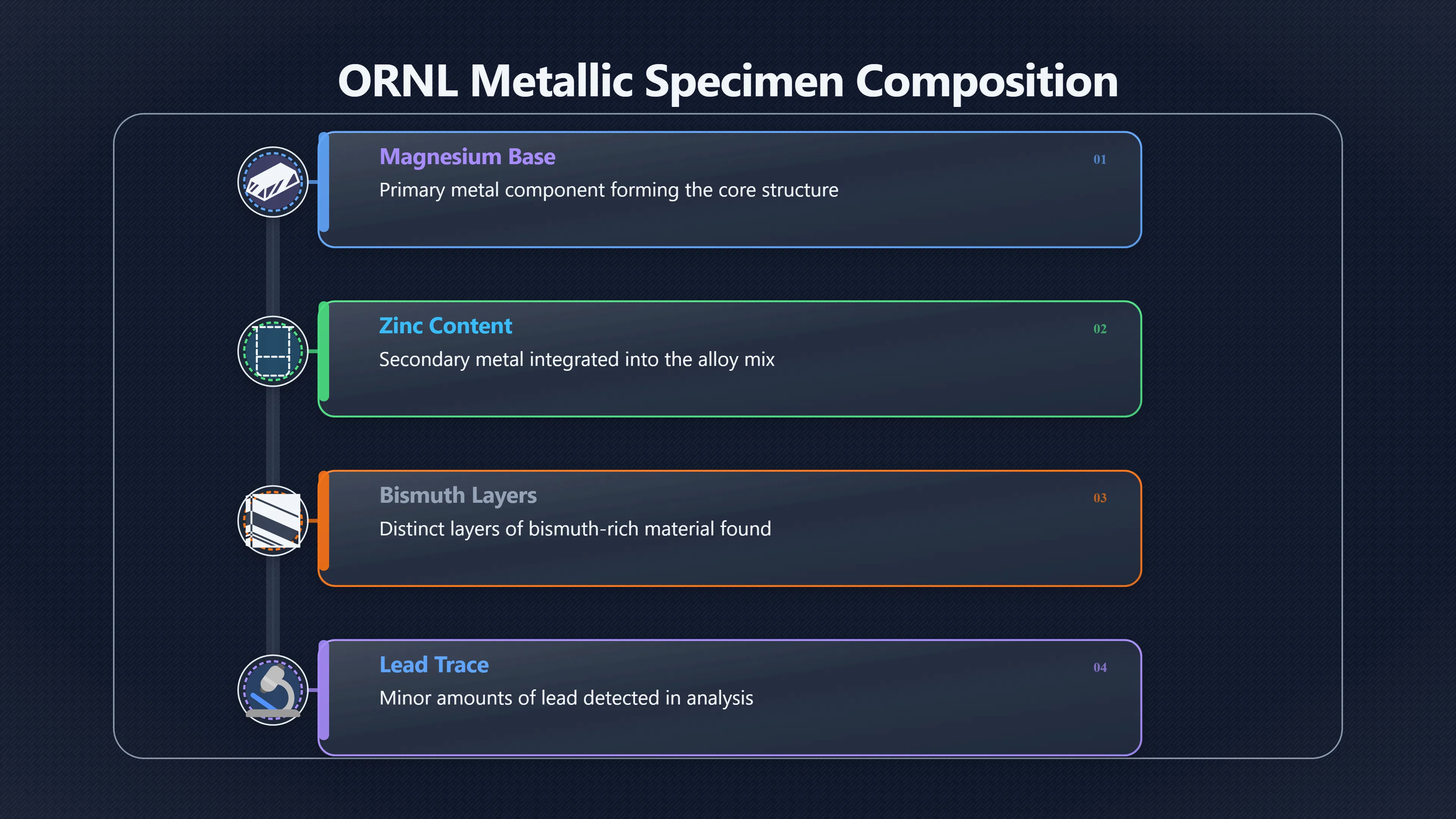
ORNL’s analysis found that the specimen was fundamentally a magnesium-based alloy containing zinc, bismuth, lead and trace elements. While the composition was somewhat uncommon by modern standards, it was not beyond the range of terrestrial metallurgy.[AARO]aaro.milORNL Synopsis Analysis of a Metallic SpecimenSynopsis: Analysis of a Metallic Specimen10 Jul 2024 — Based on these findings ORNL determined that this material is highly unlikely…
The isotope question was especially important because previous discussions had suggested the material might contain isotopic ratios inconsistent with Earth-based sources. ORNL examined magnesium and lead isotopes and concluded that the measured ratios were terrestrial. Scientists observed evidence that manufacturing processes had altered isotope distributions through fractionation effects, but the results did not indicate an extraterrestrial origin.[AARO]aaro.milAARO's Supplement to Oak Ridge National Laboratory's…This specimen has been publicly alleged to be a component recovered from a cr…
This distinction matters. Isotope anomalies can arise from industrial processing, heat treatment and chemical separation. An unusual ratio alone is not evidence of alien manufacture. ORNL’s findings indicated that the specimen’s isotope signatures could be explained within known terrestrial processes.[AARO]aaro.milAARO's Supplement to Oak Ridge National Laboratory's…This specimen has been publicly alleged to be a component recovered from a cr…
The laboratory also examined the specimen’s physical structure. The layered arrangement of magnesium alloy and bismuth was real, but the structure appeared consistent with manufactured material rather than an unknown technological artefact. Researchers noted evidence of mechanical and thermal stress that could be explained by production methods and subsequent handling.[AARO]aaro.milORNL Synopsis Analysis of a Metallic SpecimenSynopsis: Analysis of a Metallic Specimen10 Jul 2024 — Based on these findings ORNL determined that this material is highly unlikely…
One of the more significant outcomes was methodological rather than sensational: the object was shown to be a fabricated material with an identifiable metallurgical history. That finding shifted discussion away from speculation about impossible chemistry and toward questions about what industrial or experimental programme might have produced it.

Why the waveguide argument failed
Perhaps the most influential claim attached to the specimen was that it had been engineered as a terahertz waveguide. In this interpretation, the layered bismuth and magnesium structure was not merely a metal fragment but part of an advanced electromagnetic system capable of manipulating high-frequency radiation in ways beyond conventional engineering.[AARO]aaro.milORNL Synopsis Analysis of a Metallic SpecimenSynopsis: Analysis of a Metallic Specimen10 Jul 2024 — Based on these findings ORNL determined that this material is highly unlikely…
ORNL directly evaluated this proposition. Scientists examined the geometry, composition and physical characteristics relevant to waveguide performance. Their conclusion was clear: the specimen was highly unlikely ever to have functioned as a bismuth-based terahertz waveguide.[AARO]aaro.milORNL Synopsis Analysis of a Metallic SpecimenSynopsis: Analysis of a Metallic Specimen10 Jul 2024 — Based on these findings ORNL determined that this material is highly unlikely…
Several factors contributed to that assessment:
- The dimensions and structural characteristics did not align with what would be expected for an effective terahertz device.
- Material interfaces and manufacturing features were inconsistent with a purpose-built advanced waveguide.
- The specimen showed evidence of conventional metallurgical processing rather than precision fabrication for exotic electromagnetic applications.[AARO]aaro.milORNL Synopsis Analysis of a Metallic SpecimenSynopsis: Analysis of a Metallic Specimen10 Jul 2024 — Based on these findings ORNL determined that this material is highly unlikely…
AARO later issued a supplementary explanation emphasising that the laboratory findings did not support claims of anti-gravity capabilities, advanced propulsion functions or other extraordinary technological properties attributed to the fragment.[AARO]aaro.milAARO's Supplement to Oak Ridge National Laboratory's…This specimen has been publicly alleged to be a component recovered from a cr…
This is an important example of how a scientific test can be decisive without solving every historical mystery. ORNL did not identify the exact workshop, project or individual responsible for producing the material. Nor did it reconstruct the complete chain of custody. What it did accomplish was more limited and more valuable: it tested the specific technological claims attached to the specimen and found that the evidence did not support them.
What the ORNL test actually ruled out
The ORNL investigation did not prove where the specimen originated, but it substantially narrowed the range of plausible interpretations.
The testing ruled against three major claims:
- That the material possessed isotopic signatures indicating a non-terrestrial source.
- That the layered structure required unknown or impossible manufacturing methods.
- That the specimen likely functioned as an advanced terahertz waveguide or related exotic technology.[AARO]aaro.milAARO's Supplement to Oak Ridge National Laboratory's…This specimen has been publicly alleged to be a component recovered from a cr…
What remained after the analysis was a more ordinary, though still somewhat unusual, metallurgical object. The exact historical purpose may remain uncertain, but the strongest arguments for it being debris from a crashed extraterrestrial vehicle were weakened by the very laboratory tests that enthusiasts had hoped would validate them. In the broader history of alleged UFO crash materials, the ORNL specimen stands as a case where scientific scrutiny reduced an extraordinary claim to a narrower question about terrestrial manufacturing rather than revealing evidence of non-human technology.[AARO]aaro.milAARO's Supplement to Oak Ridge National Laboratory's…This specimen has been publicly alleged to be a component recovered from a cr…

Amazon book picks
Further Reading
Books and field guides related to What the ORNL metal test actually ruled out. Use these as the next step if you want deeper reading beyond the article.
The Demon-Haunted World
Rating: 4.5/5 from 43 Google Books ratings
Explains scientific testing of extraordinary claims.
eBay marketplace picks
Marketplace Samples
Example marketplace items related to this page. Use the search link to explore similar finds on eBay.




Endnotes
1.
Source: aaro.mil
Link:https://www.aaro.mil/Portals/136/PDFs/Information%20Papers/AAROs_Supplement_to_ORNLs_Analysis_of_a_Metallic_Specimen.pdf
Source snippet
AARO's Supplement to Oak Ridge National Laboratory's...This specimen has been publicly alleged to be a component recovered from a cr...
2.
Source: aaro.mil
Title: ORNL Synopsis Analysis of a Metallic Specimen
Link:https://www.aaro.mil/Portals/136/PDFs/Information%20Papers/ORNL-Synopsis_Analysis_of_a_Metallic_Specimen.pdf
Source snippet
Synopsis: Analysis of a Metallic Specimen10 Jul 2024 — Based on these findings ORNL determined that this material is highly unlikely...
3.
Source: ornl.gov
Title: researchers illuminate nuclear material origin stories
Link:https://www.ornl.gov/news/researchers-illuminate-nuclear-material-origin-stories
Source snippet
Credit: ORNL/...Read more...
4.
Source: ornl.gov
Title: methods medicine ornl supplies isotopes used cancer therapy
Link:https://www.ornl.gov/blog/methods-medicine-ornl-supplies-isotopes-used-cancer-therapy
Source snippet
Methods for medicine: ORNL supplies isotopes used in...27 Jul 2016 — Actinium-225 and its “daughter” bismuth-213 are short-lived radioac...
5.
Source: impact.ornl.gov
Title: magnesium alloy development for structural and biomedical applica
Link:https://impact.ornl.gov/en/publications/magnesium-alloy-development-for-structural-and-biomedical-applica
Source snippet
Alloy Development for Structural and...by AA Luo · 2022 · Cited by 4 — This presentation provides an overview of recent magnesium alloy...
6.
Source: isotopes.gov
Link:https://www.isotopes.gov/sites/default/files/2019-07/Isotope-Program–Product-Catalog.pdf
Source snippet
ordering isotopes or for additional information on isotope products and services, please contact the NIDC or visit our online catalog at...
7.
Source: Wikipedia
Link:https://en.wikipedia.org/wiki/Oak
Source snippet
OakAn oak is a hardwood tree or shrub in the genus Quercus of the beech family. They have spirally arranged leaves, often with lobed e...
8.
Source: britannica.com
Link:https://www.britannica.com/plant/oak
Source snippet
Description, Characteristics, Types, & Facts18 May 2026 — Oak, (genus Quercus), genus of about 450 species of ornamental and timber trees...
Published: May 2026
9.
Source: forestryandland.gov.scot
Link:https://forestryandland.gov.scot/living-and-working/learning-and-education/trees/oak
Source snippet
Trees and Forestry | FLSThe oak tree once formed a third of all tree cover in Britain. Oaks can support more than 2,000 species, more tha...
Additional References
10.
Source: tothestars.media
Link:https://tothestars.media/blogs/press-and-news/material-of-interest-magnesium-zinc-bismuth?srsltid=AfmBOooAIAN-Hbv7xgCoHYiYvr26vv3imH6CujfAN9UjZXsQ8NSNjhw_
Source snippet
Material of Interest: Magnesium-Zinc-BismuthOne artifact on loan to TTSA for analysis is a Magnesium-Zinc-Bismuth (MgZn/Bi) sample, which...
11.
Source: woodlandtrust.org.uk
Link:https://www.woodlandtrust.org.uk/trees-woods-and-wildlife/british-trees/oak-tree-wildlife/
Source snippet
Oak trees and wildlifeOur fantastic oaks support more life than any other UK native tree. Discover which species live and feed on oak, fr...
12.
Source: popularmechanics.com
Link:https://www.popularmechanics.com/science/a69821680/ufo-alien-tech/
Source snippet
Initially thought to exhibit extraordinary properties suggestive of a technosignature—an indicator of intelligent extraterrestrial design...
13.
Source: indiandefencereview.com
Link:https://indiandefencereview.com/ufo-hunters-claimed-metal-shard-levitate-objects-alien-technology-government-lab-other-ideas/
Source snippet
UFO Hunters Claimed This Metal Shard Could Levitate...26 Mar 2026 — According to AARO and Oak Ridge National Laboratory's published find...
14.
Source: reddit.com
Link:https://www.reddit.com/r/UFOs/comments/1e0pswd/aaro_releases_findings_on_suspected/
15.
Source: gizmodo.com
Title: pentagon publishes report on material from a reported alien [aircraft]({{ ‘aircraft/’ | relative_url }}) 2000469433
Link:https://gizmodo.com/pentagon-publishes-report-on-material-from-a-reported-alien-aircraft-2000469433
Source snippet
Pentagon Publishes Report on Material From an Alleged...11 Jul 2024 — Oak Ridge National Laboratory scientists studied the scrap of meta...
16.
Source: youtu.be
Link:https://youtu.be/v8KYZHMkTHw
Source snippet
If you stuck around until the very end of the video you may have noticed I just launched a Patreon page! Take a look, and thank you if yo...
17.
Source: medium.com
Link:https://medium.com/quantum-psychology-and-engineering/an-inquiry-into-the-material-evidence-of-non-human-intelligence-04dc38a85103
Source snippet
A critical examination of physical specimens associated with [unidentified]({{ 'unidentified/' | relative_url }}) aerial phenomena.Read more...
18.
Source: tothestars.media
Link:https://tothestars.media/blogs/press-and-news/material-of-interest-magnesium-zinc-bismuth?srsltid=AfmBOoqry0CTzp5Tt9daEyVw0YwWF_50IFGxqJ_r15a6FxhrypNAs0L_
Source snippet
While this source cannot be verified, this is a particularly interesting sample for...Read more...
19.
Source: youtube.com
Title: Levitate a Magnet with Bismuth Crystals
Link:https://www.youtube.com/watch?v=A5pZZJ23rDM
Source snippet
Metal Piece From 1947 Roswell Incident Analyzed By a Government Lab - YouTube Metal Piece From 1947 Roswell Incident Analyzed By a Govern...
Topic Tree