Within Radar Debris
Why Radar Targets Look Unlike Aircraft Parts
Corner-style reflectors and box-kite assemblies can look purposeful but unfamiliar because they are built for radar visibility, not flight.
On this page
- How reflector geometry creates radar echoes
- Why box kite shapes appeared in balloon work
- Why purpose built geometry can look mysterious
Page outline Jump by section
Introduction
One reason some alleged UFO crash debris has appeared so puzzling is that radar targets were designed to satisfy radar systems, not human expectations. A witness encountering twisted foil, angular frames, folded panels, or box-like structures in a field might reasonably expect aircraft wreckage to contain recognisable components such as engines, skin panels, or control surfaces. Radar reflectors often contain none of those things. Instead, they are built around geometric shapes that maximise radar visibility. Their unusual forms can look purposeful yet unfamiliar, creating the impression of technology from an unknown source when the underlying purpose was simply to generate a strong radar echo.[Wikipedia]WikipediaCorner reflectorCorner reflector
 Within UFO crash narratives, this mismatch between appearance and function is especially important. Radar targets used in balloon programmes frequently employed folded, multi-faced reflector assemblies whose geometry was driven by radio-wave physics rather than aeronautical design.[NSA]nsa.govreport of air force research regarding theMarch 24, 2018 — 21 Jul 1994 — These targets were made up of aluminum "foil" or foil·backed…
How Reflector Geometry Creates Radar Echoes
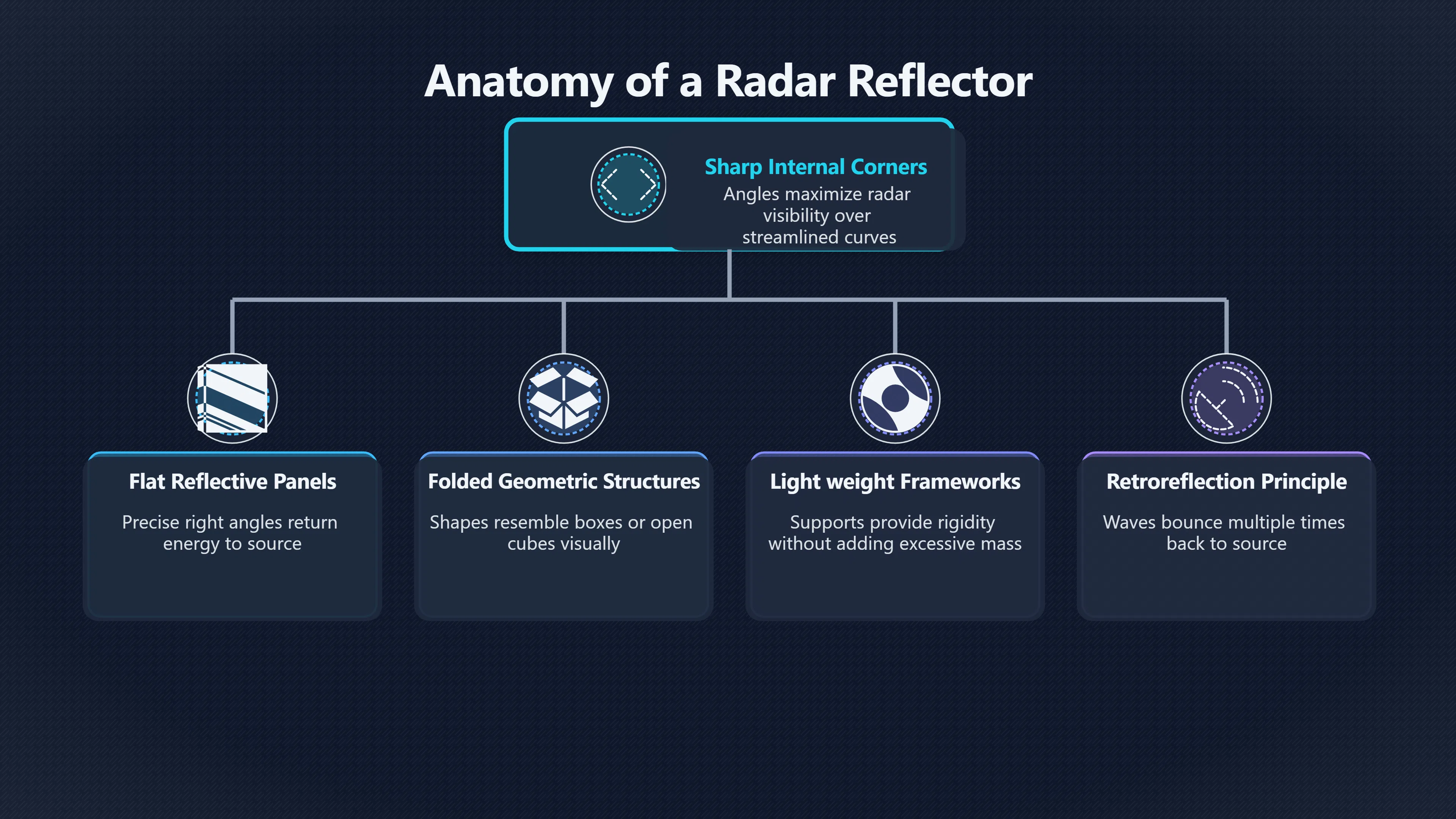
The central idea behind a radar reflector is retroreflection: returning incoming radar energy back toward its source. The most effective designs use surfaces arranged at right angles. In a classic trihedral corner reflector, three mutually perpendicular reflective surfaces cause incoming radar waves to bounce multiple times before returning in nearly the opposite direction from which they arrived. This produces a much stronger radar return than the object’s size alone would suggest.[wikipedia.org]WikipediaCorner reflectorCorner reflector
To achieve this effect, engineers deliberately create shapes that look unusual:
- Sharp internal corners rather than streamlined curves.
- Flat reflective panels arranged at precise right angles.
- Folded geometric structures that resemble boxes, diamonds, or open cubes.
- Lightweight frameworks supporting reflective surfaces.
These features are excellent for radar detection but visually strange. A damaged reflector may leave fragments with repeated angles, metallic surfaces, and symmetrical folds that do not resemble conventional aircraft construction.[wikipedia.org]WikipediaCorner reflectorCorner reflector
The result is a form of technological unfamiliarity. Witnesses often interpret wreckage according to known categories. When debris does not resemble an aeroplane, vehicle, or weather balloon, observers may infer that it belongs to something extraordinary. Radar reflector geometry can unintentionally encourage that conclusion because its appearance is governed by electromagnetic performance rather than intuitive visual design.[Wikipedia]WikipediaOpen source on wikipedia.org.
Why Box-Kite Shapes Appeared in Balloon Work
Many early balloon-tracking systems needed a way for ground radar to follow otherwise hard-to-detect balloons. One solution was the radar target, sometimes called a Rawin target in meteorological applications. These devices suspended reflective structures beneath balloons so radar operators could track their position and movement.[Muller Lab]muller.lbl.govMuller LabProject MogulRawin is short for radar wind, a technique in which a single comer reflector is towed aloft by a single neoprene b…
The reflector assemblies used in some military and research programmes were often described as resembling box kites. Their construction combined lightweight materials with multiple reflective faces arranged in geometric patterns. According to Air Force descriptions of Project Mogul-era equipment, reflector assemblies used foil or foil-backed paper, balsa wood supports, tape, twine, eyelets, and swivels to create multi-faced reflector structures.[NSA]nsa.govreport of air force research regarding theMarch 24, 2018 — 21 Jul 1994 — These targets were made up of aluminum "foil" or foil·backed…
This design choice was practical rather than aesthetic:
- Lightweight materials reduced balloon payload weight.
- Multiple faces improved radar visibility from different angles.
- Foldable structures simplified transport and deployment.
- Open frameworks provided sufficient rigidity without excessive mass.
From a distance, or after partial destruction, these assemblies could look unlike either a balloon or an aircraft. Witnesses might find angular frames, reflective fragments, sticks connected by unusual joints, or kite-like structures whose purpose was not immediately obvious. That unfamiliarity became significant in later interpretations of crash debris.[nsa.gov]nsa.govreport of air force research regarding theMarch 24, 2018 — 21 Jul 1994 — These targets were made up of aluminum "foil" or foil·backed…

Why Purpose-Built Geometry Can Look Mysterious
A key source of confusion is that people tend to associate advanced technology with complexity and unusual shapes. Radar reflectors often possess unusual shapes, but for a completely different reason: they are optimised for a narrow engineering task.
An aircraft wing looks the way it does because it must generate lift. An engine looks the way it does because it must produce thrust. A radar reflector looks strange because it must maximise radar reflections. The visual result can seem highly engineered while offering few clues about its actual purpose.[wikipedia.org]WikipediaCorner reflectorCorner reflector
Several characteristics contribute to witness confusion:
Angular symmetry. Repeating right angles and geometric patterns can appear intentionally sophisticated, especially when encountered outside a technical setting.[Wikipedia]WikipediaCorner reflectorCorner reflector
Reflective materials. Foil-backed surfaces can look metallic and technologically advanced even when attached to simple wooden frames.[NSA]nsa.govreport of air force research regarding theMarch 24, 2018 — 21 Jul 1994 — These targets were made up of aluminum "foil" or foil·backed…
Lack of familiar aircraft parts. Crash investigators and witnesses often expect engines, riveted skin, wiring harnesses, or heavy structural members. Radar targets may contain none of these.[NSA]nsa.govreport of air force research regarding theMarch 24, 2018 — 21 Jul 1994 — These targets were made up of aluminum "foil" or foil·backed…
Fragmentation. Once exposed to weather, impact, or prolonged field conditions, reflector assemblies can break into scattered pieces whose original configuration is difficult to reconstruct. A witness may see isolated components rather than a recognisable complete device.[NSA]nsa.govreport of air force research regarding theMarch 24, 2018 — 21 Jul 1994 — These targets were made up of aluminum "foil" or foil·backed…
Because radar reflectors are purpose-built for electromagnetic visibility rather than human interpretation, they occupy an awkward middle ground. They are clearly engineered objects, yet they do not resemble the machines most people know. In UFO crash stories, that combination has repeatedly allowed ordinary tracking hardware to acquire an aura of mystery.
A Useful Lesson for UFO Crash Claims
The history of radar targets demonstrates that unusual debris is not automatically exotic debris. Technical equipment designed for specialised military or scientific purposes can look highly unconventional when separated from its operating context. In cases involving balloon-borne radar targets, the most confusing elements were often not advanced materials or hidden propulsion systems, but simple geometric structures optimised to return radar signals.[nsa.gov]nsa.govreport of air force research regarding theMarch 24, 2018 — 21 Jul 1994 — These targets were made up of aluminum "foil" or foil·backed…
Understanding the geometry of radar reflectors helps explain why crash witnesses sometimes described debris as strange, unfamiliar, or seemingly non-aeronautical. The odd appearance was real. What differed was the interpretation. The shapes looked unusual not because they came from another world, but because they were designed around the requirements of radar physics rather than the visual expectations people bring to wreckage.[wikipedia.org]WikipediaCorner reflectorCorner reflector

Amazon book picks
Further Reading
Books and field guides related to Why Radar Targets Look Unlike Aircraft Parts. Use these as the next step if you want deeper reading beyond the article.
UFO Crash at Roswell
Includes discussion of radar targets and why their construction was misunderstood.
The UFO Enigma
Helps readers evaluate unusual-looking materials without jumping to conclusions.
UFOs, Chemtrails, and Aliens
Useful for understanding misidentification and evidence evaluation.
eBay marketplace picks
Marketplace Samples
Example marketplace items related to this page. Use the search link to explore similar finds on eBay.

Endnotes
1.
Source: Wikipedia
Title: Corner reflector
Link:https://en.wikipedia.org/wiki/Corner_reflector
2.
Source: radarsimx.com
Title: corner reflector rcs
Link:https://radarsimx.com/2021/05/10/corner-reflector-rcs/
Source snippet
10 May 2021 — A corner reflector (trihedral reflector) consists of three mutually perpendicular conducting surfaces. Incident radar waves...
Published: May 2021
3.
Source: nsa.gov
Link:https://www.nsa.gov/portals/75/documents/news-features/declassified-documents/ufo/report_af_roswell.pdf
Source snippet
report of air force research regarding theMarch 24, 2018 — 21 Jul 1994 — These targets were made up of aluminum "foil" or foil·backed...
Published: March 24, 2018
4.
Source: radartutorial.eu
Title: corner reflectors
Link:https://www.radartutorial.eu/17.bauteile/bt47.en.html
Source snippet
A corner reflector consisting of two or three electrically conductive surfaces which are mounted crosswise (at an angle of e...
5.
Source: Wikipedia
Link:https://en.wikipedia.org/wiki/Radar
6.
Source: Wikipedia
Title: Radar cross section
Link:https://en.wikipedia.org/wiki/Radar_cross_section
7.
Source: Wikipedia
Link:https://en.wikipedia.org/wiki/Project_Mogul
Source snippet
Project MogulProject Mogul was a top secret project by the US Army Air Forces involving microphones flown on high-altitude balloons, w...
8.
Source: aresia.com
Title: Radar reflectors
Link:https://aresia.com/radar-reflector/?lang=en
Source snippet
Luneberg lensTrihedral reflectors are used to generate a particularly strong radar echo. The trihedral corner reflector simulates radar t...
9.
Source: youtube.com
Title: Project Mogul, the secret operation behind the UFO crash in Rodwell!!!
Link:https://www.youtube.com/watch?v=K3MlXHFm6m8
Source snippet
Project Mogul...
10.
Source: youtube.com
Title: Project Mogul
Link:https://www.youtube.com/watch?v=mBcYtSsPIuU
11.
Source: sciencefriday.com
Title: the real roswell cover up spying on air
Link:https://www.sciencefriday.com/articles/the-real-roswell-cover-up-spying-on-air/
Source snippet
Science FridayThe Real Roswell Cover-Up? Spying On Air21 Jul 2017 — Each reflector looked something like a metallic box kite, and Project...
12.
Source: muller.lbl.gov
Link:https://muller.lbl.gov/teaching/physics10/Roswell/USMogulReport.html
Source snippet
Muller LabProject MogulRawin is short for radar wind, a technique in which a single comer reflector is towed aloft by a single neoprene b...
Additional References
13.
Source: academia.edu
Link:https://www.academia.edu/43171162/Trihedral_Corner_Reflector
Source snippet
(PDF) Trihedral Corner ReflectorIn general, the corner reflector consists mutually intersected perpendicular plates. The commonly seen co...
14.
Source: iosrjen.org
Link:https://iosrjen.org/Papers/vol4_issue12%28part-4%29/H04124047051.pdf
Source snippet
Analysis of Radar Cross Sectional Area of Corner ReflectorsA corner reflector is a retro reflector consisting of three mutually perpendic...
15.
Source: perisens.de
Link:https://perisens.de/wp-content/uploads/2022/08/publication_Radarcon_2022.pdf
Source snippet
Definition 1. A trihedral corner reflector is described by three isosceles, right-angled triangles acting as reflection surfaces. In case...
16.
Source: nauticgear.nl
Link:https://www.nauticgear.nl/bootaccessoires/veiligheid/radarreflector/aanbieding-radarreflector.html
Source snippet
Buis Type Radarreflectoren, voor motorboot of zeilschipDeze radar reflector is in 3 varianten verkrijgbaar: 58,5 cm lang voor een zeilboo...
17.
Source: pepperl-fuchs.com
Link:https://www.pepperl-fuchs.com/nl-nl/products-gp25581/132625
Source snippet
MW-REF-M100 Radar corner reflectorMW-REF-M100 Radar corner reflector. Radar corner reflector, triangular 142.8 x 124.5 x 111.5 mm, with 2...
18.
Source: divequipment.nl
Link:https://www.divequipment.nl/en-us/assortment/water-rescue/man-over-board-life-saving-equipment/signals-reflectors/radar-reflectors
Source snippet
Radar ReflectorsThese radar reflectors are made of light alloy and provided with head plastic protection. The model is suitable for foldi...
19.
Source: reddit.com
Link:https://www.reddit.com/r/UFOs/comments/1aus1bi/the_long_held_mogul_balloon_explanation_for_the/
Source snippet
The long held Mogul Balloon explanation for the Roswell...The Mogul Balloon explanation is a theory that the DoD has long held to explai...
20.
Source: physics.smu.edu
Link:https://www.physics.smu.edu/pseudo/UFOs/pt01a.pdf
Source snippet
USAF Roswell Report part 1These targets were made up of aluminum “foil” or foil-backed paper, balsa wood beams that were coated in an. “E...
21.
Source: dafhistory.af.mil
Link:https://www.dafhistory.af.mil/Portals/16/documents/AFD-101201-038.pdf
Source snippet
Roswell ReportThe importance of attachment 32, Lieutenant McAndrew's synopsis, derives from his description of Project MOGUL... Reflecto...
22.
Source: bootplus.nl
Link:https://bootplus.nl/meervlaks-reflectoren/34671-radar-reflector-opbouwbaar.html
Topic Tree