Within FOIA
Why UFO Files Can Stay Hidden Legally
Even real records can be withheld or redacted when classification, privacy, law enforcement, or other legal exemptions apply.
On this page
- The nine exemption problem for crash researchers
- Classification versus ordinary withholding
- How redactions differ from missing records
Page outline Jump by section
Introduction
For researchers investigating alleged UFO crash recoveries, the Freedom of Information Act (FOIA) is often treated as a route to hidden government records. In practice, FOIA is an access law with limits, not a guarantee that every surviving document will be released. Even if a crash-related file exists, agencies may legally withhold it in full, release only fragments, or confirm that records were located while refusing to disclose their contents. The key reason is that FOIA contains nine statutory exemptions that allow information to remain secret under specific circumstances. In disputes over UFO crash records, the most important questions are often not whether records exist, but whether they fall within exemptions for classification, other secrecy laws, privacy protection, law enforcement interests, or privileged internal communications.[foia.gov]foia.govExemption 1: Information that is classified to protect national security. Exemption 2: Information related solely to…Read more…

The Nine Exemption Problem for Crash Researchers
A common misunderstanding in UFO-records debates is that a successful FOIA search must result in public disclosure. Federal agencies are required to search for responsive records, but they are not required to release information covered by one of FOIA’s nine exemptions. As a result, a researcher may receive hundreds of pages with extensive redactions, or even a complete withholding notice, despite the existence of responsive material.[foia.gov]foia.govExemption 1: Information that is classified to protect national security. Exemption 2: Information related solely to…Read more…
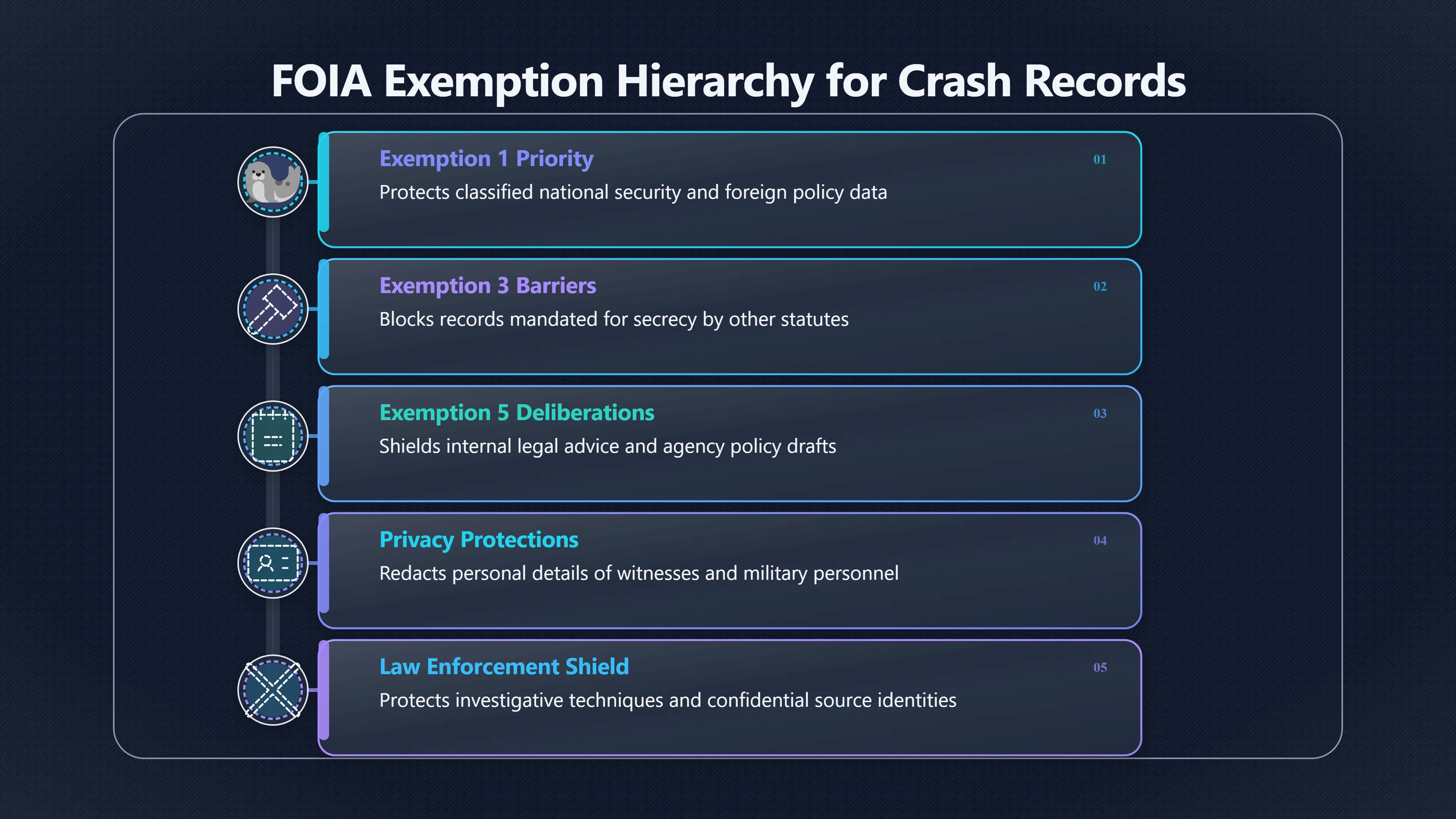
For alleged crash-retrieval records, several exemptions are particularly significant:
- Exemption 1 protects properly classified national-security information.[foia.gov]foia.govExemption 1: Information that is classified to protect national security. Exemption 2: Information related solely to…Read more…
- Exemption 3 protects information that another federal statute specifically requires to remain secret.
- Exemption 5 protects certain internal government deliberations, legal advice, and privileged communications.
- Exemptions 6 and 7(C) protect personal privacy interests.
- Exemption 7 can also shield law-enforcement records, confidential sources, and investigative techniques. Office of Inspector General+3FOIA.gov+3United States Secret Service[foia.gov]foia.govExemption 1: Information that is classified to protect national security. Exemption 2: Information related solely to…Read more…
This means that a hypothetical crash-recovery file could survive in government custody and still remain unavailable for reasons that have nothing to do with UFOs specifically. The same legal framework applies to intelligence programmes, weapons systems, criminal investigations, and many other categories of government records.[FOIA.gov]foia.govExemption 1: Information that is classified to protect national security. Exemption 2: Information related solely to…Read more…
Classification Versus Ordinary Withholding
Why Exemption 1 Receives So Much Attention
Among UFO researchers, Exemption 1 attracts the most interest because it covers information that has been properly classified in the interests of national defence or foreign policy. If a document contains classified operational information, intelligence capabilities, sensor systems, military technologies, or foreign-intelligence material, agencies may withhold it even decades after its creation if classification rules still apply.[Department of Justice]justice.govfoia guide 2004 edition exemption 1Department of JusticeFOIA Guide, 2004 Edition: Exemption 1Exemption 1 of the FOIA integrates the national security protections provided b…
Importantly, Exemption 1 does not require the government to prove that a UFO crash occurred. It merely allows information to remain secret if the information itself is properly classified. In a crash-related context, agencies could theoretically release the fact that a search occurred while continuing to redact technical details, collection methods, or intelligence sources.[Department of Justice]justice.govfoia guide 2004 edition exemption 1Department of JusticeFOIA Guide, 2004 Edition: Exemption 1Exemption 1 of the FOIA integrates the national security protections provided b…
Exemption 3 Can Be Even Harder to Challenge
Researchers often focus on classification while overlooking Exemption 3. This exemption incorporates secrecy requirements found in other federal laws. If another statute mandates nondisclosure, agencies may withhold information regardless of whether it is formally classified. Intelligence-community records are a frequent example because specialised secrecy statutes can independently block disclosure.[FOIA.gov]foia.govFOI A.govFreedom of Information ActExemption 3 incorporates into the FOIA certain nondisclosure provisions that are contained in other federal law…
In practical terms, a requester may win an argument that material is no longer properly classified yet still face an Exemption 3 barrier if another law protects the same information. Courts have repeatedly recognised that Exemptions 1 and 3 can operate together, making certain records especially difficult to obtain.[FOIA.gov]foia.govoip 101012Summaries of New Decisions – August 2010Exemption 1: The court finds that information properly withheld under Exemption… information…

Internal Deliberations and Legal Advice
Even where national security is not involved, Exemption 5 can shield drafts, legal analyses, recommendations, and internal policy discussions. For crash-related inquiries, this can affect later reviews, investigations, or agency debates about how to respond to public claims. The result is that final conclusions may be released while some of the internal reasoning process remains hidden.[FOIA.gov]foia.govExemption 1: Information that is classified to protect national security. Exemption 2: Information related solely to…Read more…
How Redactions Differ From Missing Records
One of the most important distinctions in UFO document research is the difference between a redacted record and a missing record.
A redacted record is evidence that the agency located something responsive. The agency is effectively saying, “We found material, but part of it cannot be released.” Modern declassification and FOIA systems often mark redactions with exemption codes that identify the legal basis for withholding specific passages.[National Archives]archives.govredaction codesNational ArchivesRedaction Codes13 May 2025 — Each redaction will be associated with a redaction code, which gives the reason for why the…
A missing record, by contrast, may indicate many different things:
- The record never existed.
- It existed but was destroyed under records-management procedures.
- It was misfiled or transferred elsewhere.
- The search did not reach the correct office or archive.
- The agency genuinely could not locate it.
A missing file therefore tells researchers much less than a heavily redacted file. Redactions confirm the existence of responsive material; missing records often leave the underlying question unresolved.[The National Archives]nationalarchives.gov.ukThe National ArchivesAccess to public recordsThe Information Commissioner's Office (ICO) issues guidance on FOIA exemptions (the reasons…
This distinction is frequently blurred in UFO discussions. A blacked-out page can be interpreted as proof of concealment, while a missing page can be interpreted as proof of destruction. Legally, however, the two situations are very different. One involves acknowledged records being partially withheld; the other involves uncertainty about whether records are available at all.
Privacy and Law-Enforcement Exemptions in Crash Cases
Not every withholding is about national security. UFO crash allegations often involve military personnel, intelligence officers, witnesses, contractors, or private citizens. Names, addresses, identifying details, and personal information can be removed under privacy exemptions even when the underlying document is released.[secretservice.gov]secretservice.govUnited States Secret ServiceFOIA ExemptionsExemption 1: Information that is classified to protect national security…. Exemption 3: Inf…
Law-enforcement exemptions can also affect crash-related files. If records contain information about investigations, confidential sources, investigative methods, or safety concerns, agencies may redact those portions. In some circumstances, agencies may even refuse to confirm whether certain records exist if acknowledging their existence would itself reveal protected information.[United States Secret Service]secretservice.govUnited States Secret ServiceFOIA ExemptionsExemption 1: Information that is classified to protect national security…. Exemption 3: Inf…
For researchers, this means that a document may arrive with key names, locations, technical details, or source references removed, making interpretation difficult even when disclosure technically occurs.
What FOIA Exemptions Can and Cannot Prove
FOIA exemptions are often cited in arguments about UFO crash secrecy, but their existence does not resolve the underlying question of whether any particular crash claim is true. A withholding under Exemption 1 shows that information is being protected as classified national-security material; it does not establish that the hidden information concerns extraterrestrial technology. Likewise, a privacy or law-enforcement redaction does not imply a cover-up of a crash event.[foia.gov]foia.govExemption 1: Information that is classified to protect national security. Exemption 2: Information related solely to…Read more…
At the same time, exemptions matter because they create a lawful mechanism for records to remain hidden even when those records unquestionably exist. The central lesson for UFO crash researchers is therefore straightforward: FOIA can reveal important evidence, but it cannot compel the release of every surviving government record. The presence of exemptions means that some files may remain partially or wholly inaccessible for legal reasons long after their existence becomes known.[foia.gov]foia.govExemption 1: Information that is classified to protect national security. Exemption 2: Information related solely to…Read more…
eBay marketplace picks
Marketplace Samples
Example marketplace items related to this page. Use the search link to explore similar finds on eBay.




Endnotes
1.
Source: foia.gov
Link:https://www.foia.gov/faq.html
Source snippet
Exemption 1: Information that is classified to protect national security. Exemption 2: Information related solely to...Read more...
2.
Source: archives.gov
Link:https://www.archives.gov/personnel-records-center/foia-info
Source snippet
National ArchivesFreedom of Information Act (FOIA) and The Privacy ActMay 29, 2025 — This right to access is limited when such informatio...
Published: May 29, 2025
3.
Source: justice.gov
Link:https://www.justice.gov/oip/doj-guide-freedom-information-act-0
Source snippet
Department of JusticeDepartment of Justice Guide to the Freedom of Information...The Guide includes detailed discussions of the FOIA's p...
4.
Source: justice.gov
Title: foia guide 2004 edition exemption 1
Link:https://www.justice.gov/archives/oip/foia-guide-2004-edition-exemption-1
Source snippet
Department of JusticeFOIA Guide, 2004 Edition: Exemption 1Exemption 1 of the FOIA integrates the national security protections provided b...
5.
Source: justice.gov
Title: foia update protecting national security under foia
Link:https://www.justice.gov/archives/oip/blog/foia-update-protecting-national-security-under-foia
Source snippet
Department of JusticeFOIA Update: Protecting National Security Under the FOIA19 Dec 2024 — Under Exemption 1 of the Freedom of Informatio...
6.
Source: foia.gov
Title: FOI A.gov
Link:https://www.foia.gov/
Source snippet
Freedom of Information ActExemption 3 incorporates into the FOIA certain nondisclosure provisions that are contained in other federal law...
7.
Source: foia.gov
Link:https://www.foia.gov/foia-statute.html
Source snippet
Freedom of Information Act StatuteExemption 3 incorporates into the FOIA certain nondisclosure provisions that are contained in other fed...
8.
Source: foia.gov
Title: oip 101012
Link:https://www.foia.gov/iso/opa/foia/oip-101012.html
Source snippet
Summaries of New Decisions -- August 2010Exemption 1: The court finds that information properly withheld under Exemption... information...
9.
Source: archives.gov
Title: redaction codes
Link:https://www.archives.gov/declassification/iscap/redaction-codes.html
Source snippet
National ArchivesRedaction Codes13 May 2025 — Each redaction will be associated with a redaction code, which gives the reason for why the...
Published: May 2025
10.
Source: archives.gov
Link:https://www.archives.gov/files/foia/directives/nara1601.pdf
Source snippet
National ArchivesNARA Directive 1601Jan 10, 2002 — “Exempted information” refers to information that may be legitimately withheld under o...
11.
Source: nationalarchives.gov.uk
Link:https://www.nationalarchives.gov.uk/information-management/manage-information/selection-and-transfer/sensitivity-reviews-on-selected-records/access-to-public-records/
Source snippet
The National ArchivesAccess to public recordsThe Information Commissioner's Office (ICO) issues guidance on FOIA exemptions (the reasons...
12.
Source: nationalarchives.gov.uk
Title: The National Archives Legislation and regulations Archives
Link:https://www.nationalarchives.gov.uk/category/information-management/legislation-and-regulations/page/2/
Source snippet
Some records however are transferred 'closed', meaning subject to FOI exemptions. There are...Read more...
13.
Source: archives.gov
Title: The Freedom of Information Act (FOIA)
Link:https://www.archives.gov/about/laws/foia.html
Source snippet
overview, where appropriate, of certain general categories of agency records to which those exemptions apply;. (F) offer training to agen...
14.
Source: archives.gov
Title: foia guide
Link:https://www.archives.gov/foia/foia-guide
Source snippet
Freedom of Information Act (FOIA) Reference Guide (2018)Jan 20, 2026 — If the National Archives receives a request for records that we be...
15.
Source: nationalarchives.gov.uk
Link:https://www.nationalarchives.gov.uk/terms-and-conditions/privacy-notice/
Source snippet
Privacy noticeThird parties will not have access to your personal information unless the law allows them to do so. Use of data processors...
16.
Source: secretservice.gov
Link:https://www.secretservice.gov/foia/exemptions
Source snippet
United States Secret ServiceFOIA ExemptionsExemption 1: Information that is classified to protect national security.... Exemption 3: Inf...
17.
Source: doioig.gov
Link:https://www.doioig.gov/complaints-requests/foia/foia-exemptions-and-exclusions
Source snippet
FOIA Exemptions and ExclusionsExemption (b)(1) protects classified information from disclosure, under... Exemption (b)(3) protects infor...
18.
Source: sussex.ac.uk
Link:https://www.sussex.ac.uk/ogs/policies/information/foi/exemptions
Source snippet
Freedom of InformationThe Freedom of Information Act 2000 sets out 23 exemptions where the general right of access to information is eith...
Additional References
19.
Source: csosa.gov
Link:https://www.csosa.gov/foia-exemptions/
Source snippet
FOIA ExemptionsExemptions. Exemption 1 – Protects from disclosure information that has been deemed classified “under criteria established...
20.
Source: fincen.gov
Link:https://www.fincen.gov/foia-exemptions-and-exclusions
Source snippet
FOIA Exemptions and ExclusionsExemption One: Classified national defense and foreign relations information. Exemption Two: Internal agenc...
21.
Source: energy.gov
Link:https://www.energy.gov/gc/foia-frequently-asked-questions-faqs
Source snippet
FOIA Frequently Asked Questions (FAQs)Exemption (b)(1) protects from disclosure national security information concerning the national def...
22.
Source: fbi.gov
Link:https://www.fbi.gov/how-we-can-help-you/more-fbi-services-and-information/freedom-of-information-privacy-act/foia-pa-overviews-exemptions-and-terms
Source snippet
FOIA/PA Overviews, Exemptions, and TermsExemptions: (b)(1) (A) Specifically authorized under criteria by an executive order to be kept se...
23.
Source: dol.gov
Link:https://www.dol.gov/general/foia/exemptions
24.
Source: rcfp.org
Link:https://www.rcfp.org/open-government-sections/1-character-of-exemptions/
Source snippet
1. Character of exemptions ArchivesMost exceptions are relatively specific, but AS 40.25.120(4) is a "catch-all" exemption that closes "r...
25.
Source: compliance.af.mil
Link:https://www.compliance.af.mil/Guide-to-FOIA-Exemptions/
26.
Source: ico.org.uk
Link:https://ico.org.uk/for-organisations/foi/guide-to-managing-an-foi-request/exemptions/list-of-exemptions/
Source snippet
List of exemptionsThe section 24 exemption applies if it is “required for the purpose of safeguarding national security”. The exemption d...
27.
Source: nsarchive2.gwu.edu
Link:https://nsarchive2.gwu.edu/nsa/foia/guide.html
Source snippet
National Security ArchiveFOIA BasicsThe FOIA allows an agency only nine exemptions from its obligation to provide information in response...
28.
Source: Commerce.gov
Title: FOIA Exemptions and Exclusions(b)(1)
Link:https://www.commerce.gov/opog/foia-exemptions-and-exclusions
Source snippet
Protects Classified Matters of National Defense or Foreign Policy This exemption protects from disclosure national security information c...
Topic Tree