Within FOIA
How Good UFO Crash Records Requests Work
A useful UFO crash request names dates, places, units, record types, and alternate terms instead of asking for a mystery to be solved.
On this page
- Why broad UFO requests fail
- Records and keywords that narrow the search
- How to frame follow up requests after a no records reply
Page outline Jump by section
Introduction
When people file Freedom of Information (FOI or FOIA) requests about an alleged UFO crash, the most common mistake is asking the government to solve the mystery. Records laws are designed to locate existing documents, not to answer open-ended questions. A useful request therefore focuses on records that could realistically exist: incident reports, base logs, message traffic, photographs, radar records, unit histories, recovery orders, contractor correspondence, or later investigations. Agencies are generally required to search for records that are reasonably described, but they are not required to create new records or conduct research on a requester’s behalf.[FOIA.gov]foia.govOpen source on foia.gov.
 In the context of UFO crash claims, the quality of the request often determines whether a search produces meaningful results. The goal is not to ask, “Did aliens crash here?” but to identify where, when, and by whom records would have been created if an unusual recovery event actually occurred.
Why Broad UFO Requests Fail
A request such as “Send me all UFO crash files” is usually too vague to guide a records search. Agencies organise records by offices, units, dates, subjects, filing systems, and record series. Requests that fail to identify those elements can be rejected as overly broad or may produce only superficial searches. Agencies typically require requests to reasonably describe the records sought.[foia.gov]foia.govOpen source on foia.gov.
For example, a crash claim tied to a specific military installation in a specific month creates a far more searchable trail than a request covering decades of unidentified phenomena. A records officer can search known repositories, operational files, correspondence systems, and archives only if the request provides enough detail to locate likely records.
Researchers who have successfully obtained documents in controversial cases usually begin with a narrow factual claim rather than the broader UFO narrative. Instead of requesting proof of extraterrestrial technology, they seek records generated by identifiable organisations during a defined event window.
Records and Keywords That Narrow the Search
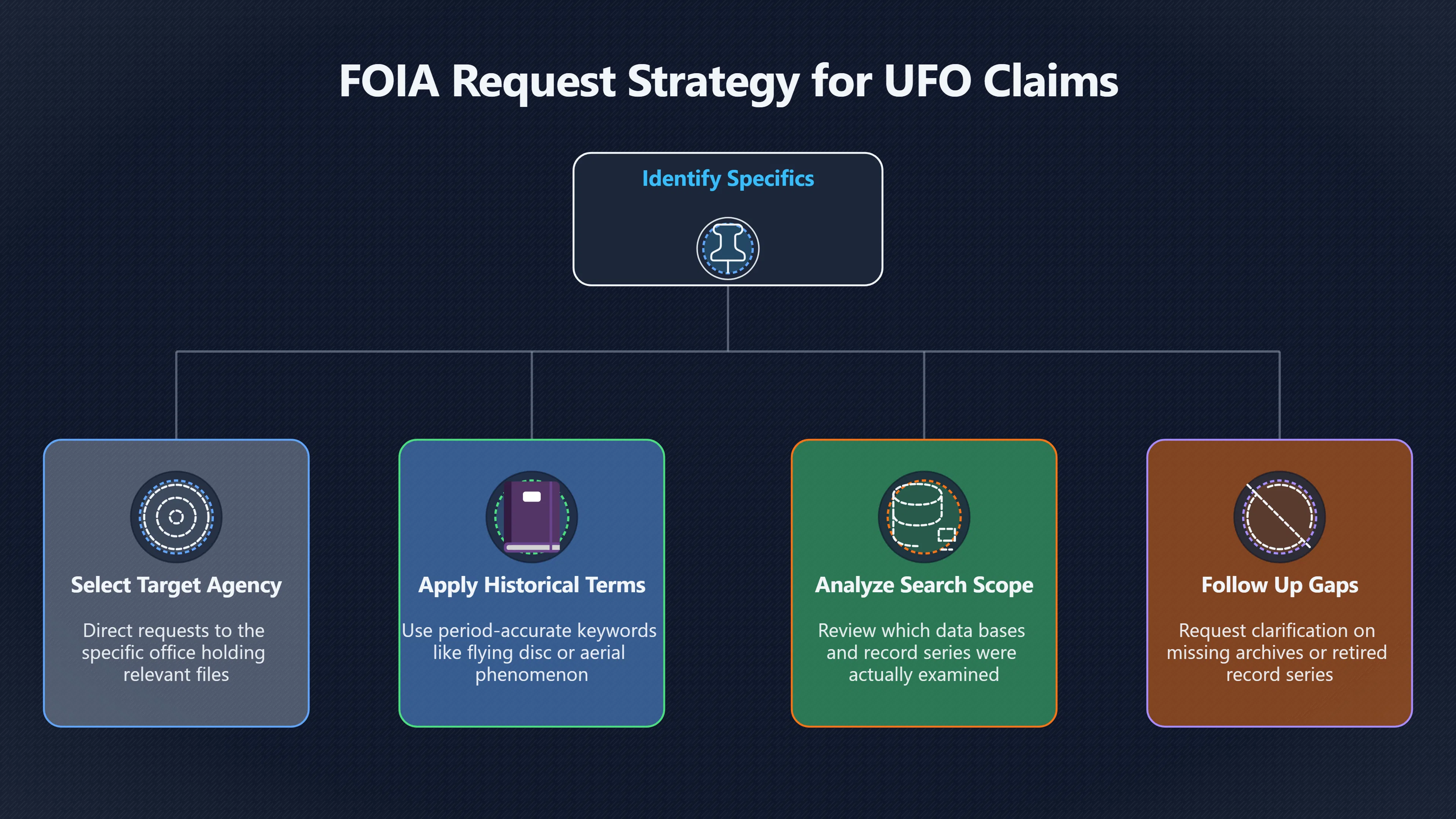
The strongest UFO crash requests combine five elements:
- Date or date range
- Location
- Military or government unit
- Specific record types
- Alternative terminology
This approach mirrors general FOIA guidance that recommends identifying names, places, time periods, document titles, and other details that help agencies locate records.[nfoic.org]nfoic.orgSample FOIA Request LettersReasonably describe the records and/or information you need. It helps to include names of people and plac…
Consider a hypothetical crash claim near an air base in July 1947. Rather than requesting “all UFO records,” a targeted request might seek:
- Daily staff journals
- Base operations logs
- Military police blotters
- Intelligence summaries
- Teletype messages
- Aircraft accident reports
- Search-and-recovery orders
- Photographs
- Unit history reports
- Correspondence with higher headquarters
The choice of keywords matters as much as the record type. Officials in earlier decades rarely used modern UFO terminology consistently. A search may need to include alternative terms such as:
- Flying disc
- Flying saucer
- Unidentified aerial object
- Unidentified object
- Aerial phenomenon
- Balloon recovery
- Debris recovery
- Aircraft incident
- Experimental equipment
- Project names associated with the period
Using multiple historically plausible terms can prevent records from being missed because they were catalogued under language different from today’s UFO vocabulary. FOIA specialists routinely recommend supplying keywords and known titles that match how records were originally created and stored.[National Security Archive]nsarchive.gwu.edu2) WRITE your request clearly; and be specific. 3) TARGET your request. 4) Establish and maintain CONTACT…Read more…
Target the Agency Most Likely to Hold the Records
A common failure point in UFO crash research is sending requests to the wrong organisation.
Records laws generally apply to records held by a particular agency, not to the government as a whole. A request reaches the quickest and most effective search when it is directed to the office most likely to possess the relevant records.[FOIA.gov]foia.govMost federal agencies now accept FOIA requests electronically, includingFreedom of Information Act: Frequently Asked Questions…The request simply must be in writing and reasonably describe the records you seek…
For a crash claim, potential custodians might include:
- Military branches involved in local operations
- Intelligence agencies that later reviewed the incident
- National archives holding transferred historical files[whatdotheyknow.com]whatdotheyknow.comNational Archivesview and make Freedom of Information…Requests to the National Archives can be made for around 5% of the National Archives' records are…
- Civil aviation authorities
- Law-enforcement agencies
- Scientific or technical organisations involved in investigations
Before filing, researchers often examine archival catalogues, published histories, previously released documents, and declassified collections to determine which organisation actually created the records. This preliminary work can save months or years of misdirected requests.[gwu.edu]nsarchive.gwu.edu2) WRITE your request clearly; and be specific. 3) TARGET your request. 4) Establish and maintain CONTACT…Read more…

Building a Request Around a Specific Claim
The most productive requests read almost like a records map.
A crash allegation usually contains several factual elements that can be converted into search parameters:
Claim ElementRecords ClueLocation of crashBase records, local police files, recovery reportsDateDaily logs, message traffic, duty officer reportsMilitary unit involvedUnit histories, operations recordsWitness claims of recoveryPersonnel correspondence, investigation filesAlleged transport of debrisShipping records, movement orders, convoy reportsLater official explanationInvestigative studies, review memoranda
A records officer may not know anything about UFO history, but they can search these categories if the request clearly identifies them.
How to Frame Follow-Up Requests After a No-Records Reply
A “no responsive records” response is not necessarily the end of the search.
The most useful follow-up question is often not “Are you sure?” but rather “What records were searched?” A requester can seek clarification about:
- Which offices were tasked with searching
- Which databases or record series were examined
- Whether archived or retired records were included
- Whether alternate keywords were used
- Whether another agency might be a more likely custodian
This approach shifts the discussion from the UFO claim itself to the adequacy of the records search.
FOIA law focuses on whether an agency conducted a reasonable search for responsive records. Understanding what was searched allows researchers to identify gaps and craft a narrower second request.[FOIA.gov]foia.govFreedom of Information Act StatuteA request submitted to a federal agency asking for agency records on any topic. A FOIA request can gene…
For example, if an agency searched only headquarters files, a follow-up request might target field offices, operational units, or archived records. If a search used only “UFO” as a keyword, a revised request might add historical terms such as “flying disc” or “recovered debris.”
Turning Negative Results Into New Leads
Some of the most valuable UFO crash FOIA work comes from following administrative breadcrumbs rather than expecting a dramatic disclosure.
A no-records response can reveal:
- That a record series once existed but was destroyed
- That records were transferred elsewhere
- That a different office controlled the files
- That records were reclassified under another subject category
- That an investigation was conducted by a separate organisation
Even unsuccessful requests can therefore refine the search.
In historical UFO crash controversies, researchers often build a chain of requests, each based on information learned from the previous response. The process resembles archival investigation more than revelation hunting. Each request narrows dates, offices, record series, and terminology until the search either finds documentary evidence or establishes that no surviving records can currently be identified.

What a Strong UFO Crash Request Actually Seeks
The strongest UFO crash requests do not ask whether extraterrestrial craft crashed. They ask for specific records connected to a specific alleged event. They identify dates, locations, units, document types, and alternate terminology. They target the agency most likely to possess the records and use follow-up requests to understand how searches were conducted.
That approach does not guarantee dramatic discoveries. It does, however, maximise the chance of finding the paper trail that would exist if a significant recovery incident generated official records in the first place. The more precisely a crash claim can be translated into a search for identifiable documents, the more effectively freedom-of-information laws can test it.
Amazon book picks
Further Reading
Books and field guides related to How Good UFO Crash Records Requests Work. Use these as the next step if you want deeper reading beyond the article.
eBay marketplace picks
Marketplace Samples
Example marketplace items related to this page. Use the search link to explore similar finds on eBay.




Endnotes
1.
Source: foia.gov
Link:https://www.foia.gov/how-to.html
2.
Source: foia.gov
Title: Most federal agencies now accept FOIA requests electronically, including
Link:https://www.foia.gov/faq.html
Source snippet
Freedom of Information Act: Frequently Asked Questions...The request simply must be in writing and reasonably describe the records you seek...
3.
Source: foia.gov
Link:https://www.foia.gov/foia-statute.html
Source snippet
Freedom of Information Act StatuteA request submitted to a federal agency asking for agency records on any topic. A FOIA request can gene...
4.
Source: nfoic.org
Link:https://www.nfoic.org/sample-foia-request-letters/
Source snippet
Sample FOIA Request LettersReasonably describe the records and/or information you need. It helps to include names of people and plac...
5.
Source: archives.gov
Title: file foia request
Link:https://www.archives.gov/research/foia/file-foia-request
Source snippet
Specify that you are filing a FOIA request · 2. Include your contact information: Complete name (first and last) · 3. Describe the record...
6.
Source: nationalarchives.gov.uk
Link:https://www.nationalarchives.gov.uk/help-with-your-research/
Source snippet
· Search our records · Need help using Discovery? · Find a research guide · How to view our records · Contact us...Read more...
7.
Source: archives.gov
Link:https://www.archives.gov/research
Source snippet
National ArchivesResearch Our RecordsJan 14, 2026 — Research your ancestry, learn about our records and how to use them to research and d...
8.
Source: nationalarchives.gov.uk
Link:https://www.nationalarchives.gov.uk/freedom-of-information/
Source snippet
Freedom of InformationLearn how to submit a Freedom of Information request to The National Archives. Freedom of Information requests. Thi...
9.
Source: nationalarchives.gov.uk
Link:https://www.nationalarchives.gov.uk/freedom-of-information/making-a-freedom-of-information-request/
Source snippet
Please submit your FOI request to one of the below: Address. Enquiry Service, The National Archives, Kew...Read more...
10.
Source: nationalarchives.gov.uk
Title: access to public records
Link:https://www.nationalarchives.gov.uk/information-management/manage-information/selection-and-transfer/sensitivity-reviews-on-selected-records/access-to-public-records/
Source snippet
The Freedom of Information Act 2000 (FOIA) governs public access to public records, and these are transferred 'open on transfer' unless a...
11.
Source: nationalarchives.gov.uk
Title: Make a Freedom of Information enquiry
Link:https://www.nationalarchives.gov.uk/contact-us/make-a-freedom-of-information-enquiry/
Source snippet
Contact usUse this form to send us your Freedom of Information (FOI) request if you would like information from The National Archives, in...
12.
Source: nationalarchives.gov.uk
Link:https://www.nationalarchives.gov.uk/about/our-role/transparency/freedom-of-information-requests/
Source snippet
For each entry we show the request, whether or not it was successful...Read more...
13.
Source: nationalarchives.gov.uk
Link:https://www.nationalarchives.gov.uk/freedom-of-information/requests/?page=1
Source snippet
Freedom of Information requestsThis disclosure log shows Freedom of Information requests received by The National Archives for informatio...
14.
Source: nationalarchives.gov.uk
Link:https://www.nationalarchives.gov.uk/terms-and-conditions/takedown-and-reclosure-policies/reclosure-policy/
Source snippet
Reclosure PolicyThe FOI Act ensures that even where records are marked 'Access Under Review' on Discovery, members of the public can stil...
15.
Source: GOV.UK
Link:https://www.gov.uk/make-a-freedom-of-information-request
Source snippet
If you ask for environmental...Read more...
16.
Source: GOV.UK
Title: Information on making a complaint about how your request was handled.Read more
Link:https://www.gov.uk/government/collections/requests-for-personal-data-and-service-records
Source snippet
for personal data and service records: a detailed...9 Nov 2016 — A short guide to finding out how to get a copy of military service reco...
17.
Source: ckan.publishing.service.gov.uk
Title: publishing.service.gov.uk The National Archives
Link:https://ckan.publishing.service.gov.uk/organization/the-national-archives?_res_format_limit=0&page=3
Source snippet
National Archives - Publishers - data.gov.ukThe file shows the data provided by those 21 [bodies]({{ 'bodies/' | relative_url }}) that transfer 90% of the records sent to...
18.
Source: opengovernment.ny.gov
Title: Open Government Freedom of Information Law
Link:https://opengovernment.ny.gov/freedom-information-law
Source snippet
An agency may reject a request that does not "reasonably describe" records. If the...Read more...
19.
Source: nsarchive.gwu.edu
Link:https://nsarchive.gwu.edu/foia/making-foia-work-you
Source snippet
2) WRITE your request clearly; and be specific. 3) TARGET your request. 4) Establish and maintain CONTACT...Read more...
20.
Source: Wikipedia
Link:https://en.wikipedia.org/wiki/The
Source snippet
The - WikipediaThe is a grammatical article in English, denoting nouns that are already or about to be mentioned, under discussion, im...
21.
Source: ico.org.uk
Title: the national archives
Link:https://ico.org.uk/action-weve-taken/foi-regulatory-action/2023/03/the-national-archives/
Source snippet
14 Mar 2023 — These records require preserving and storing safely to archival standards. The records are closed until 115 years after...
22.
Source: whatdotheyknow.com
Title: National Archives
Link:https://www.whatdotheyknow.com/body/national_archives
Source snippet
view and make Freedom of Information...Requests to the National Archives can be made for around 5% of the National Archives' records are...
Additional References
23.
Source: justice.gov
Link:https://www.justice.gov/oip/department-justice-freedom-information-act-reference-guide
Source snippet
Department of JusticeDepartment of Justice Freedom of Information Act...This Reference Guide is designed to familiarize you with the spe...
24.
Source: multimedia.journalism.berkeley.edu
Link:https://multimedia.journalism.berkeley.edu/tutorials/public-records-act-requests/
Source snippet
Berkeley Advanced Media InstitutePublic Records Act or FOIA RequestsThe law requires that each request must reasonably describe the recor...
25.
Source: youtube.com
Link:https://www.youtube.com/watch?v=D8rxsWyv87M
26.
Source: justice.gov
Title: foia update foia counselor what foia request
Link:https://www.justice.gov/archives/oip/blog/foia-update-foia-counselor-what-foia-request
Source snippet
FOIA Update: FOIA Counselor: What is a FOIA Request?1 Jan 1980 — The spirit of FOIA requires that agencies give consideration under FOIA...
27.
Source: ico.org.uk
Link:https://ico.org.uk/for-the-public/official-information/preparing-and-submitting-your-information-request/
Source snippet
It should be straightforward to find their details on the organisation's website.Read more...
28.
Source: ico.org.uk
Link:https://ico.org.uk/for-organisations/advice-for-small-organisations/freedom-of-information-foi/freedom-of-information-quick-guide/
Source snippet
ublic authorities such as schools, councils and healthcare...Read more...
29.
Source: Wikipedia
Title: Freedom of Information Act (United States)
Link:https://en.wikipedia.org/wiki/Freedom_of_Information_Act_%28United_States%29
Source snippet
Freedom of Information Act (United States)The United States federal freedom of information law that requires the full or partial discl...
30.
Source: workdynamics.com
Title: what is a foia request
Link:https://www.workdynamics.com/what-is-a-foia-request/
Source snippet
?10 Mar 2026 — A FOIA request is a formal request submitted to a U.S. federal agency asking for access to government records. Emails. Rep...
31.
Source: youtube.com
Title: UFO research: Scientists, spies and push for disclosure | UFO Mysteries
Link:https://www.youtube.com/watch?v=ahTxgnexVjM
Source snippet
Key moments at House UFO transparency hearing...
32.
Source: leavesfamilyhistory.co.uk
Title: closed records
Link:https://leavesfamilyhistory.co.uk/research/closed-records/
Source snippet
Accessing Closed Records in Archives.7 Jul 2019 — You will need to complete a 3rd Party Access Request Form and produce a copy of the dea...
Topic Tree