Within UFO Crashes
What Search Operations Can Tell US
Official searches are valuable because they create timelines, personnel trails, and practical limits on what was actually found.
On this page
- Who searched and why
- Logs, reports, and operational records
- How searches can leave a case unresolved
Page outline Jump by section
Introduction
Search-and-rescue records are among the most useful evidence trails in UFO crash cases because they show what officials did before anyone knew whether the incident was extraordinary, ordinary, dangerous or simply mistaken. A claimed crash should trigger practical actions: police calls, rescue coordination, aircraft-accounting checks, vessel or ground searches, diver tasking, military messages, press statements and later record searches. Those records rarely prove an exotic object crashed. More often, they reveal the limits of the case: who searched, where they searched, what they were looking for, what they failed to find, and which explanations were ruled in or out.
This matters because UFO crash stories often grow after the emergency phase. Search records freeze the early response in time. They can strengthen a case, as at Shag Harbour, where Canadian records show a real search for an unidentified object in the water. They can also weaken later claims, as at Roswell and Kecksburg, where searches and record reviews point to balloons, meteors, missing files, or no recovered object rather than a documented alien crash.
Who searched and why
The most important question in a UFO crash case is not whether later witnesses used the word “UFO”. It is what the first responders thought they were dealing with. Search-and-rescue systems are designed around immediate risk: missing aircraft, survivors in water or woods, fire, hazardous debris, radiation, public safety and airspace accountability. In that first phase, officials may respond to an “unknown object” without endorsing any extraordinary interpretation.
Shag Harbour in Nova Scotia is the clearest example. On 4 October 1967, witnesses reported an object descending into the water near the village. Library and Archives Canada now lists the Shag Harbour sighting as “Canada’s most famous UFO incident” and notes that it was investigated by the Royal Canadian Mounted Police and Canadian Forces. That is a crucial distinction: the case is not merely a later folklore claim, because it generated records in ordinary official channels.[LAC Recherche]recherche-research.bac-lac.gc.caOpen source on gc.ca.
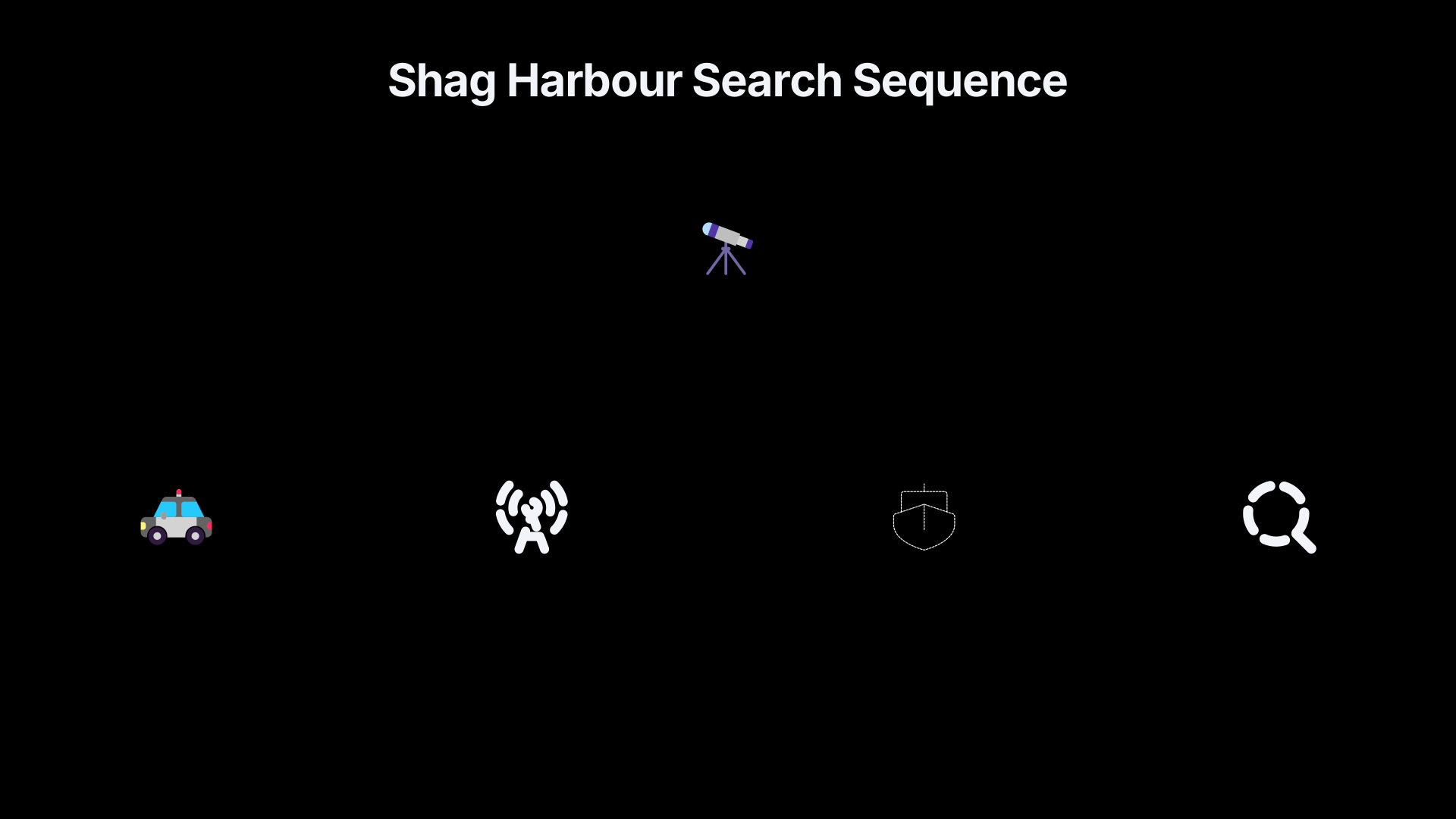
The operational reason for the response was straightforward. The first report was treated as a possible aircraft crash. Accounts of the case describe the RCMP contacting the Rescue Coordination Centre in Halifax to ask whether any aircraft were missing; local boats and a Canadian Coast Guard cutter searched the water, and naval divers later searched the seabed. The most evidentially useful feature is not that the object remained unexplained, but that the search moved through identifiable agencies and tasks: police report, rescue coordination, aircraft-accounting check, surface search, and underwater search.[Wikipedia]WikipediaShag Harbour UFO incidentShag Harbour UFO incident
Kecksburg, Pennsylvania, shows a different pattern. On 9 December 1965, a bright fireball was seen across a wide region of North America, and witnesses near Kecksburg reported that something came down in the woods. Contemporary and later reporting describe state police, Air Force personnel, soldiers, curiosity seekers and a restricted search area; one Air Force memo cited in later Associated Press reporting said that after a late-night search “they could not find anything”. That search trail matters because it separates the documented emergency response from the later claim that a large acorn-shaped object was secretly removed.[ABC News]abcnews.comABC News NASA to search files for UFO incidentABC News NASA to search files for UFO incident
Roswell is different again. The famous 1947 story began with military recovery of debris, not a public rescue operation for survivors. The Government Accountability Office later examined whether the US government had records concerning the crash near Roswell and noted that the Roswell Army Air Field public information office had reported recovery of a “flying disc” on 8 July 1947, followed the next day by an announcement that the recovered object was a radar-tracking weather balloon.[GovInfo]govinfo.govGAOREPORTS NSIADGAOREPORTS NSIAD
Logs, reports and operational records
Search-and-rescue records are valuable because they are usually boring in the right way. They are written to coordinate work, not to persuade believers or sceptics. In crash cases, the most useful records tend to fall into several overlapping categories.
Initial call records and police reports establish the first description, time, place and perceived emergency. A report of “a plane has gone down” is not the same as a report of “an alien craft has crashed”. In Shag Harbour, that distinction matters because the search began from a possible aircraft crash report and only later became a recorded unidentified object case after aircraft checks did not account for it.[Wikipedia]WikipediaShag Harbour UFO incidentShag Harbour UFO incident
Rescue coordination messages show whether authorities checked aircraft status. In Shag Harbour, the key operational question was whether any commercial, private or military aircraft were missing. Accounts of the search describe Halifax rescue coordination determining by the next morning that aircraft were accounted for, which is why the case remained anomalous rather than becoming an aircraft accident investigation.[Wikipedia]WikipediaShag Harbour UFO incidentShag Harbour UFO incident
Tasking records and unit messages identify who was sent. Shag Harbour’s paper trail includes references to the RCMP, Canadian Coast Guard, Canadian Forces, and Fleet Diving Unit Atlantic. The Library and Archives Canada UFO collection is especially important here because it contains federal records from the Department of National Defence, Department of Transport, National Research Council and RCMP, with roughly 9,500 digitised documents including correspondence, reports, memos and procedures.[Canada]canada.cas UFOs: The search for the unknowns UFOs: The search for the unknown
Search results are often the decisive evidence. A search that finds wreckage, bodies, radioactive fragments or identifiable aircraft parts has one kind of meaning. A search that finds nothing has another. In Shag Harbour, local and Coast Guard searches reportedly found no survivors, bodies or debris, and the later naval search found no trace of an object. In Kecksburg, the official search account cited in later reporting also says searchers found nothing.[Wikipedia]WikipediaShag Harbour UFO incidentShag Harbour UFO incident
Later archival searches matter when the alleged crash becomes politically or historically contested. Roswell is the central example. The GAO searched classified and unclassified records across numerous agencies and found only two 1947 records directly concerning the incident: a 509th Bomb Group/Roswell Army Air Field history noting that the “flying disc” was later determined to be a radar-tracking balloon, and an FBI teletype stating that the object resembled a high-altitude weather balloon with a radar reflector.[GovInfo]govinfo.govGAOREPORTS NSIADGAOREPORTS NSIAD
Shag Harbour shows the strongest rescue trail
Shag Harbour is often described as one of the best-documented UFO crash-style cases because the search was practical, multi-agency and tied to a real location. The phrase “UFO crash” can mislead here: the records do not establish an alien craft, but they do show an official response to something witnesses and responders could not identify.
The timeline is what gives the case its strength. Witnesses reported an object going into the sea; RCMP officers responded; rescue coordination was contacted; local boats searched the water; a Coast Guard cutter joined; aircraft were checked; and naval divers later searched below the surface. That sequence creates a testable operational trail. It also explains why the case still attracts serious attention: the mystery is not simply “someone saw lights”, but “official agencies treated the report as a possible crash or recovery problem and still did not publicly identify the object”.[Wikipedia]WikipediaShag Harbour UFO incidentShag Harbour UFO incident
The Canadian archival setting also helps researchers avoid relying only on retellings. Library and Archives Canada’s UFO research guide says the federal UFO documents were accumulated between 1947 and the early 1980s and include correspondence, reports, memos, procedures, and records tied to particular sightings. That is exactly the kind of collection in which search trails can be checked against later narratives.[Canada]canada.cas UFOs: The search for the unknowns UFOs: The search for the unknown
Yet Shag Harbour also shows the limits of search records. A search can confirm that officials looked; it cannot automatically prove what they failed to find. The absence of debris could mean the object sank beyond the searched area, never existed as a solid object, was mislocated, was ordinary but unrecovered, or was something else entirely. The record supports an unresolved search, not a confirmed exotic recovery.
Kecksburg shows why a search can increase dispute
Kecksburg is useful because it shows how a search can make a crash case more controversial rather than clearer. Witnesses reported a fireball, local stories placed an object in the woods, officials searched, and later accounts alleged military removal of a large object. But the official search trail that has surfaced points towards no found object, while the wider sky event was commonly explained as a meteor or meteors.
The public record contains two competing layers. One layer is operational: soldiers or police restricted access, searchers went into the area, and an Air Force memo later described the search as unsuccessful. The other layer is testimonial: residents said an object was seen or removed, and the story became “Pennsylvania’s Roswell”. Those layers do not cancel each other out, but they do not have equal evidential weight. Search records are closer in time and tied to agencies; later memories and folklore may preserve real observations, but they are harder to verify.[ABC News]abcnews.comABC News NASA to search files for UFO incidentABC News NASA to search files for UFO incident
The later Freedom of Information Act fight is also part of the search-trail story. Journalist Leslie Kean sued NASA for records, and reporting in 2007 said NASA agreed to search its archives again after resisting in federal court. The dispute was not proof that a spacecraft was recovered; it was proof that the record trail itself had become a contested object. NASA had produced documents that Kean argued were not responsive, and a federal judge agreed sufficiently to prompt a more comprehensive search.[ABC News]abcnews.comABC News NASA to search files for UFO incidentABC News NASA to search files for UFO incident
That is the lesson Kecksburg offers for UFO crash research: an inconclusive search does not end a story if witnesses believe officials withheld information. But it does set a baseline. Any later claim of recovery has to explain why the available search records say nothing was found, why ordinary fireball explanations were offered, and where the missing chain of custody would be.
Roswell shows how missing records cut both ways
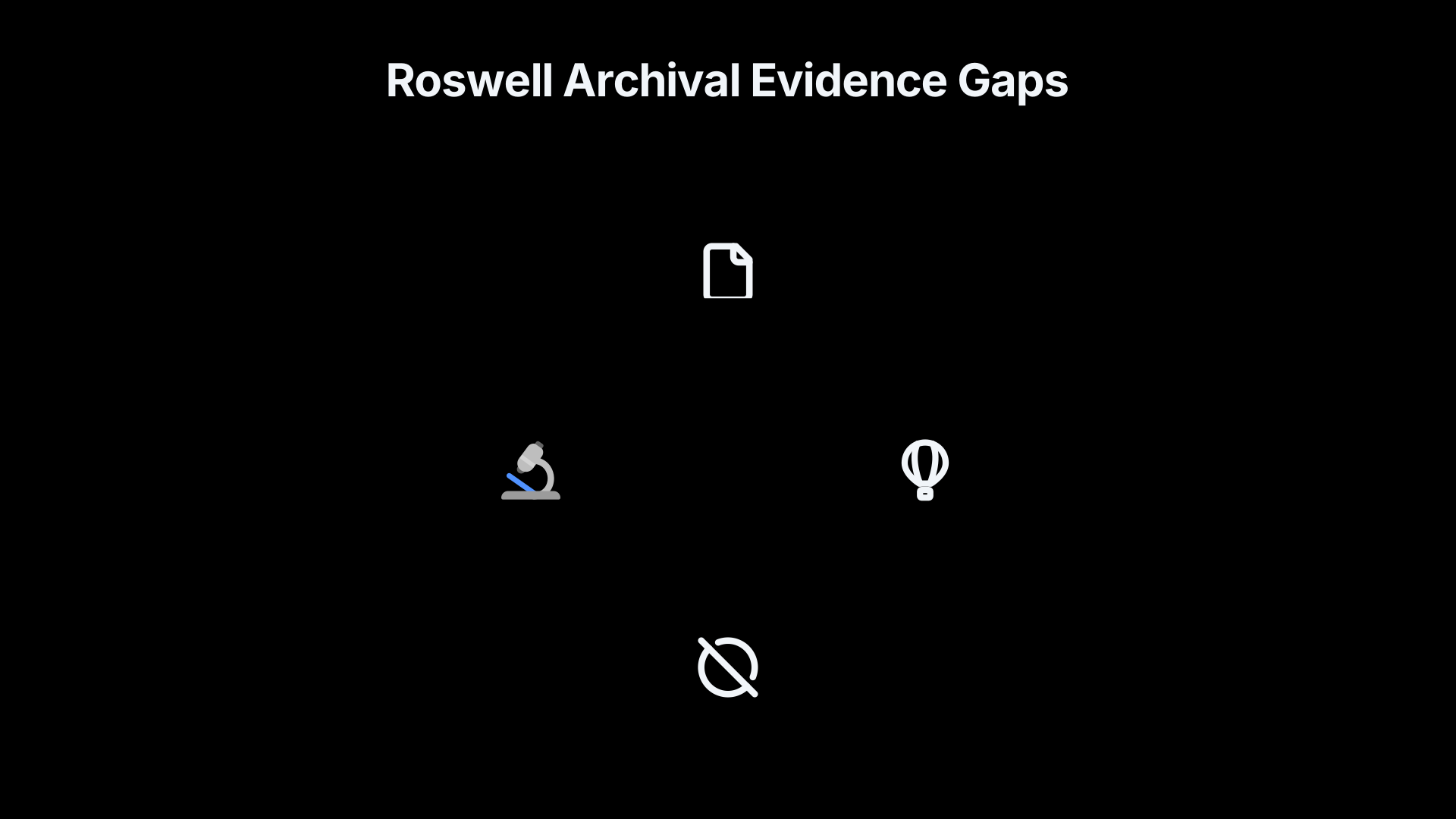
Roswell is the case where the absence of records has done the most cultural work. The GAO found that some Roswell Army Air Field records had been destroyed, including administrative records from March 1945 through December 1949 and outgoing messages from October 1946 through December 1949. The destruction form did not say who destroyed them, when, or under what authority. For UFO crash researchers, that is a real archival problem.[GovInfo]govinfo.govGAOREPORTS NSIADGAOREPORTS NSIAD
But missing records do not automatically support the strongest crash claim. The GAO also found that, under 1947 requirements, there was no requirement to prepare an air accident report for a weather-balloon crash, and it located only two 1947 records directly concerning the incident. Those two records supported a balloon-related recovery, not an extraterrestrial vehicle.[GovInfo]govinfo.govGAOREPORTS NSIADGAOREPORTS NSIAD
The later Air Force position widened the explanation. Its Roswell materials argued that debris came from Project Mogul, a balloon-borne research programme, and that later “alien body” accounts were probably conflations with later Air Force incidents, including high-altitude balloon dummy recoveries and real aircraft or balloon accidents. The Air Force summary explicitly states that reports of unusual military arrival-and-recovery activity were accurate descriptions of personnel engaged in high-altitude research balloon launch and recovery operations, but placed into the Roswell story later.[U.S. Air Force]af.milThe Roswell Report…
This is where search-and-rescue records become a guardrail against narrative drift. Roswell’s later body-recovery stories depend heavily on retrospective testimony and alleged hidden records. The official record trail, imperfect as it is, points to debris recovery and later archival gaps. It does not produce the kind of contemporaneous rescue log, medical chain, crash-scene cordon record or transport documentation that would be expected in a confirmed crash involving bodies.
How searches can leave a case unresolved
A failed search is not the same as a debunking. It simply narrows what can responsibly be claimed. Search-and-rescue records can leave a UFO crash case unresolved for several reasons.
First, search areas are imperfect. Witnesses may misjudge distance, angle, speed, splash location or terrain. A sea search is especially difficult: currents, darkness, weather, seabed conditions and delayed tasking can all break the link between the observed point and the searched point. Shag Harbour’s rescue trail is strong precisely because it shows serious effort, but the lack of recovered debris still prevents a firm physical conclusion.[Wikipedia]WikipediaShag Harbour UFO incidentShag Harbour UFO incident
Second, the record system may not have been built for the kind of event later claimed. Roswell is the clearest example. GAO’s review found that Army regulations required permanent retention of air accident reports, but Air Force officials said there was no 1947 requirement to prepare a report for a weather-balloon crash. If the original event was logged administratively as balloon debris, later researchers looking for an aircraft-style crash file may find a gap that feels suspicious but reflects the category used at the time.[GovInfo]govinfo.govGAOREPORTS NSIADGAOREPORTS NSIAD
Third, search records can be scattered across agencies. A single case may touch local police, military bases, rescue coordination centres, transport departments, civil aviation authorities, coast guards, archives and intelligence channels. Canada’s UFO collection is a good example of this dispersed structure: its records came from National Defence, Transport, the National Research Council and the RCMP, and the archive warns that date and location searches may be partial because the original documents were inconsistent.[Canada]canada.cas UFOs: The search for the unknowns UFOs: The search for the unknown
Fourth, later secrecy claims may attach themselves to ordinary operational opacity. A cordon, a military presence, a non-public memo or a missing box of files can all look dramatic in hindsight. Sometimes they may indicate withholding; sometimes they reflect normal defence bureaucracy, poor records management or the fact that an agency was never the primary custodian. The evidence standard has to remain the same: a claim of recovered craft needs a credible chain from search to recovery to custody, not merely a gap in the archive.
What a strong search trail should contain
A useful search-and-rescue trail in a UFO crash case does not need to answer every mystery. It needs to make the early response reconstructable. The strongest cases usually contain several of the following elements:
- A contemporary first report with time, location, caller identity or agency recipient.
- A stated operational reason for the response, such as suspected aircraft crash, marine emergency, fire, impact, radiation or debris.
- Identifiable responders, including police, rescue coordination staff, coast guard, military units, divers, aircraft crews or ground teams.
- Aircraft or vessel accounting, showing whether known craft were missing or accounted for.
- Search-area details, including shore points, woods, water sectors, dive locations, radar references or witness bearings.
- A result statement, such as debris found, no debris found, search suspended, object identified, or no trace located.
- A custody trail if anything was recovered, including who collected it, where it was sent and whether it was tested.
- Later archival continuity, meaning the original records can be found, cited and compared with subsequent claims.
By that measure, Shag Harbour has a stronger search trail than most UFO crash cases because it includes named official institutions, a rescue rationale, surface search, underwater search and unresolved result. Kecksburg has a partial trail: a real public event, search activity and later FOIA dispute, but no public chain of recovered material. Roswell has an extensive later archival review but a weak rescue trail for the more dramatic versions of the story, especially body-recovery claims.

Why search records matter more than dramatic testimony
The search record is not the whole truth of a UFO crash case, but it is the part least dependent on later storytelling. Testimony can be sincere and still drift over time. Press reports can simplify. Government explanations can be incomplete. Search-and-rescue records are valuable because they sit at the intersection of all three: they capture what witnesses triggered, what officials believed was urgent, and what practical work was actually done.
They also discipline the question. Instead of asking, “Was it alien?”, the better first questions are: What emergency was reported? Who responded? What did they search? What did they recover? What did they rule out? What records should exist if the strongest claim were true? In UFO crash cases, that shift is essential. It turns a legend into an audit trail.
The strongest search trails do not necessarily produce the most spectacular conclusions. Shag Harbour remains compelling because officials searched for something and did not identify it. Kecksburg remains disputed because the public record and local claims diverge. Roswell remains culturally powerful because a small documentary core, later missing records and expanding testimony have been repeatedly reinterpreted. In all three, the search-and-rescue record is not a side issue. It is the practical evidence line that shows where the case is grounded, where it is missing support, and where uncertainty genuinely remains.
Amazon book picks
Further Reading
Books and field guides related to What Search Operations Can Tell US. Use these as the next step if you want deeper reading beyond the article.
UFOs
Emphasizes documentary evidence, official records, witness evaluation, and government responses to unexplained incidents.
The UFO Experience
Focuses on case evaluation, evidence quality, and investigative methodology relevant to search and response records.
The Report on Unidentified Flying Objects
Discusses official investigations and how military and governmental inquiries handled unexplained reports.
The Skeptics' Guide to the Universe
Provides tools for evaluating evidence, reports, testimony, and unresolved claims in controversial cases.
eBay marketplace picks
Marketplace Samples
Live-tested eBay searches with available results related to this page.



Endnotes
1.
Source: canada.ca
Title: ‘s UFOs: The search for the unknown
Link:https://www.canada.ca/en/library-archives/collection/research-help/science-technology/ufos.html
2.
Source: Wikipedia
Title: Shag Harbour UFO incident
Link:https://en.wikipedia.org/wiki/Shag_Harbour_UFO_incident
3.
Source: govinfo.gov
Title: GAOREPORTS NSIAD 95 187
Link:https://www.govinfo.gov/content/pkg/GAOREPORTS-NSIAD-95-187/html/GAOREPORTS-NSIAD-95-187.htm
4.
Source: af.mil
Title: U.S. Air Force
Link:https://www.af.mil/The-Roswell-Report/
Source snippet
The Roswell Report...
5.
Source: Wikipedia
Title: Kecksburg UFO incident
Link:https://en.wikipedia.org/wiki/Kecksburg_UFO_incident
6.
Source: Wikipedia
Title: Roswell incident
Link:https://en.wikipedia.org/wiki/Roswell_incident
7.
Source: shag.com
Link:https://www.shag.com/
8.
Source: archives.gov
Title: presidential libraries
Link:https://www.archives.gov/research/topics/uaps/presidential-libraries
9.
Source: archives.gov
Title: Project BLUE BOOK
Link:https://www.archives.gov/research/military/air-force/ufos
10.
Source: nasa.gov
Link:https://www.nasa.gov/foia/nasa-e-libraries/headquarters-foia-library/
11.
Source: gao.gov
Title: nsiad 95 187
Link:https://www.gao.gov/products/nsiad
12.
Source: vault.fbi.gov
Link:https://vault.fbi.gov/search?SearchableText=ufo
13.
Source: youtube.com
Title: Canada’s Famous Officially Investigated UFO Incident | Shag Harbour UFO Incident
Link:https://www.youtube.com/watch?v=AffaetLkx2U
Source snippet
The Kecksburg UFO Case: Finally Solved After 60 Years?...
14.
Source: recherche-research.bac-lac.gc.ca
Link:https://recherche-research.bac-lac.gc.ca/eng/public/list/43130
15.
Source: abcnews.com
Title: ABC News NASA to search files for UFO incident
Link:https://abcnews.com/Technology/story?id=3785376&page=1
16.
Source: globalnews.ca
Link:https://globalnews.ca/news/3761270/canadas-best-documented-ufo-sighting-still-intrigues-50-years-on/
17.
Source: recherche-research.bac-lac.gc.ca
Link:https://recherche-research.bac-lac.gc.ca/fra/publique/liste/43130
18.
Source: recherche-research.bac-lac.gc.ca
Title: bac-lac.gc.ca Public research lists
Link:https://recherche-research.bac-lac.gc.ca/eng/public/search?topicId=5
19.
Source: sgp.fas.org
Link:https://sgp.fas.org/othergov/roswell.html
20.
Source: collectionscanada.gc.ca
Link:https://www.collectionscanada.gc.ca/databases/ufo/001057-110.01-e.php?PHPSESSID=7s3gu1hfmo1icf3uviansi35p1&brws_s=&q4=NS&sk=441
21.
Source: groseducationalmedia.ca
Link:https://www.groseducationalmedia.ca/vsc/canada6.html
22.
Source: toronto.citynews.ca
Link:https://toronto.citynews.ca/2017/09/21/canadas-best-documented-ufo-sighting-still-intrigues-50-years-on/
23.
Source: post-gazette.com
Link:https://www.post-gazette.com/breaking/2005/12/08/kecksburg-ufo-records-still-an-alien-concept/stories/200512080509
Additional References
24.
Source: youtube.com
Title: The Kecksburg UFO Case: Finally Solved After 60 Years?
Link:https://www.youtube.com/watch?v=3Ka9dOx7ZWY
Source snippet
'I do believe something happened': Search for answers about Kecksburg UFO in Pennsylvania...
25.
Source: nsa.gov
Link:https://www.nsa.gov/Helpful-Links/NSA-FOIA/Declassification-Transparency-Initiatives/FOIA-Reports-and-Releases/FOIA-Reports-and-Releases-List/igphoto/2002761379/
26.
Source: youtube.com
Link:https://www.youtube.com/watch?v=REsZcbglO3c
Source snippet
The Roswell Incident Mystery Finally Solved...
27.
Source: barringtonmunicipality.com
Link:https://www.barringtonmunicipality.com/Visiting-Us/shag-harbour-ufo-incident
28.
Source: facebook.com
Link:https://www.facebook.com/CanadianCoastGuard/posts/did-you-know-the-coast-guard-once-searched-for-a-possible-ufo-in-1967-residents-/1138213549994735/
29.
Source: facebook.com
Link:https://www.facebook.com/TravelChannel/posts/former-federal-agent-and-ufowitness-host-ben-hansen-sets-his-sights-on-kecksburg/10160932835078851/
30.
Source: phillyvoice.com
Link:https://www.phillyvoice.com/disclosure-day-ufo-encounters-kecksburg-pennsylvania/
31.
Source: hangar1publishing.com
Link:https://hangar1publishing.com/blogs/ufos-uaps-and-aliens/shag-harbour-incident?srsltid=AfmBOor1vYUtewuZlftM2c6OWCtOF4CH6ZZD4MB5zfrsHQQKPacCL8bS
32.
Source: theblackarchive.net
Link:https://theblackarchive.net/en/case/013
33.
Source: reddit.com
Link:https://www.reddit.com/r/UFOs/comments/11g3m0i/the_shag_harbour_ufo_crash_and_retrieval/
Topic Tree