Within UFO Crashes
How to Judge a UFO Crash Claim
A good evaluation starts with contemporary records, physical evidence, ordinary explanations, and what is actually missing.
On this page
- Start with the earliest records
- Look for recoverable material
- Test prosaic explanations first
Page outline Jump by section
Introduction
A UFO crash claim should be judged less like a mystery story and more like a recoverable incident: something came down, people responded, material remained, and records should exist. The strongest evaluation starts with the earliest records, then asks whether there is testable physical evidence, whether ordinary explanations have been ruled out, and what is actually missing. A dramatic witness account can be worth preserving, but it is not the same as wreckage with chain of custody, contemporary emergency logs, independent laboratory results and corroborating documents.
This matters because “UFO crash” claims sit at the point where speculation should become testable. A sighting may leave little more than memory or a poor image; a crash should leave traces. NASA’s 2023 UAP study made the broader problem clear: many reports are hard to analyse because they lack calibrated sensor data, multiple observations and usable metadata, and it found no conclusive peer-reviewed evidence that UAP have an extraterrestrial origin.[NASA Science]science.nasa.govNASA ScienceIndependent Study Team ReportAt present, analysis of UAP data is hampered by poor sensor calibration, the lack of multiple me…
Start with the earliest records
The first question is not “Could this be alien?” but “What did the earliest records say before the story had time to harden?” In a serious crash evaluation, contemporary documents carry more weight than later retellings: police logs, rescue coordination messages, military incident reports, air-traffic records, local press accounts, photographs taken at the time, landowner statements, hospital records, recovery inventories and weather data from the relevant date.
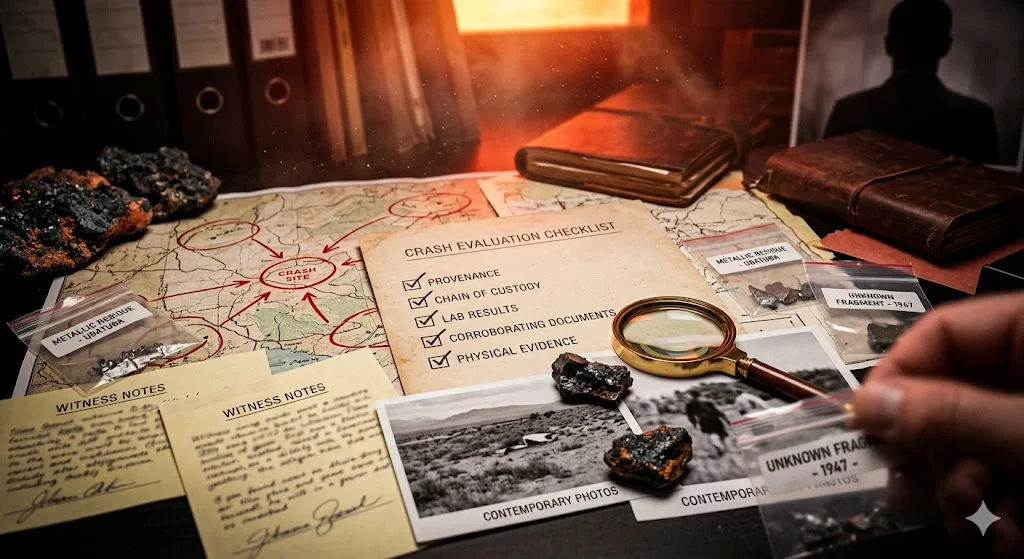
Roswell shows why chronology matters. The public legend grew into claims about bodies, autopsies, multiple crash sites and secret storage, but the documented 1947 core is narrower. The US Government Accountability Office found two 1947 records directly referring to the incident: a unit history saying the “flying disc” was later determined by military officials to be a radar-tracking balloon, and an FBI teletype saying the recovered object resembled a high-altitude weather balloon with a radar reflector. The GAO also found that some Roswell Army Air Field records had been destroyed under records-disposal procedures, which left a genuine gap, but it did not find records proving a recovered extraterrestrial craft.[GAO]gao.govNSIAD-95-187 Government RecordsNSIAD-95-187 Government RecordsJuly 28, 1995 — 28 Jul 1995 — The FBI message stated that the military had reported that an object rese…
That does not mean every official document is automatically correct. It means the first layer of evidence should be separated from later elaboration. A useful evaluation asks:
- What is the first known version of the claim? A same-day police report is stronger than a memoir written decades later.
- Did the earliest account mention a craft, bodies, symbols or unusual materials? If those details appear only years later, they need separate support.
- Were officials responding to an aircraft emergency, a public safety incident, a military security matter or a media panic? The reason for a response affects what records should exist.
- Are missing records specific and suspicious, or merely part of ordinary archival loss? Missing documents can justify caution, but they cannot by themselves prove the most extraordinary version of the story.
Shag Harbour in Nova Scotia is useful because it has a more clearly documented emergency-response core than many crash claims. Library and Archives Canada identifies the 4 October 1967 Shag Harbour case as an incident investigated by the Royal Canadian Mounted Police and Canadian Forces, and local accounts note that a Rescue Coordination Centre report described something hitting the water whose origin was unknown. The key point for evaluation is not that Shag Harbour proves an extraterrestrial crash; it is that a real search-and-response trail exists, while the absence of recovered material sharply limits what can be concluded.[LAC Recherche]recherche-research.bac-lac.gc.caLAC Recherche1967 Shag Harbour UFO Sighting and Related Research26 Sept 2024 — The Shag Harbour UFO sighting on 4 October 1967 is Canada'…
Look for recoverable material
A crash claim rises or falls on material evidence. If something physically crashed, there should in principle be wreckage, fragments, residue, biological material, impact marks, burn patterns, radar tracks, sonar contacts, photographs, transport records or laboratory reports. The question is not merely whether someone says debris existed; it is whether the material can be traced from recovery to testing without unexplained substitutions.
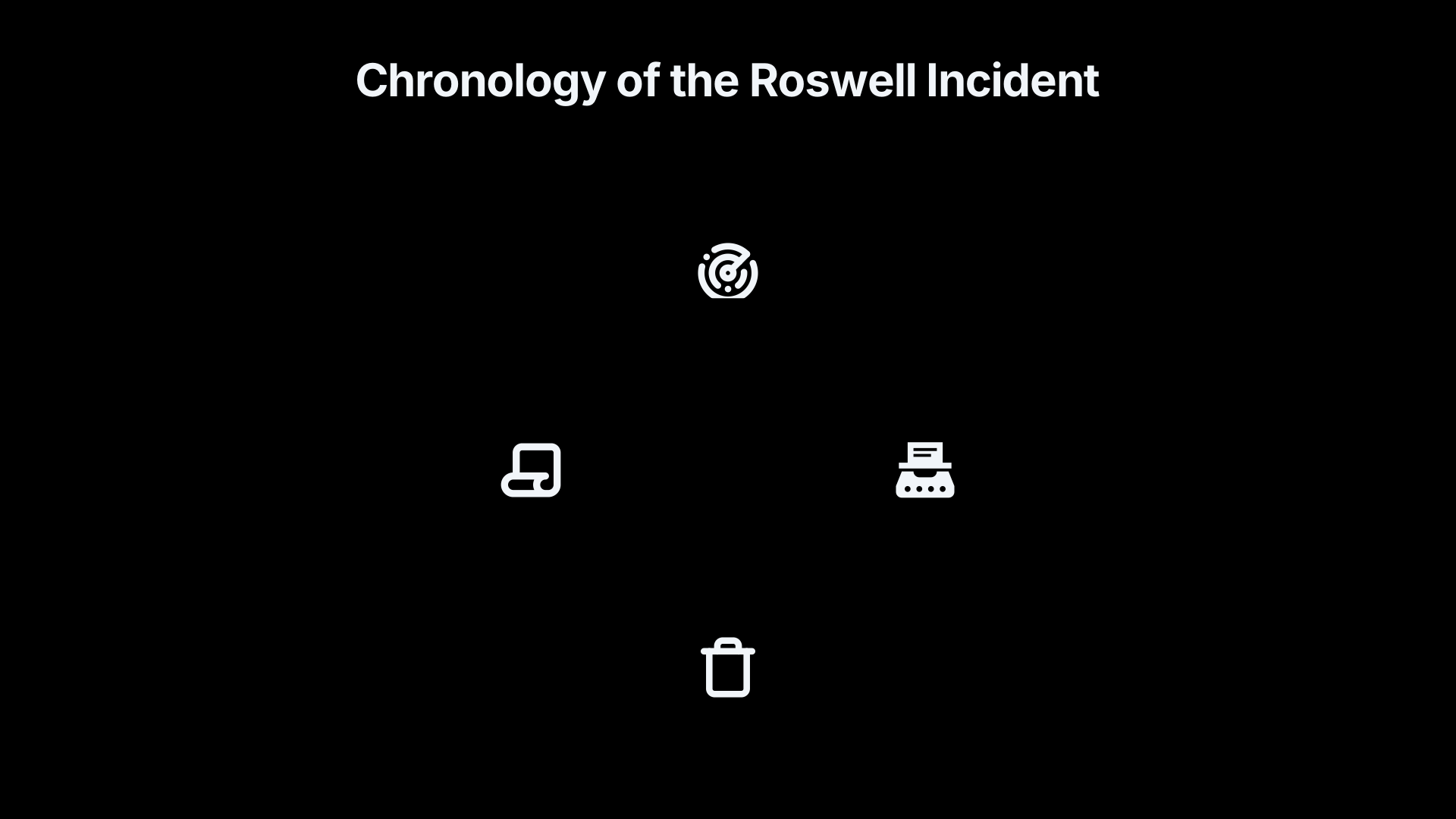
A good material-evidence test asks four things. First, provenance: who recovered it, where, when, and under what conditions? Secondly, chain of custody: who handled it, stored it, moved it and tested it? Thirdly, independent replication: can different qualified laboratories test the same or comparable samples? Fourthly, interpretation: do the results require an extraordinary origin, or are they compatible with known industrial, aerospace, military, meteoritic or environmental materials?
The Ubatuba magnesium fragments show why this standard is necessary. In a 2022 analysis of the famous Brazilian fragment, the magnesium isotope ratios were found to fall within terrestrial limits, while trace-element isotope results were inconclusive. That is exactly the kind of result evaluators must be ready to accept: laboratory work can narrow possibilities without producing the spectacular answer a claimant hoped for.[journalofscientificexploration.org]journalofscientificexploration.orgOpen source on journalofscientificexploration.org.
The same caution applies to alleged debris from better-known crash narratives. The US Air Force’s Roswell analysis argued that the debris was consistent with Project Mogul, a classified balloon programme using balloon trains and radar targets, rather than a recovered spacecraft. Later claims about alien bodies were addressed separately in the 1997 Air Force report, which argued that memories of high-altitude balloon tests, anthropomorphic dummies and other accidents from the 1950s had been compressed into a supposed 1947 body-recovery story.[U.S. Department of War]media.defense.govOpen source on defense.gov.(https://media.defense.gov/2010/Oct/27/2001330219/-1/-1/0/AFD-101027-030.pdf)
Material evidence should also be judged against what is missing. A small odd fragment with no secure recovery history is not equivalent to a wreckage field. A witness who says material was taken away is not equivalent to an inventory sheet, photographs, serial numbers, transfer orders and laboratory reports. The stronger the claimed event, the larger the expected documentary and physical footprint.
Test prosaic explanations first
A disciplined evaluation gives ordinary explanations the first serious attempt, not because they are always right, but because they are common. Balloons, aircraft, drones, satellites, meteors, re-entering space debris, military exercises, flares, hoaxes, misremembered events and sensor artefacts have repeatedly explained reports that initially looked strange.
Modern UAP case work gives practical examples. AARO’s public case-resolution page includes reports resolved as balloons, and one Al Taqaddum case was assessed with high confidence as a cluster of fully and partially inflated balloons rather than an anomalous object. In another case involving an object observed near Eglin Air Force Base, AARO said a meteorological or Mylar balloon would present similarly on electro-optical and infrared imagery, with reflective surfaces exaggerating apparent illumination.[AARO]aaro.milOpen source on aaro.mil.
For crash claims, prosaic testing should be concrete rather than dismissive. The evaluator should ask whether the date and location match:
- Balloon activity, including weather balloons, radar targets, research balloons and classified high-altitude programmes.
- Aircraft incidents, including military crashes, emergency landings, target drones and test ranges.
- Space events, including meteor fireballs and satellite or rocket-body re-entry.
- Military exercises, especially where witnesses saw lights, flares, divers, recovery teams or restricted-area activity.
- Local environmental effects, such as burning debris, swamp gas, marine foam, lightning-struck material or industrial dumping.
- Media feedback loops, where one dramatic report causes later witnesses to reinterpret ordinary memories.
Project Blue Book’s own definition of an “unidentified” case is a useful guardrail: a report was considered unidentified only when it apparently contained enough pertinent data to suggest a valid hypothesis, yet the object or motion still could not be correlated with known phenomena. That is very different from treating every incomplete or confusing account as extraordinary.[WHS ESD]esd.whs.milESDProject Blue BookESDProject Blue Book
The evaluator should also avoid a common mistake: “unidentified” does not mean “non-human technology”. The US Air Force’s Project Blue Book fact sheet says that sightings left unidentified did not provide evidence of extraterrestrial vehicles, and NASA similarly stressed that poor data quality is a central obstacle in UAP analysis. The honest category for many crash claims is not “solved as alien” or “debunked”; it is “insufficiently evidenced after ordinary explanations have been tested”.[U.S. Air Force]af.milOpen source on af.mil.
Separate witness value from witness limits
Witnesses matter, especially in crash claims where the first reports often come from residents, police, pilots, ranchers, sailors or rescue workers. A witness can establish that people saw lights, heard an impact, found debris, watched a search or encountered officials. But witnesses are not all doing the same evidential work. A person who saw an object descend is not the same as a person who handled material; a person who heard a second-hand story is not the same as a named first responder whose report exists in an archive.
The strongest witness evidence has several features: the witness is named, the account is close in time to the event, the role is clear, the statement is internally consistent, and it is corroborated by independent records. Multiple witnesses are more useful when they are independent of each other; they are less useful when they appear after press coverage, conferences, documentaries or local folklore has already shaped the story.
Roswell again illustrates the problem. The earliest documentary material concerns debris. Many of the most dramatic body-recovery claims emerged much later, and the Air Force’s 1997 report argued that events from different years had been consolidated in memory into a single 1947 narrative. That conclusion is disputed by some UFO researchers, but the evaluation principle is sound: later testimony should be compared against the earliest record, not allowed to rewrite it automatically.[U.S. Air Force]af.milOpen source on af.mil.
A careful evaluation does not mock witnesses. It asks what their testimony can actually support. A witness may be sincere and still mistaken about distance, scale, altitude, material, date or the meaning of official activity. The more extraordinary the claim, the more important it becomes to distinguish sincerity from verification.
Ask what a real crash should leave behind
A UFO crash claim is unusual because it implies a physical chain of events. Something travelled through airspace, lost control or broke apart, struck land or water, caused witnesses or sensors to notice, and was recovered or disappeared. That chain creates many opportunities for evidence.
A practical crash-claim review can be organised around expected traces:
Expected traceWhat to look forWhy it mattersBefore impactRadar data, air-traffic reports, pilot reports, weather records, satellite or meteor dataTests whether an object was actually present and moving as claimedAt impactPolice calls, fire logs, rescue dispatches, sound reports, ground scars, water disturbance, burn marksDistinguishes a crash from a light in the skyAfter impactSearch teams, divers, cordons, transport vehicles, military orders, photographs, local pressShows whether a real recovery operation occurredRecovered materialDebris inventory, chain of custody, lab reports, isotopic and metallurgical analysisDetermines whether physical evidence exists and what it isLong-term recordArchival files, declassified documents, consistent witness statements, independent reanalysisTests whether the claim survives outside folklore
The absence of one category is not always fatal. A water impact may leave little visible trace; classified activity may obscure some records; old files may be lost. But as absences accumulate, the claim should become more tentative. A crash story with no contemporary reports, no recoverable material, no documented search, no photographs, no records and only late testimony is weak even if it is culturally famous.
The Shag Harbour case shows the difference between a documented unknown and a proven extraordinary crash. There was a reported impact, an official response and an unsuccessful underwater search. That makes it more substantial than a purely anecdotal legend. But the search reportedly found no positive trace, so the case does not cross the threshold from “unidentified incident” to “recovered anomalous craft”.[LAC Recherche]recherche-research.bac-lac.gc.caLAC Recherche1967 Shag Harbour UFO Sighting and Related Research26 Sept 2024 — The Shag Harbour UFO sighting on 4 October 1967 is Canada'…
Treat secrecy claims as hypotheses, not evidence
Many UFO crash stories include claims that the decisive records or materials are hidden by governments, contractors or military units. Secrecy is plausible in a narrow sense: military programmes, test ranges, intelligence sensors and Cold War projects can be classified. Roswell’s Project Mogul explanation depends partly on that reality; a classified balloon programme could produce evasive public explanations without requiring an alien craft.[DAF History]dafhistory.af.milOpen source on af.mil.
But secrecy is not a blank cheque. A cover-up claim should still produce testable expectations. Which agency had custody? Which unit responded? Which contractor received material? What budget line, transport route, security order, storage site or technical programme would have been needed? Are the same names and documents independently corroborated, or do later authors cite each other in a loop?
AARO’s 2024 historical report is relevant because it directly reviewed claims of government involvement with UAP, including allegations about recovered extraterrestrial technology. Its public conclusion was that the office found no empirical evidence for claims that the US government or private companies had recovered or reverse-engineered extraterrestrial technology. Reuters summarised the report’s finding that many sightings were ordinary objects or phenomena, and that better-quality data could resolve more cases.[U.S. Department of War]media.defense.govOpen source on defense.gov.(https://media.defense.gov/2024/Mar/08/2003409233/-1/-1/0/DOPSR-2024-0263-AARO-HISTORICAL-RECORD-REPORT-VOLUME-1-2024.PDF)
That does not require a reader to accept every government conclusion uncritically. It does mean that a secrecy claim must do more than explain away missing evidence. The weaker version says, “The evidence is absent because it was hidden.” The stronger version identifies specific documents, witnesses, transfer chains or technical inconsistencies that can be checked.
Use a tiered credibility scale
The most useful outcome is often not a yes-or-no verdict, but a credibility tier. UFO crash claims vary widely: some have contemporary emergency records but no debris; some have alleged fragments but weak provenance; some have vivid testimony but no records; some are later reconstructions of ordinary military activity.
A practical scale might look like this:
Tier 1: Documented ordinary explanation. The event has contemporary records and a well-supported prosaic cause, such as a balloon, aircraft, meteor, re-entry or known test. Roswell, as assessed by GAO and the Air Force, is placed here by official investigators because the documentary record and material explanation point to balloon-related debris, though believers dispute that conclusion.[GAO]gao.govNSIAD-95-187 Government RecordsNSIAD-95-187 Government RecordsJuly 28, 1995 — 28 Jul 1995 — The FBI message stated that the military had reported that an object rese…
Tier 2: Documented incident, no extraordinary recovery. There are real records of a search, impact report or official response, but no recovered anomalous material. Shag Harbour fits this kind of cautious category: stronger than folklore, weaker than proof of a crashed craft.[LAC Recherche]recherche-research.bac-lac.gc.caLAC Recherche1967 Shag Harbour UFO Sighting and Related Research26 Sept 2024 — The Shag Harbour UFO sighting on 4 October 1967 is Canada'…
Tier 3: Physical sample with weak or disputed provenance. A fragment or residue exists, but the recovery story is uncertain, the chain of custody is incomplete, or testing is inconclusive. The Ubatuba fragment is a useful example because laboratory analysis did not establish a non-terrestrial origin.[journalofscientificexploration.org]journalofscientificexploration.orgOpen source on journalofscientificexploration.org.
Tier 4: Late testimony without recoverable evidence. Witnesses describe debris, bodies or recovery operations long after the alleged event, but there are no contemporary records or testable materials. These claims may be historically interesting, but they should not be treated as strong crash evidence.
Tier 5: Rumour, hoax or media artefact. The story rests on anonymous sources, copied internet claims, entertainment media, forged documents or circular citations. It may still be part of UFO culture, but it has little evidential value.
This kind of scale is fairer than assuming every case is either a hoax or a hidden alien recovery. It lets a reader say, “There was a real search,” “There is a real fragment,” or “There is a real archival gap,” without jumping to a conclusion those facts do not support.
Red flags that weaken a crash claim
Some warning signs appear repeatedly in weak UFO crash stories. None proves a claim false on its own, but several together should lower confidence.
A claim is weaker when the most dramatic details appear only decades later; when “documents” cannot be traced to an archive; when photographs show debris without a secure connection to the alleged site; when alleged material has no chain of custody; when witnesses disagree on basic facts such as date, location, number of bodies or recovery route; when ordinary explanations are dismissed without testing; or when the argument depends on saying that every missing piece was removed by a perfect cover-up.
Another red flag is an expanding narrative. A modest early report of debris becomes a crashed disc, then bodies, then multiple crash sites, then secret hangars, then reverse-engineering programmes. Each new layer needs its own evidence. It is not enough for a later claim to inherit credibility from the earliest incident.
Circular sourcing is especially common. One article cites a book, the book cites an interview, the interview repeats a local rumour, and later websites cite the whole chain as if it were independent confirmation. A strong evaluation follows each claim back to its earliest reachable source and asks whether that source actually says what later retellings claim.
What would change the assessment?
The evidential bar for a persuasive UFO crash claim is high but not mysterious. The most important development would be recoverable material with a secure chain of custody and results that independent laboratories could replicate. Extraordinary material would need more than unusual composition; it would need a demonstrated origin or manufacturing process not plausibly explained by known terrestrial, industrial, military or natural sources.
Strong documentation would also matter: original incident logs, recovery photographs, transport manifests, lab records, budget trails, named personnel records, contemporaneous correspondence and sensor data. NASA’s recommendation for better UAP study points in the same direction: calibrated instruments, multiple data streams and good metadata are essential if anomalous reports are to be moved from anecdote into analysis.[NASA Science]science.nasa.govNASA ScienceIndependent Study Team ReportAt present, analysis of UAP data is hampered by poor sensor calibration, the lack of multiple me…
The best current standard is therefore not “believe nothing” or “believe every witness”. It is to treat a crash claim as an evidence chain. The earliest records show how the story began. The physical evidence shows whether anything recoverable exists. Prosaic testing shows whether ordinary causes have been ruled out. The missing pieces show where uncertainty remains. A claim becomes stronger when each link holds independently; it becomes weaker when the links are supplied mainly by assumption, secrecy or retelling.
Amazon book picks
Further Reading
Books and field guides related to How to Judge a UFO Crash Claim. Use these as the next step if you want deeper reading beyond the article.
The Demon-Haunted World
Rating: 4.5/5 from 43 Google Books ratings
Provides a framework for evaluating extraordinary crash claims.
The Report on Unidentified Flying Objects
Demonstrates evidence standards in practice.
eBay marketplace picks
Marketplace Samples
Example marketplace items related to this page. Use the search link to explore similar finds on eBay.




Endnotes
1.
Source: science.nasa.gov
Link:https://science.nasa.gov/wp-content/uploads/2023/09/uap-independent-study-team-final-report.pdf
Source snippet
NASA ScienceIndependent Study Team ReportAt present, analysis of UAP data is hampered by poor sensor calibration, the lack of multiple me...
2.
Source: gao.gov
Title: NSIAD-95-187 Government Records
Link:https://www.gao.gov/assets/nsiad-95-187.pdf
Source snippet
NSIAD-95-187 Government RecordsJuly 28, 1995 — 28 Jul 1995 — The FBI message stated that the military had reported that an object rese...
Published: July 28, 1995
3.
Source: gao.gov
Title: nsiad 95 187
Link:https://www.gao.gov/products/nsiad
Source snippet
Results of a Search for Records Concerning the 1947...GAO provided information on the 1947 weather balloon crash at Roswell Army Air...
4.
Source: journalofscientificexploration.org
Link:https://journalofscientificexploration.org/index.php/jse/article/view/2415/1565
5.
Source: journalofscientificexploration.org
Link:https://journalofscientificexploration.org/index.php/jse/article/view/2415
6.
Source: aaro.mil
Link:https://www.aaro.mil/UAP-Cases/Official-UAP-Imagery/
7.
Source: aaro.mil
Link:https://www.aaro.mil/UAP-Cases/UAP-Case-Resolution-Reports/
8.
Source: aaro.mil
Link:https://www.aaro.mil/portals/136/PDFs/case_resolution_reports/Case_Resolution_of_Eglin_UAP_2508.pdf
9.
Source: esd.whs.mil
Title: ESDProject Blue Book
Link:https://www.esd.whs.mil/Portals/54/Documents/FOID/Reading%20Room/UFOsandUAPs/proj_b1.pdf?ver=2017-05-22-113513-837
10.
Source: esd.whs.mil
Link:https://www.esd.whs.mil/Portals/54/Documents/FOID/Reading%20Room/UFOsandUAPs/rosswe1.pdf
11.
Source: reuters.com
Link:https://www.reuters.com/technology/space/pentagon-ufo-report-says-most-sightings-ordinary-objects-phenomena-2024-03-08/
12.
Source: science.nasa.gov
Link:https://science.nasa.gov/uap/
13.
Source: nasa.gov
Title: update nasa shares uap independent study report names director
Link:https://www.nasa.gov/news-release/update-nasa-shares-uap-independent-study-report-names-director/
14.
Source: aaro.mil
Link:https://www.aaro.mil/
15.
Source: aaro.mil
Title: UAP Records
Link:https://www.aaro.mil/UAP-Records/
16.
Source: aaro.mil
Title: AARO Historical Record Report Vol 1 2024
Link:https://www.aaro.mil/Portals/136/PDFs/AARO_Historical_Record_Report_Vol_1_2024.pdf
17.
Source: esd.whs.mil
Title: Roswell Report Case Closed
Link:https://www.esd.whs.mil/Portals/54/Documents/FOID/Reading%20Room/UFOsandUAPs/RoswellReportCaseClosed.pdf?ver=2017-05-22-113519-430
18.
Source: esd.whs.mil
Link:https://www.esd.whs.mil/Portals/54/Documents/FOID/Reading%20Room/UFOsandUAPs/nas_re1.pdf?ver=2017-05-22-113513-883
19.
Source: archives.gov
Title: Project BLUE BOOK
Link:https://www.archives.gov/research/military/air-force/ufos
20.
Source: archive.org
Link:https://archive.org/stream/pdfy-4vyHjooOJagoGAwN/Scientific%2BStudy%2BOf%2BUnidentified%2BFlying%2BObjects_djvu.txt
21.
Source: space.com
Title: pentagon ufo office aaro historical report no emprical evidence alien technology
Link:https://www.space.com/pentagon-ufo-office-aaro-historical-report-no-emprical-evidence-alien-technology
22.
Source: space.com
Title: nasa ufo uap study team first results revealed
Link:https://www.space.com/nasa-ufo-uap-study-team-first-results-revealed
23.
Source: vault.fbi.gov
Title: Roswell UFO
Link:https://vault.fbi.gov/Roswell%20UFO
24.
Source: fbi.gov
Title: ufos and the guy hottel memo
Link:https://www.fbi.gov/news/stories/ufos-and-the-guy-hottel-memo
25.
Source: war.gov
Title: dod examining unidentified anomalous phenomena
Link:https://www.war.gov/News/News-Stories/Article/Article/3965403/dod-examining-unidentified-anomalous-phenomena/
26.
Source: war.gov
Title: dod report discounts sightings of extraterrestrial technology
Link:https://www.war.gov/News/News-Stories/Article/Article/3701297/dod-report-discounts-sightings-of-extraterrestrial-technology/
27.
Source: war.gov
Title: statement by pentagon press secretary maj gen pat ryder on the historical recor
Link:https://www.war.gov/News/Releases/Release/Article/3700894/statement-by-pentagon-press-secretary-maj-gen-pat-ryder-on-the-historical-recor/
28.
Source: recherche-research.bac-lac.gc.ca
Link:https://recherche-research.bac-lac.gc.ca/eng/public/list/43130
Source snippet
LAC Recherche1967 Shag Harbour UFO Sighting and Related Research26 Sept 2024 — The Shag Harbour UFO sighting on 4 October 1967 is Canada'...
Published: October 1967
29.
Source: media.defense.gov
Link:https://media.defense.gov/2010/Oct/27/2001330219/-1/-1/0/AFD-101027-030.pdf
30.
Source: af.mil
Link:https://www.af.mil/The-Roswell-Report/
31.
Source: af.mil
Link:https://www.af.mil/About-Us/Fact-Sheets/Display/Article/104590/unidentified-flying-objects-and-air-force-project-blue-book/
32.
Source: dafhistory.af.mil
Link:https://www.dafhistory.af.mil/Portals/16/documents/AFD-101201-038.pdf
33.
Source: media.defense.gov
Title: DOPSR 2024 0263 AARO HISTORICAL RECORD REPORT VOLUME 1 2024
Link:https://media.defense.gov/2024/Mar/08/2003409233/-1/-1/0/DOPSR-2024-0263-AARO-HISTORICAL-RECORD-REPORT-VOLUME-1-2024.PDF
34.
Source: Wikipedia
Title: Project Blue Book
Link:https://en.wikipedia.org/wiki/Project_Blue_Book
35.
Source: sgp.fas.org
Link:https://sgp.fas.org/othergov/roswell.html
36.
Source: britannica.com
Title: Project Blue Book
Link:https://www.britannica.com/topic/Project-Blue-Book
Additional References
37.
Source: youtube.com
Link:https://www.youtube.com/watch?v=VuCPbavls0U
Source snippet
Pre Sputnik UFOs Crash and Burn (w @MickWest)...
38.
Source: youtube.com
Title: Pentagon UFO files show no alien evidence, analyst says
Link:https://www.youtube.com/watch?v=Rn39Hhyk7WE
Source snippet
Ross Coulthart reveals the night that convinced him to investigate UFOs | Reality Check...
39.
Source: arxiv.org
Link:https://arxiv.org/abs/2305.18566
40.
Source: youtube.com
Title: Replay! NASA’s Release of the Unidentified Anomalous Phenomena Report
Link:https://www.youtube.com/watch?v=nuBMnluJfs0
Source snippet
Pentagon UFO files show no alien evidence, analyst says...
41.
Source: youtube.com
Title: Unidentified Anomalous Phenomena Independent Study Report
Link:https://www.youtube.com/watch?v=TQcqOW39ksk
Source snippet
Replay! NASA's Release of the Unidentified Anomalous Phenomena Report...
42.
Source: cia.gov
Link:https://www.cia.gov/readingroom/docs/CIA-RDP81R00560R000100060001-5.pdf
43.
Source: muller.lbl.gov
Link:https://muller.lbl.gov/teaching/physics10/Roswell/USMogulReport.html
44.
Source: cia.gov
Link:https://www.cia.gov/readingroom/docs/CIA-RDP81R00560R000100010008-3.pdf
45.
Source: nsa.gov
Link:https://www.nsa.gov/Helpful-Links/NSA-[FOIA
46.
Source: reddit.com
Link:https://www.reddit.com/r/UFOs/comments/1l288kz/new_us_platform_films_a_ufo_in_the_middle_east/
Topic Tree
Follow this branch
Parent topic
UFO CrashesRelated pages 29
- Debris Trail Can alleged debris survive the custody test?
- Earliest Records What did the first records actually say?
- Prosaic Checks What ordinary causes should be tested first?
- Shag Harbour Why Shag Harbour is strong but incomplete
- Ubatuba Test What did the Ubatuba fragments really prove?
- +1 more in sidebar